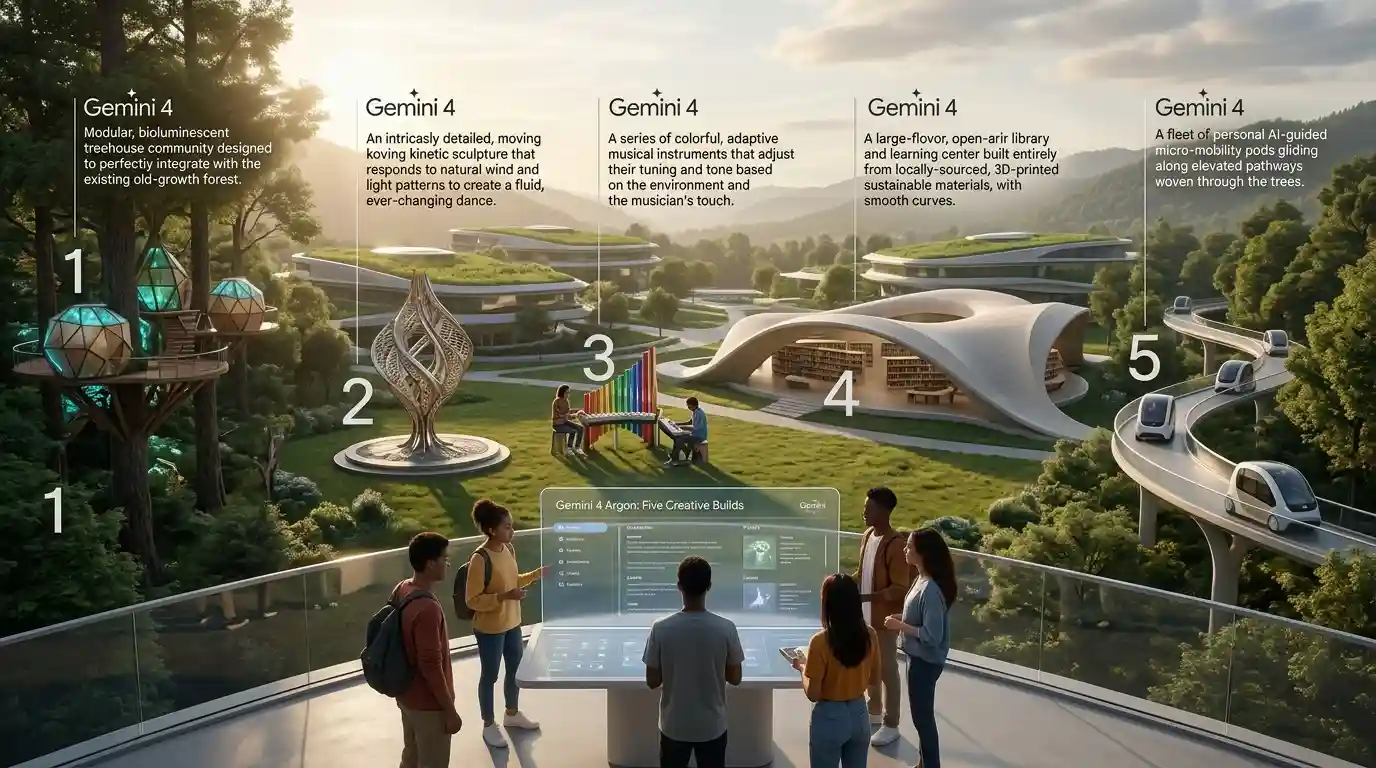

Google’s showcase of Gemini 4 Argon explores what happens when an AI model must do more than answer a single question. It presents five community projects combining reasoning, coding, visual interpretation and connected steps. Together, they show how an advanced AI model can help creators turn ambitious ideas into interactive digital experiences.
Why Gemini 4 Argon stands out
Creative software projects often require several skills at once. A developer may need to understand spatial relationships, write code, manage data and refine a visual result. Google describes Gemini 4 Argon as a model for complex, multi-step work, with spatial reasoning, mathematical precision and visual coding that support projects combining logic and design.
That combination matters because a promising idea often needs more than a text response. It may need a prototype that moves, reacts or displays information. In these examples, the model helps builders connect components instead of treating every stage as separate. The creator defines the goal and evaluates the result; the model assists with implementation.
A seaplane simulation brings motion to life
One builder used Argon to create a 3D seaplane simulation. The project combines the aircraft, water movement, reflections and lighting. These elements must work together: the plane should sit convincingly on the water, while the environment responds visually to motion and light.
Google presents this as a test of spatial reasoning and precision. Coordinating moving parts can be difficult, especially when a scene must look believable from different viewpoints. This demonstration shows how an AI coding assistant may help turn a visual concept into a working scene.
An interactive globe turns data into a story
Another project combines NASA’s live wildfire feed with seismic information from the U.S. Geological Survey. Its creator used Gemini 4 Argon in Antigravity to build an interactive 3D globe showing fire hotspots and animated tectonic shockwaves.
This is an interactive data visualization with a geographic dimension. A system must interpret incoming information, associate values with locations and present them in an explorable form. Instead of reading separate tables, viewers can use the globe to understand where events are happening. The showcase suggests a workflow for turning complex data into a clearer interface. Users should verify source data, update frequency and the meaning of each visual layer before relying on it for decisions.
A jet engine becomes an explorable model
A third builder combined Gemini 4 Argon with Blender and Three.js to create an interactive high-bypass turbofan engine simulation. The experience includes components, measurements and part-by-part specifications.
This AI-powered 3D modeling makes the machine more useful than a static illustration. Learners can explore how parts fit together, while developers can test ways to present technical information in 3D. Blender supports modeling, and Three.js can bring web-based scenes to life. Google says Argon helped with coding and the multi-step coordination needed to model separate elements and render them together. Such a prototype could support education or product demonstrations, provided experts check its technical details.
A single image inspires a Victorian carriage
The fourth build starts with one image: a Gothic Victorian carriage. Its creator asked Argon to turn that flat reference into an interactive 3D experience. The scene includes functioning doors and windows, flickering oil lamps, and an undercarriage that reacts to road bumps.
This workflow uses an image as a starting point, then develops it into an environment viewers can inspect. The model interprets visible shapes and infers how features might work. Those inferences can help a creator begin, but they cannot replace reliable references when historical or engineering accuracy matters. Creators should review and refine the result, and describe it as a digital interpretation when appropriate.
A multiplayer game demonstrates connected features
The final project, “Backyard Rascals,” is a browser-based multiplayer game featuring cartoon animals in a capture-the-flag contest. Players run, collide, hit one another and celebrate as they compete in real time.
A multiplayer game involves more than character design. It needs controls, rules, collisions and a way for players to participate together. This example shows how a creator can use an AI model to coordinate features across a larger project. It also explains why testing matters: responsive controls, fair gameplay and reliable connections shape the experience. Argon can assist with building blocks, but creators must check performance, accessibility and safe interactions before sharing widely.
What builders can take away
These projects suggest that Gemini 4 Argon may help when a task combines coding with visual reasoning, data interpretation or dependent steps. Start with a clear goal. Break it into smaller tasks, provide relevant references or data, and review each result before proceeding. This makes errors easier to spot and gives the builder control over the final experience.
The examples also show why tool choice matters. Antigravity, Blender and Three.js appear in the builds, while NASA and USGS data support the globe. An AI model can help connect tools, but it cannot make every input accurate or every output production-ready. Creators should confirm data rights, inspect generated code, test interactions and validate technical claims. Creators must still review outputs.
Availability and practical expectations
Google says Gemini 4 Argon is globally available to developers and enterprises through the API in AI Studio and the Gemini platform. The post also lists access for eligible Google AI Ultra and paid Pro subscribers in Google Antigravity, the Gemini app and AI Mode in Search.
These community builds make Gemini 4 Argon’s capabilities easier to picture. A moving seaplane, live-data globe, explorable engine, image-inspired carriage and multiplayer game each demonstrate a different way an AI model can support creative development. The lesson is not that AI replaces a builder. It can help turn complex ideas into testable prototypes, while human judgment, verification and iteration remain essential.
Source: Google’s Gemini 4 Argon builders article