
Apple’s first foldable iPhone is attracting attention for its design, but battery details may matter just as much to people considering a large-screen phone. The European Union’s energy-label database lists the iPhone Duo with a 4,883mAh battery and a rating of 1,000 charging cycles before the battery reaches 80% of its original capacity. The same label reports 51 hours and 30 minutes of endurance per charge cycle.
Those figures offer a useful starting point for comparing Apple’s foldable with Android rivals. They do not, on their own, tell us exactly how long the phone will last in everyday use. Battery capacity, software efficiency, screen habits, charging patterns, and the way a device is tested all affect the experience.
What the iPhone Duo battery specifications say
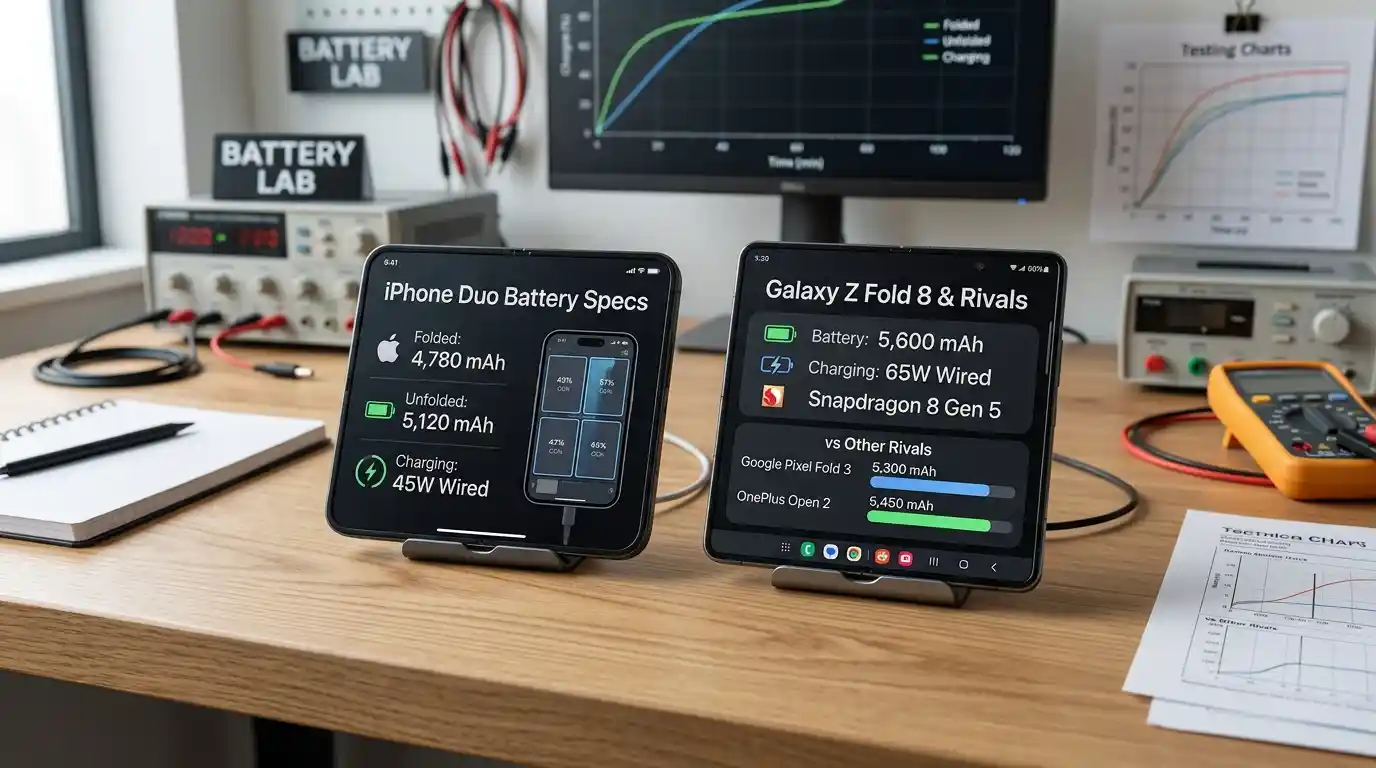
According to the EU energy-label information reported by Android Authority, the iPhone Duo has a listed battery capacity of 4,883mAh. The label also gives it a cycle-life rating of 1,000 cycles and a per-cycle endurance figure of 51 hours and 30 minutes.
These measurements describe different things. The capacity figure indicates how much charge the battery can store under the stated measurement standard. The cycle rating estimates how many full-equivalent charge cycles the battery can go through before its remaining capacity falls to 80%. The endurance figure represents the database’s standardized estimate for use between charges.
It is important not to treat these numbers as a promise that every owner will get the same results. Real-world battery life changes with display brightness, mobile signal, camera use, gaming, multitasking, background activity, and temperature. A foldable also gives people a larger screen to use, which can increase power demand during some tasks.
How large is 4,883mAh for a foldable phone?
On paper, 4,883mAh gives the iPhone Duo a substantial battery for a foldable device. The Android Authority report compares it with the Galaxy Z Fold 8, whose battery is listed at 4,660mAh rated capacity and 4,800mAh typical capacity. It also cites larger battery figures for two other wide-foldable models: 6,000mAh for the Xiaomi 18 Fold and 5,300mAh for the HUAWEI Pura X Max.
However, capacity comparisons need context. Manufacturers and databases may report typical and rated capacities differently. A typical capacity can describe an expected or nominal value, while rated capacity can represent a minimum value under specified conditions. That difference explains why two numbers for one phone do not necessarily conflict.
Battery capacity also does not equal battery life. A phone with fewer milliamp-hours can last longer if its processor, display, operating system, and apps use energy efficiently. Conversely, a larger battery may not deliver a longer day if the phone powers a large, bright screen or demanding software. The most useful comparison combines capacity with endurance testing and, once a phone reaches customers, independent real-world testing.
Charging-cycle ratings: what 1,000 cycles means
A charging cycle does not necessarily mean one trip from zero to 100%. Instead, a cycle generally represents using an amount of charge equal to the battery’s full capacity, even if that use happens across several partial discharges and recharges. For example, two separate uses of roughly half the battery can add up to one full-equivalent cycle.
The iPhone Duo’s 1,000-cycle rating means the EU label expects the battery to retain at least 80% of its original capacity through that number of cycles under the prescribed evaluation. It does not mean the battery suddenly stops working at cycle 1,001. Rather, the rating describes a degradation threshold, not an expiration date.
This distinction matters when people compare foldable phone battery life. Samsung’s Galaxy Z Fold 8 is rated for 1,200 cycles in the same report. That gives the Samsung a higher stated cycle count, but a cycle rating alone does not guarantee that each owner will see better long-term battery performance. Usage patterns and temperature can influence degradation, and standardized ratings may not perfectly predict every individual’s experience.
The endurance comparison with Samsung
The reported EU figures list 51 hours and 30 minutes of endurance per cycle for the iPhone Duo and 49 hours and 10 minutes for the Galaxy Z Fold 8. Those figures suggest that the iPhone Duo could last longer between charges in the database’s test, despite its lower battery capacity than the Galaxy’s typical figure.
The same report points to Apple’s close integration between its hardware and software as a possible reason for the endurance result. That is a plausible factor, but it should not be read as proof that the iPhone Duo will outperform Samsung in every situation. Different apps, network conditions, display settings, and testing methods can change the outcome.
Multiplying the reported endurance by the cycle rating gives a rough way to illustrate the trade-off: about 51,500 hours for the iPhone Duo and about 59,000 hours for the Galaxy Z Fold 8 before reaching the 80% capacity threshold. These are arithmetic projections based on the listed figures, not real-life guarantees or predictions of how many years a phone will last. Actual use does not follow a perfectly repeated laboratory cycle.
What the numbers mean for everyday users
For shoppers, the iPhone Duo’s battery story is a balance of endurance and longevity. Its listed per-cycle endurance figure is higher than the Galaxy Z Fold 8’s, while its cycle rating is lower. Someone who values longer time between charges may focus on endurance testing. Someone who plans to keep a phone for many years may pay closer attention to battery degradation, repair options, and replacement costs as well.
The design of a foldable adds another consideration. People often buy these phones to read, watch videos, use multiple apps, or work on a larger inner display. Those activities can consume more power than light messaging or short calls. So a 4,883mAh battery may feel adequate for one person and less impressive to another, depending on how often they unfold the device and what they do on its screen.
It is also worth waiting for independent battery tests before drawing a firm conclusion. Regulatory labels make model comparisons easier, but reviewers can test screen-on time, video playback, web browsing, standby drain, and charging behavior under repeatable conditions. Those results can show whether a phone’s stated endurance translates into consistent day-to-day performance.
How to support battery health over time
Owners can take a few practical steps to reduce unnecessary battery stress. Avoid leaving a phone in very hot environments, since heat can accelerate battery aging. Use charging accessories that match the phone’s specifications, and check the device’s battery-health settings for charging limits or optimized charging features. These settings may help manage charging behavior, though they cannot prevent normal battery aging.
People should also avoid making a single charging habit into a strict rule. Battery health depends on the combined effects of temperature, usage, charging behavior, and time. Keeping the phone cool and using reliable accessories are sensible habits; obsessively avoiding every full charge is not necessary for most users.
When the iPhone Duo launches and reaches independent reviewers, long-term testing will provide a clearer picture of how its battery performs beyond regulatory figures. Until then, the available data indicates a sizeable battery, a notable endurance estimate, and a cycle rating that trails the one reported for the Galaxy Z Fold 8.
Bottom line
The iPhone Duo’s EU-listed 4,883mAh battery looks competitive, especially when considered alongside its 51-hour-and-30-minute endurance estimate. Its 1,000-cycle rating, however, is lower than the Galaxy Z Fold 8’s reported 1,200 cycles. That contrast makes the key takeaway straightforward: capacity, time between charges, and long-term battery durability are related, but they are not interchangeable measures.
The published figures make the iPhone Duo a promising battery contender, not a confirmed winner. Independent testing and real-world use will show how Apple’s foldable balances its large display, software efficiency, and battery aging over time.