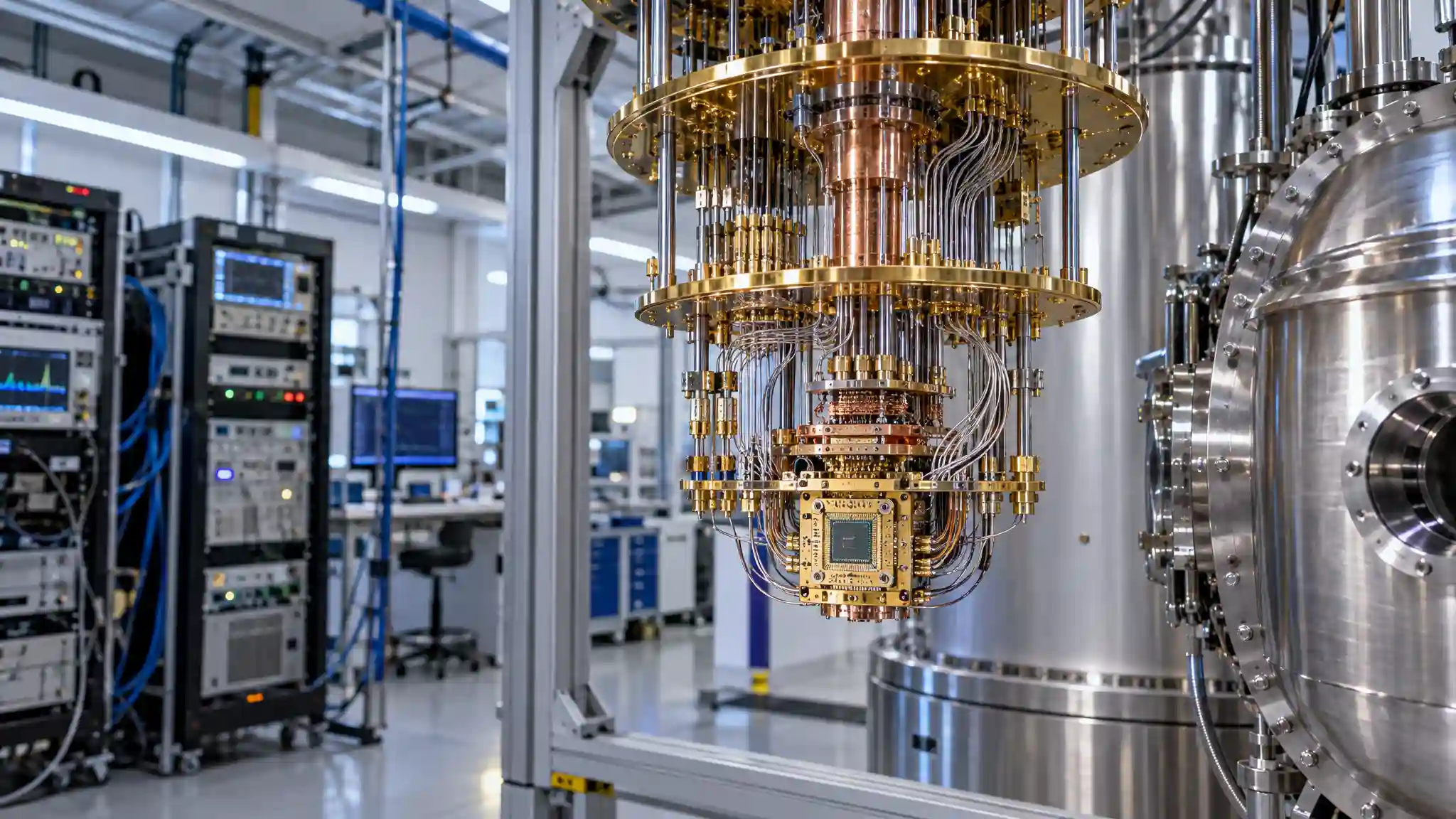

Quantum computing needs more than impressive chips. It needs reliable ways to perform useful operations without letting errors overwhelm the calculation. Google Quantum AI has reported progress on that challenge by demonstrating magic state cultivation on its Willow processor. The technique targets a demanding preparation process that can consume much of a future quantum computer’s resources.
According to Google’s October 2026 announcement, the experiment reduced errors approximately fortyfold compared with uncultivated states and produced T-states with 99.99% logical fidelity. These results mark an engineering milestone, not the arrival of a commercially useful universal quantum computer.
Why Quantum Computers Need Magic States
A quantum processor must support an appropriate collection of operations to execute general quantum programs. Protecting those operations against noise adds another layer of difficulty. Researchers use quantum error correction to safeguard information, but that protection does not make every required operation equally straightforward.
Magic states provide a resource for implementing operations that an otherwise restricted toolkit cannot supply. Think of them as specially prepared ingredients: the computer consumes them while carrying out particular steps in a calculation. Once an operation uses a magic state, the machine cannot simply recycle that same state for another operation.
This constant demand creates a production problem. A powerful processor needs both reliable computational resources and a practical supply of these consumable states.
The Resource Problem Behind the Breakthrough
Google notes that some estimates assign as much as 95% of a quantum computer’s capacity to magic state production. That figure describes particular resource estimates, not a fixed rule for every architecture or algorithm. Nevertheless, it illustrates why researchers care about reducing preparation overhead.
If supporting infrastructure occupies most of the machine, relatively little capacity remains for the intended program. Improving state preparation could therefore change the balance between maintaining a computation and actually performing it.
Magic state cultivation addresses this imbalance by pursuing cleaner states through a carefully coordinated process. Its significance lies in resource efficiency as well as accuracy: better preparation methods could help researchers design smaller machines for demanding future tasks.
How Magic State Cultivation Works
The protocol starts by injecting a noisy state into a small region of a quantum chip. Researchers then perform coordinated measurements that look for evidence of errors. They reject flawed attempts instead of allowing unreliable states to continue through the process.
Google compares this approach to a filter. The team progressively cultivates a high-quality state while adapting it into a larger encoding that can support subsequent computation. This combination links state preparation with the protective structures that a working quantum architecture requires.
Craig Gidney, Noah Shutty, and Cody Jones developed the approach in 2024 after refining an idea from earlier research. Moving from that theoretical proposal to hardware required additional advances in control, measurement, and experimental design.
What Willow Demonstrated in Practice
On the Willow processor, Google’s team demonstrated a fortyfold error reduction relative to states without cultivation. The reported T-state logical fidelity reached 99.99%, providing evidence that the method can produce exceptionally accurate states on actual hardware.
That fidelity describes the prepared logical states, not the accuracy of every operation across an entire quantum computer. Likewise, the error reduction does not mean that Willow suddenly runs all programs forty times faster. Keeping these distinctions clear helps readers understand the achievement without overstating it.
For fault-tolerant quantum computing, reliable resource preparation matters because complex programs depend on many successful operations. This experiment strengthens one essential part of that broader engineering effort.
Why Better Measurements Mattered
The researchers also encountered a measurement problem that initially made the results appear physically inconsistent. Emma Rosenfeld investigated the discrepancy through simulations, discussions, and repeated checks. The team eventually traced it to an incorrect assumption in its benchmarking technique.
Electrical equipment drift and temperature variation introduced noise that undermined the benchmark’s validity. Researchers responded by adding control measures and developing a different benchmarking approach that used cultivation to help characterize itself.
This episode highlights an easily overlooked lesson: improving quantum hardware also requires improving how scientists evaluate it. A convincing performance claim depends on measurements that remain trustworthy under real laboratory conditions.
Connecting Color Codes and Surface Codes
Useful states must move into the structures that support the rest of a computation. Google therefore tested a grafting protocol that transferred states from a distance-3 color code to a distance-5 surface code.
Color codes and surface codes represent different approaches to protecting quantum information. Demonstrating a connection between them shows how a cultivation-friendly encoding can interface with another part of the architecture. It provides an integration result rather than proof that every scaling challenge has disappeared.
What Comes Next for Quantum Computing
Google still needs to demonstrate cultivation at larger scales. Researchers must establish how efficiently the process operates as systems grow and how well it supports longer computations. The present experiment does not establish a timetable for practical applications.
Its contribution is more specific and more useful than a sweeping prediction: a promising theoretical method now works on hardware. By improving magic state preparation and testing compatibility with error-correcting codes, the team has advanced the infrastructure that future universal quantum computing will require.
The next meaningful tests will connect state quality with production throughput, transfer reliability, and overall resource requirements. Those measurements will help determine whether laboratory improvements translate into more economical architectures, rather than merely better results for an isolated component.