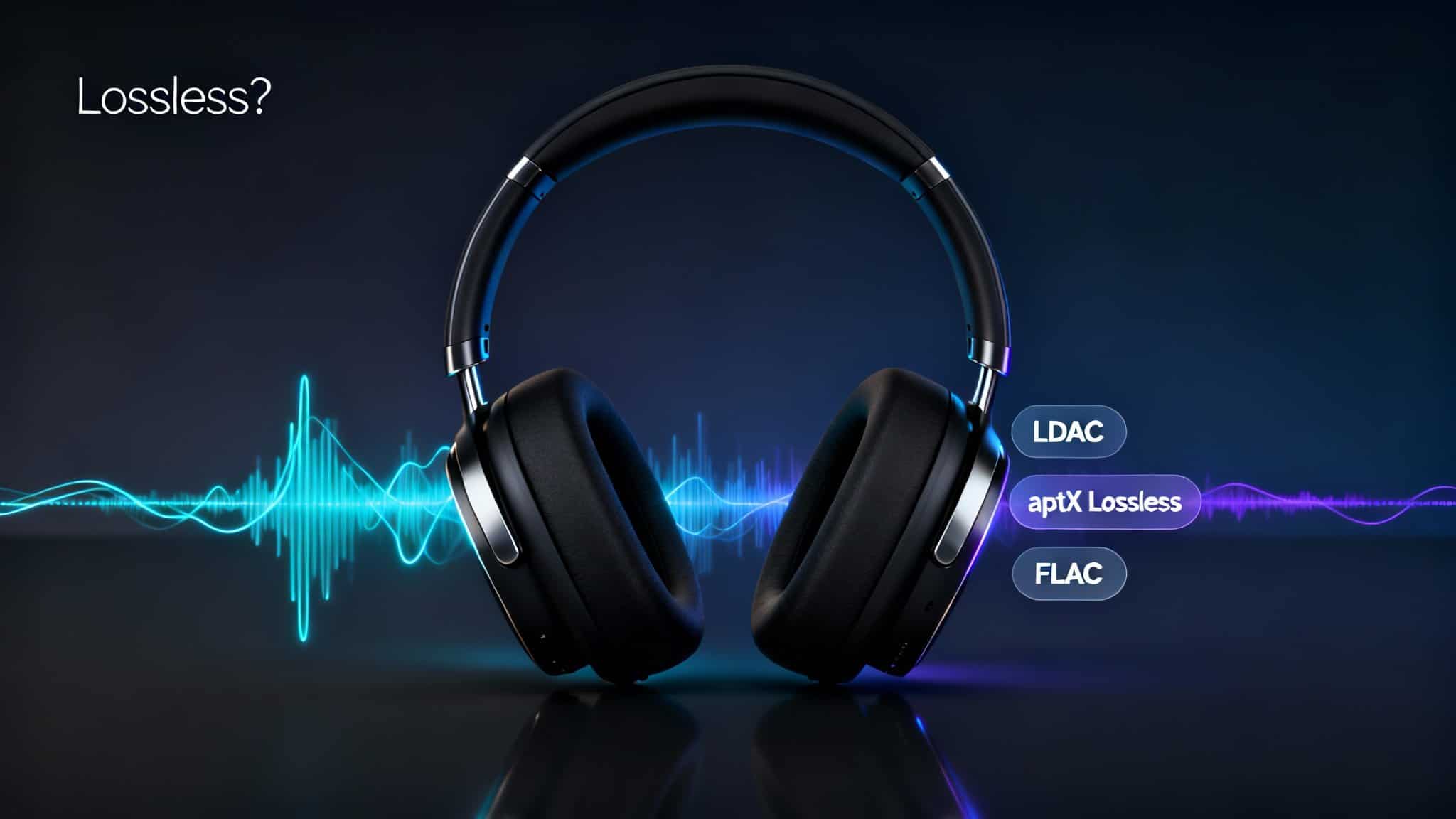

“Is lossless audio possible on wireless headphones?” is a question that keeps surfacing as streaming platforms push high‑resolution audio and consumers move increasingly toward cable‑free listening. At first glance, “lossless” and “wireless” sound contradictory. Traditional Bluetooth transmission applies compression to fit audio within limited bandwidth, implying some information loss. However, advances in codecs, hardware, and new transport layers are narrowing the gap. This article explains what “lossless” actually means, how wireless audio works, where current limitations lie, and what you can do today to get as close as possible to truly lossless wireless playback.
What does “lossless” mean?
Lossless audio refers to a digital representation that preserves the original PCM data bit‑for‑bit from the mastering source. Common lossless formats include FLAC, ALAC, WAV, and AIFF. They may be uncompressed (WAV/AIFF) or compressed without losing data (FLAC/ALAC). Typical bitrates:
- CD quality: 16‑bit/44.1 kHz ≈ 1,411 kbps
- Hi‑res: 24‑bit/48 kHz ≈ 2,304 kbps
- Hi‑res: 24‑bit/96 kHz ≈ 4,608 kbps and higher
To be truly “lossless,” the entire chain—file, player, operating system mixer, transport, receiver, DAC, and analog stage—must avoid lossy operations and resampling.
How Bluetooth audio works
Bluetooth audio, used by most wireless headphones, transmits using codecs that compress PCM into a lower‑bitrate stream:
- SBC: Baseline codec; lossy; variable up to ~345 kbps typical.
- AAC: Efficient for Apple devices; still lossy, ~256–320 kbps common.
- aptX/aptX HD: 352–576 kbps; psychoacoustic compression; not bit‑perfect.
- aptX Adaptive/Lossless: Adaptive from ~140 kbps up to 1,200 kbps peak under ideal RF conditions; “lossless” claim applies up to 16‑bit/44.1 kHz only and not guaranteed at all times.
- LDAC: Up to 990 kbps; three modes (330/660/990 kbps). Still lossy; higher modes approach transparency for many listeners, but not bit‑perfect.
- LC3 (LE Audio): More efficient successor to SBC; focuses on quality at lower bitrates and robustness; not inherently lossless.
Because these codecs discard or reshape data to fit within bandwidth constraints, classic Bluetooth A2DP has historically been incompatible with bit‑perfect lossless audio. Even if a service provides FLAC, your phone typically decodes to PCM and recompresses into a Bluetooth codec before sending.
Where do “lossless claims” come from?
A newer development is Bluetooth LE Audio and proprietary modes like aptX Lossless (part of Snapdragon Sound). Qualcomm’s aptX Lossless can, under favorable conditions, deliver CD‑quality audio (16‑bit/44.1 kHz) without loss by dynamically allocating up to ~1,200 kbps. But this is highly conditional:
- Both phone (SoC) and headphones must support aptX Lossless.
- RF environment must support the max bitrate; it can scale down seamlessly, potentially becoming lossy.
- Only CD quality (not hi‑res) is targeted for bit‑perfect transmission.
Some vendors market “lossless over Bluetooth” but the fine print often means “near‑lossless,” “perceptually lossless,” or “conditionally lossless at 16/44.1.” For higher sample rates and bit depths, today’s Bluetooth implementations still rely on lossy compression.
Non‑Bluetooth wireless pathways
Beyond Bluetooth, there are other wireless transports:
- Wi‑Fi streaming (AirPlay 2, Chromecast, proprietary 2.4 GHz links): Wi‑Fi offers far more bandwidth than Bluetooth, making genuine lossless—and even hi‑res—possible in theory. However, most true wireless earbuds don’t implement Wi‑Fi due to power and complexity constraints. Over‑ear headphones with dedicated transmitters (gaming, home theater) sometimes use 2.4 GHz lossless or near‑lossless links.
- Ultra‑wideband and future transports: Emerging radios may allow low‑latency, high‑bandwidth links suited for lossless audio, but mainstream consumer headphones haven’t standardized around them yet.
The real bottlenecks in wireless lossless
- Bandwidth and robustness: Lossless 16/44.1 needs ~1.4 Mbps raw; after overhead and error correction, your link must be consistently higher. Bluetooth Classic typically can’t guarantee that. Newer schemes improve efficiency but face RF interference.
- Power and latency: Higher bitrates consume more energy and can increase latency. Headphones prioritize battery life, connection stability, and lip‑sync, often at the expense of raw bitrate.
- Platform mixing: Mobile OS mixers may resample or process audio before the link, eroding bit‑perfect behavior.
- DSP in headphones: ANC, EQ, spatial processing, and crossfeed can resample internally. While that doesn’t necessarily reduce perceived quality, it may break “bit‑perfect” purity.
How close can wireless get to lossless today?
For many listeners, high‑bitrate LDAC (990 kbps) or aptX Adaptive at its higher operating range can sound indistinguishable from lossless with typical content, especially in real‑world environments where noise floors and ANC are in play. “Transparency” is a psychoacoustic threshold—if you can’t reliably ABX test a difference, the practical outcome is the same as lossless for your ears. However, purists who demand bit‑perfect transmission should note:
- Conditional CD‑quality lossless via aptX Lossless is possible with compatible phones and headphones, but it isn’t universal or guaranteed moment to moment.
- Hi‑res lossless over Bluetooth is not currently delivered bit‑for‑bit.
- Wi‑Fi or proprietary 2.4 GHz systems can be truly lossless but are uncommon in TWS earbuds and are more often found in home listening setups or specialized headsets.
Best practices to maximize wireless sound quality
- Choose the right codec pairing:
- Android: Use LDAC at 990 kbps if your headphones and phone support it; lock the mode in developer settings when possible.
- Snapdragon chain: If both ends support Snapdragon Sound with aptX Lossless, enable it for potential CD‑quality lossless.
- Apple ecosystem: AAC is optimized; while not lossless, it’s efficient and stable. Consider AirPlay to a stationary system for true lossless at home.
- Optimize your environment:
- Keep line‑of‑sight; minimize interference from crowded 2.4 GHz/5 GHz environments.
- Avoid pockets or bags that attenuate the signal; wear the source device on the same side as the headset antenna when possible.
- Start with lossless sources:
- Use FLAC/ALAC locally or enable “lossless”/“hi‑res” settings in streaming apps. Even if the link compresses, higher‑quality input helps downstream encoders perform better.
- Manage device processing:
- Disable system EQ, loudness normalization, and crossfeed if you want the cleanest chain.
- On Android, set “Disable absolute volume” only if you understand the gain staging; otherwise leave defaults for better SNR.
- Consider wired when quality matters most:
- Many wireless headphones support USB‑C audio or analog via a cable. USB‑C digital can deliver bit‑perfect hi‑res and bypass radio bandwidth constraints entirely. It’s the simplest way to guarantee lossless with the same headphones.
The future of lossless wireless
As silicon advances, we can expect:
- More efficient codecs approaching or achieving bit‑perfect CD quality at stable, real‑world bitrates.
- Wider adoption of LE Audio with LC3plus variants, potentially enabling higher fidelity at lower power.
- Hybrid radios and intelligent rate control that favor lossless when RF conditions permit, gracefully falling back without audible artifacts.
- Wi‑Fi‑enabled headsets in niche or premium segments for home listening, where battery and latency pressures are lower.
Bottom line
- Strict, bit‑perfect lossless over Bluetooth remains limited and often conditional to CD quality with specific hardware (e.g., aptX Lossless).
- Hi‑res lossless over typical Bluetooth is not yet truly lossless.
- In practice, high‑bitrate LDAC or aptX Adaptive can be audibly transparent for most listeners.
- For guaranteed lossless, use wired (USB‑C or analog from a competent DAC) or Wi‑Fi/proprietary links where available.
If your goal is the absolute highest fidelity without compromise, a wired connection still wins today. If your goal is excellent, arguably indistinguishable sound in daily use, the best modern wireless stacks can get you extremely close—often to the point where the recording, mastering, and headphone tuning matter more than the transport itself.