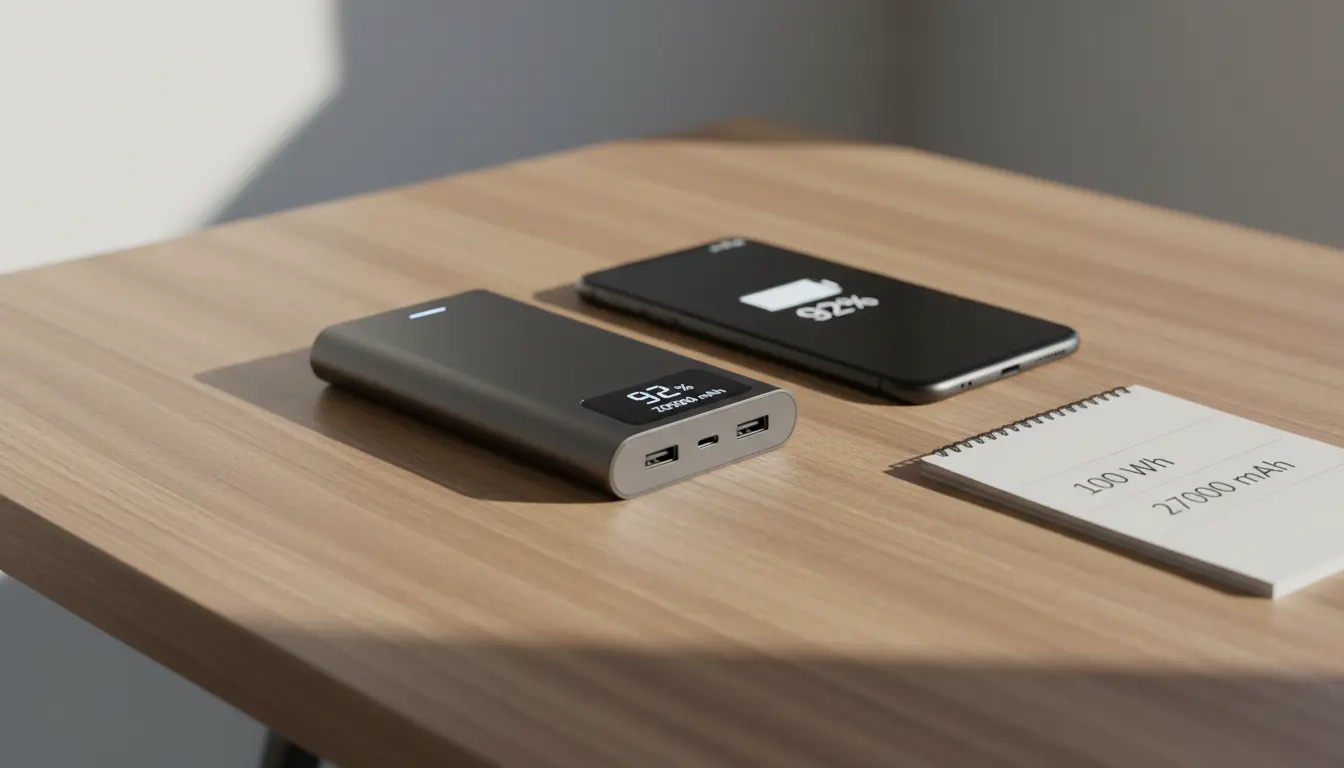

Portable Power Bank Capacity Explained: Wh, mAh and Efficiency
Choosing the right power bank can be confusing. You see big numbers like 10,000 mAh or 30,000 mAh on the box, but in real life your phone only charges 1–2 times. To buy a truly useful portable charger, you need to understand three key concepts: watt‑hours (Wh), milliamp‑hours (mAh) and efficiency.
This guide breaks them down in clear, practical English so you can compare power banks accurately and avoid misleading marketing.
1. What Do mAh and Wh Actually Mean?
Manufacturers usually advertise capacity in mAh (milliamp‑hours). This describes how much current a battery can deliver over time at its internal voltage, typically 3.6–3.7 V for lithium‑ion cells inside the power bank.
- A 10,000 mAh power bank means the internal cells can theoretically provide
10,000 mA×1 hour10{,}000 \,\text{mA} \times 1 \,\text{hour}10,000mA×1hour
at about 3.7 V.
However, your phone doesn’t charge at 3.7 V. USB outputs are 5 V (or higher with fast‑charging standards). That’s why the more realistic unit for real‑world energy is watt‑hours (Wh).
The relationship is:Wh=mAh×V1000\text{Wh} = \frac{\text{mAh} \times \text{V}}{1000}Wh=1000mAh×V
So for a 10,000 mAh power bank with 3.7 V cells:Wh=10,000×3.71000≈37 Wh\text{Wh} = \frac{10{,}000 \times 3.7}{1000} \approx 37 \,\text{Wh}Wh=100010,000×3.7≈37Wh
Wh tells you the actual stored energy, regardless of voltage. This is the best number for comparing different power banks and estimating how many charges you’ll get.
2. Why a 10,000 mAh Power Bank Doesn’t Fully Charge a 5,000 mAh Phone Twice
Most people expect:
- 10,000 mAh power bank
- 5,000 mAh phone battery
So they think: “I should get two full charges.” But in practice you usually get about 1.5 charges, because of:
- Voltage conversion losses (3.7 V → 5 V → phone battery voltage)
- Circuit inefficiency inside the power bank
- Cable and connector losses
- Battery aging and heat
To get a closer estimate, convert both capacities to Wh, include efficiency, and then compare.
Example:
- Power bank: 10,000 mAh @ 3.7 V ⇒ ~37 Wh
- Charger efficiency: say 80–90%
- Usable energy: 37 Wh × 0.85 ≈ 31.5 Wh
If your phone battery is:
- 5,000 mAh @ 3.85 V ⇒
Wh≈5000×3.851000≈19.25 Wh\text{Wh} \approx \frac{5000 \times 3.85}{1000} \approx 19.25 \,\text{Wh}Wh≈10005000×3.85≈19.25Wh
Number of full charges ≈ usable Wh / phone Wh:Charges≈31.519.25≈1.6\text{Charges} \approx \frac{31.5}{19.25} \approx 1.6Charges≈19.2531.5≈1.6
So in real life, 1.5–1.6 full charges is perfectly normal for a 10,000 mAh power bank on a 5,000 mAh phone.
3. How to Convert mAh to Wh (and Back) for Any Power Bank
mAh to Wh
Use:Wh=mAh×V1000\text{Wh} = \frac{\text{mAh} \times \text{V}}{1000}Wh=1000mAh×V
Steps:
- Find the rated voltage of the cells (typically written as 3.6 V or 3.7 V on the label).
- Multiply mAh by that voltage.
- Divide by 1000.
Example: 20,000 mAh power bank @ 3.7 V:Wh=20,000×3.71000=74 Wh\text{Wh} = \frac{20{,}000 \times 3.7}{1000} = 74 \,\text{Wh}Wh=100020,000×3.7=74Wh
Wh to mAh
If a travel rule or airline limit is in Wh and you know the voltage:mAh=Wh×1000V\text{mAh} = \frac{\text{Wh} \times 1000}{\text{V}}mAh=VWh×1000
Example: Airline allows 100 Wh at 3.7 V:mAh=100×10003.7≈27,000 mAh\text{mAh} = \frac{100 \times 1000}{3.7} \approx 27{,}000\,\text{mAh}mAh=3.7100×1000≈27,000mAh
So a 26,800–27,000 mAh power bank at 3.7 V stays under the common 100 Wh flight limit.
4. Understanding Power Bank Efficiency (Why 100% Is Impossible)
No power bank is 100% efficient. Inside, several processes waste energy as heat:
- Boost converter raises 3.7 V to 5 V (and maybe to 9 V, 12 V for fast charging).
- Voltage regulators smooth and control output.
- Cables have resistance.
- Phone charging circuitry also has losses.
Typical overall efficiency (from internal cells to your device battery) is around 75–90%. High‑quality models with modern chips and thicker cables can be on the upper end; cheap, generic models can be much worse.
To estimate usable capacity:Usable Wh=Rated Wh×Efficiency\text{Usable Wh} = \text{Rated Wh} \times \text{Efficiency}Usable Wh=Rated Wh×Efficiency
Example: 74 Wh power bank, 85% efficiency:Usable Wh≈74×0.85≈62.9 Wh\text{Usable Wh} \approx 74 \times 0.85 \approx 62.9 \,\text{Wh}Usable Wh≈74×0.85≈62.9Wh
This usable Wh is the practical energy available to recharge your devices.
5. HowMany Times Can a Power Bank Charge My Phone?
To estimate:
- Convert power bank capacity to Wh.
- Multiply by a realistic efficiency (0.8–0.9).
- Convert your phone battery to Wh.
- Divide.
General formula:Number of charges≈Power bank Wh×EfficiencyPhone Wh\text{Number of charges} \approx \frac{\text{Power bank Wh} \times \text{Efficiency}}{\text{Phone Wh}}Number of charges≈Phone WhPower bank Wh×Efficiency
Example: 20,000 mAh power bank @ 3.7 V vs 4,000 mAh phone @ 3.85 V, efficiency 0.85:
- Power bank Wh:
20,000×3.71000=74 Wh\frac{20{,}000 \times 3.7}{1000} = 74 \,\text{Wh}100020,000×3.7=74Wh
- Usable Wh:
74×0.85=62.9 Wh74 \times 0.85 = 62.9 \,\text{Wh}74×0.85=62.9Wh
- Phone Wh:
4000×3.851000=15.4 Wh\frac{4000 \times 3.85}{1000} = 15.4 \,\text{Wh}10004000×3.85=15.4Wh
- Number of charges:
62.915.4≈4.1\frac{62.9}{15.4} \approx 4.115.462.9≈4.1
So you can expect about 4 full charges in realistic conditions.
6. Other Factors That Affect Real‑World Capacity
Even if the calculations look perfect, real usage varies. These factors reduce practical output:
- High discharge current: Fast charging (e.g., 18 W, 30 W) increases heat and reduces efficiency.
- Temperature: Very cold or very hot environments lower battery performance.
- Aging: Capacity drops with each charge cycle; after hundreds of cycles, you might lose 10–20%.
- Multiple devices: Charging two devices at once increases conversion losses.
- Cable quality: Thin, long, or cheap cables can waste several percent of power.
When you see user reviews saying “only 60–70% of rated mAh is usable,” they’re often describing these combined losses. That doesn’t mean the power bank is fake; it usually reflects physics and real‑world conditions.
7. How to Choose the Right Power Bank Capacity
When shopping for a portable charger, follow these steps:
- Check the Wh rating
- Prefer models that clearly list Wh on the case or specs.
- Compare Wh, not just mAh.
- Match capacity to your usage
- For one full phone recharge per day:
- Choose a power bank with at least 2–2.5× your phone battery Wh.
- For a weekend trip without outlets:
- Aim for 4–5× your phone battery Wh, depending on how much you use it.
- For one full phone recharge per day:
- Allow for efficiency losses
- Multiply the advertised Wh by 0.8–0.85 to estimate usable energy.
- Base your expectations on that value, not the raw mAh number on the box.
- Check airline rules if you travel
- Most airlines allow power banks up to 100 Wh in carry‑on luggage.
- 20,000–27,000 mAh @ 3.7 V usually stays within this limit.
- Balance capacity, weight and size
- Larger Wh = more energy, but also heavier and bulkier.
- If you commute daily, a compact 10,000 mAh model might be ideal.
- For camping or festivals, 20,000–30,000 mAh can make a big difference.
8. Practical Checklist Before You Buy
To make an informed, organic decision based on real performance:
- Confirm Wh rating (not just mAh).
- Look for honest, detailed efficiency tests in reviews.
- Check output ports and power (e.g., USB‑C PD 20 W or 30 W).
- Make sure total Wh fits your travel and daily needs.
- Consider brand reliability and safety features (over‑charge, over‑heat, short‑circuit protection).
When you understand Wh, mAh and efficiency, you see through marketing hype and choose a power bank that genuinely matches your lifestyle.
Suggested Product on Amazon
You can look for something like the Anker PowerCore 20000mAh Portable Charger on Amazon.com. It typically offers:
- Around 20,000 mAh capacity (about 72–74 Wh),
- Multiple USB outputs,
- Efficient power management and reliable safety protections,
making it a strong, practical example of a well‑designed high‑capacity power bank.