
The Best Portable Bluetooth Speakers: A Complete 2025 Buyer’s Guide
Portable Bluetooth speakers have evolved into essential companions for everyday life—whether you’re relaxing at home, hosting a backyard BBQ, heading to the beach, or traveling light. In 2025, the best models combine impressive sound quality, long battery life, rugged durability, and seamless connectivity. This guide explains what matters most when choosing a portable Bluetooth speaker, highlights the key features and trade-offs, and helps you find the perfect device for your budget and use case.
Why Choose a Portable Bluetooth Speaker?
Portable Bluetooth speakers offer a simple value proposition: great audio anywhere, anytime. Unlike smart speakers that rely on Wi‑Fi and are tied to a room, Bluetooth speakers are built for mobility. Most now include robust water resistance, improved battery chemistry, and modern codecs for better sound quality than ever.
Core Factors to Consider
- Sound Quality and Tuning
- Frequency response: Look for a balanced profile with tight bass, clear mids (for vocals), and crisp but not harsh treble. If you listen outdoors, a slight bass lift helps compensate for open environments.
- Driver configuration: Dual drivers or a driver+tweeter combo deliver better stereo imaging. Passive radiators enhance low-end without drastically increasing size.
- Loudness without distortion: Check if the speaker maintains clarity at higher volumes—important for parties or outdoor gatherings.
- Portability and Size
- Pocketable minis are great for travel but often sacrifice bass extension.
- Mid-size models offer the best balance for most people: fuller sound while still fitting in a backpack.
- Larger, party-focused speakers deliver room-filling sound and deeper bass but are heavier.
- Battery Life
- A realistic all-day battery is 12–20 hours at moderate volume. Many brands quote “up to” figures measured at 40–50% volume.
- Fast charging (USB‑C) and power bank capability are useful for on-the-go use.
- Durability and Water Resistance
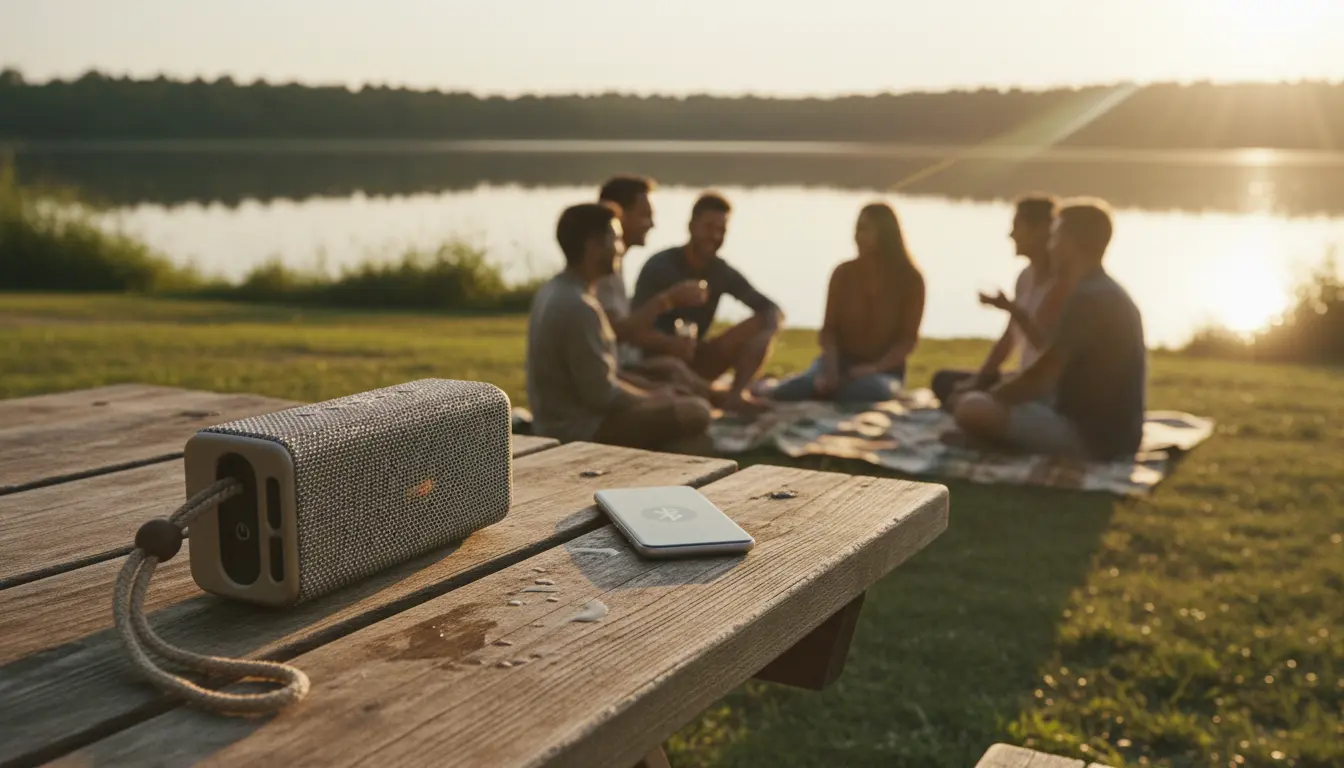
- IP ratings matter: IP67 or higher means dust-tight and submersible—great for poolside or beach days.
- Rugged materials, silicone bumpers, and fabric grilles improve longevity if you frequently travel or hike.
- Connectivity and Codecs
- Bluetooth 5.1+ improves range and stability. Multipoint lets you connect two devices at once (e.g., laptop and phone).
- Codecs like AAC, aptX, or LDAC can enhance fidelity if both your device and speaker support them.
- App support for EQ controls and firmware updates adds long-term value.
- Special Features
- Stereo pairing or party mode: Link two of the same model for stereo or multiple units for a multi-speaker setup.
- Built-in mics for calls: Handy for conference calls, though not every speaker excels at echo cancellation.
- Smart assistants: Some models integrate with voice assistants via your phone’s connection.
Matching Speakers to Your Use Case
- Travel and Daily Carry
- Prioritize weight, size, and durability. A compact model with IP67 and at least 10–12 hours of battery life is ideal.
- A lanyard or carabiner loop helps with portability; rubberized exterior prevents scuffs.
- Outdoor Adventures
- Go for IP67/IP68, shock resistance, and a robust enclosure. Buttons should be tactile and glove-friendly.
- Battery life of 15+ hours ensures you won’t run out during a day trip and campfire night.
- Home and Party Use
- Look for fuller sound with deeper bass, stereo pairing, and party mode. An integrated power bank can keep phones topped up.
- Consider smart features and app EQ to tailor sound for room acoustics.
- Work and Study
- Clear midrange and decent mic quality are beneficial for calls and podcasts. Multipoint connectivity simplifies switching between devices.
How to Evaluate Sound Without Hearing It First
- Read measurements when available: Frequency graphs help reveal bass roll-off and treble peaks.
- Look for consistent praise on clarity at high volumes and the absence of “boxy” mids.
- Consider brands with app-based EQ—fine-tuning can elevate even modest hardware.
Battery, Charging, and Care Tips
- Battery longevity improves with partial cycles. Avoid leaving the speaker on charge at 100% for days.
- Use a reliable USB‑C PD charger. Many speakers accept 15–20W for quicker top-ups.
- If you seldom use the speaker, store it around 50–70% charge and power it on monthly to maintain cell health.
Durability and Waterproofing Explained
- IP67: Dust-tight and water-resistant for up to 30 minutes at 1 meter—enough for rain, splashes, and brief submersion.
- Rinse after exposure to saltwater or chlorinated water and let it dry thoroughly with ports closed before charging.
Connectivity Tips for a Dropout-Free Experience
- Keep the source device within 10 meters and avoid crowding 2.4 GHz environments.
- Update firmware via the companion app.
- If your phone supports advanced codecs, enable them in Bluetooth settings and match them with a capable speaker.
Smart Buying Checklist
- Does it fit your typical volume needs without distortion?
- Is the battery sufficient for your longest day out?
- Will the IP rating and build survive your environment?
- Do you need multipoint, stereo pairing, or party mode?
- Is there an app with EQ and updates for long-term support?
Maintenance for Longevity
- Keep grilles clean with a soft brush; avoid solvents.
- Don’t block passive radiators; give the speaker some breathing room for best bass.
- Store in a cool, dry place. Extreme heat degrades batteries faster.
Budget vs. Premium: What Changes?
- Budget speakers today can sound shockingly good, but may lack deeper bass, advanced codecs, or premium materials.
- Mid-range models often hit the value sweet spot: balanced sound, IP67, and solid battery life.
- Premium options add bigger drivers, smarter DSP, wider soundstage, and better build quality—noticeable if you care about fidelity and volume.
Sustainability Considerations
- Choose brands that offer replaceable parts or proven warranty support.
- A speaker with firmware updates and durable construction reduces e-waste over time.
- Recycle old devices responsibly; check local e-waste programs.
Final Advice
Pick based on your primary use case, then verify essentials: balanced sound, robust build, and battery life that matches your lifestyle. A portable Bluetooth speaker should be a dependable, grab‑and‑go device—if it invites you to use it daily with minimal fuss, you’ve found the right one.
- JBL Flip 6
- Why it’s good: Punchy, balanced sound with surprisingly strong bass for its size. Rugged fabric build with IP67 dust/water resistance makes it great for outdoors.
- Battery: Up to ~12 hours (varies with volume).
- Features: USB‑C charging, PartyBoost to stereo pair two units or link multiple compatible JBL speakers, basic EQ in the JBL app.
- Best for: Travel, picnics, beach/pool use, and anyone who wants durability plus portability without sacrificing volume.
- Sony SRS‑XE300
- Why it’s good: Wide sound dispersion thanks to the Line‑Shape Diffuser design, delivering more even coverage in open spaces. Clean mids and vocals.
- Battery: Up to ~24 hours (usage dependent) with fast charging.
- Features: USB‑C, multipoint Bluetooth (connect two devices at once), EQ and tuning via Sony Music Center app, IP67 dust/water resistance, shock-resistant design.
- Best for: Long battery life, outdoor gatherings, and broader sound spread for parties or patios.