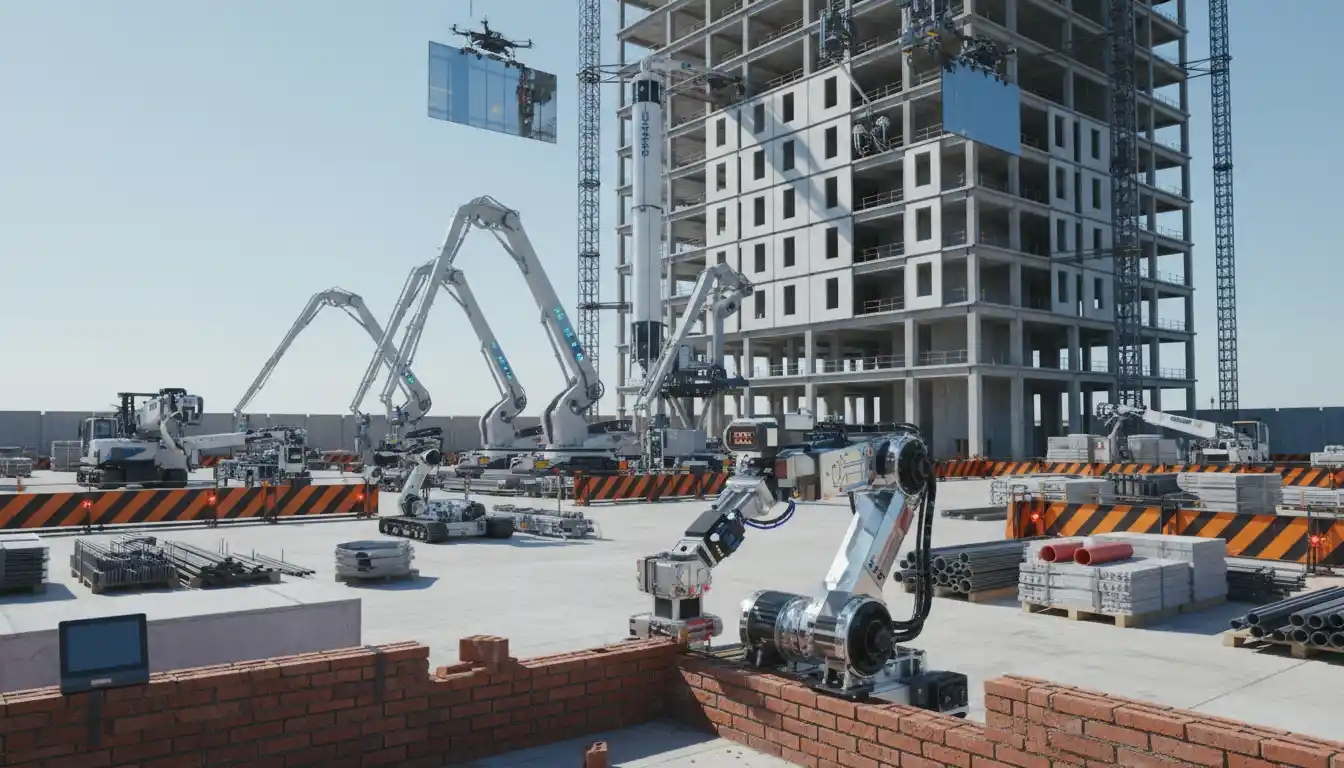

The Growing Challenge of Labor Shortage in Construction
The construction industry in the United States is facing a serious and long‑term labor shortage. Thousands of projects are delayed every year because there are not enough skilled workers available to complete them on time. As cities expand and infrastructure ages, the gap between the demand for construction and the available workforce continues to widen.
In this environment, construction robotics is emerging as a realistic and powerful solution. By automating repetitive, dangerous, and physically demanding tasks, robots allow human workers to focus on high‑value activities that require judgment, creativity, and experience. At the same time, construction automation technology helps companies keep projects on schedule, control costs, and improve safety.
The integration of robotics into construction is not just a futuristic idea. It is already changing how the U.S. builds roads, bridges, commercial buildings, and homes. As investment in innovation grows, construction robotics is becoming a central strategy for addressing the American construction workforce crisis.
Understanding Construction Robotics and Automation Technology
Construction robotics includes a wide range of automated systems and robotic construction equipment designed to perform specific tasks on job sites. These robots rely on advanced sensors, artificial intelligence, and machine learning algorithms to move, measure, and operate with high precision.
Some typical examples are:
- Robotic bricklaying machines that place bricks quickly and accurately
- Concrete automation systems that pour and finish concrete
- Robotic arms that handle welding, drilling, cutting, or fastening
- Demolition robots that break down structures safely from a distance
Unlike traditional machinery that depends entirely on manual control, modern robots can analyze their surroundings, adjust their movements in real time, and follow digital plans from Building Information Modeling (BIM) systems. As a result, automated building systems work more consistently and predictably than manual operations.
This new generation of smart construction technology turns conventional job sites into partially automated environments where humans and machines collaborate. Supervisors, engineers, and operators monitor the data, define tasks, and manage workflows, while robots take care of the heavy, repetitive, and precise work.
How Construction Robotics Solves the Labor Shortage Problem
The U.S. construction sector struggles to recruit and retain enough skilled workers, especially for physically demanding roles. Many experienced workers are retiring, and fewer young people are choosing construction as a long‑term career. This combination leads to project delays, higher wages, and increased competition for talent.
Construction robotics offers a direct response to this challenge:
- Higher output with fewer workers: Robotic bricklaying machines and concrete automation systems can operate faster than traditional crews, reducing the number of workers needed for specific tasks.
- Stable productivity: Robots do not suffer from fatigue, illness, or scheduling conflicts. They can work long shifts consistently, which helps maintain project timelines.
- Task specialization: By delegating repetitive tasks to machines, companies can reassign human workers to roles that require problem‑solving, coordination, and quality control.
In this way, construction site automation does not simply replace jobs. It restructures them. Workers can become robot operators, maintenance technicians, or automation supervisors. This transition supports career development while helping companies remain competitive in a tight labor market.
Innovative Robotic Solutions Transforming Building Sites
Across the United States, multiple categories of innovative robotic construction equipment are already in use on real projects:
- Robotic bricklaying machines can lay thousands of bricks per day with consistent mortar joints and alignment.
- Concrete automation systems use robotic arms and sensors to pour, level, and finish concrete slabs with high surface quality.
- Autonomous construction vehicles move materials across the site, reducing the need for manual handling and forklift operation.
- Robotic demolition tools remove walls, floors, and structural elements from a safe distance, especially in hazardous environments.
These applications show how building automation technology touches every phase of a project: site preparation, structural work, finishing, and even renovation or dismantling. Each new generation of robots becomes more compact, more intelligent, and easier to integrate into existing workflows.
As adoption grows, construction firms that embrace these solutions gain a significant advantage in speed, quality, and cost control over competitors who still rely mostly on manual labor.
Safety Benefits and Risk Reduction Through Automation
Construction is consistently ranked among the most dangerous industries in the U.S. Falls, heavy loads, electrical risks, and exposure to dust or chemicals put workers’ health at risk every day. Construction safety automation helps address these issues directly.
By using construction robotics in high‑risk tasks, companies can:
- Keep workers away from unsafe heights and unstable structures
- Reduce manual lifting of heavy materials
- Minimize exposure to hazardous substances and confined spaces
- Lower accident rates and related insurance and downtime costs
For example, demolition robots can remove concrete or steel from a distance, while remote operators stay safely behind protective barriers. Concrete and welding robots can work in environments with dust, noise, or fumes, where human presence would be dangerous or heavily regulated.
In many cases, automation does not eliminate human roles; instead, it changes them. Workers move from dangerous, hands‑on positions into monitoring and control roles. This shift improves overall site safety while maintaining or even increasing productivity.
Economic Impact and Cost Efficiency of Construction Automation
Investing in construction automation technology requires an initial capital expense, but the economic benefits can be substantial over the lifetime of the equipment. Key advantages include:
- Faster project completion: Automated systems shorten project timelines, allowing companies to start new jobs sooner and improve cash flow.
- Less rework and waste: Robots follow precise digital instructions, which decreases errors, material waste, and costly corrections.
- Predictable quality: Consistent performance from automated building systems leads to more uniform results and greater client satisfaction.
- Reduced labor dependency: While skilled technicians are still needed, fewer workers are required for repetitive or low‑skill tasks.
For many firms, these benefits translate into higher profit margins and a stronger ability to win bids in a competitive market. As technology continues to improve and hardware prices fall, even small and medium‑sized contractors will gain access to advanced construction efficiency solutions.
Challenges and Barriers to Widespread Adoption
Despite its potential, construction robotics still faces several barriers:
- High upfront investment for robotic construction equipment
- Training needs for operators, engineers, and maintenance staff
- Fragmented industry structure, with many small firms lacking resources
- Regulatory uncertainty around safety standards and liability
- Cultural resistance, including fears about job loss or complex technology
Addressing these issues requires collaboration between technology providers, construction companies, educational institutions, and regulators. Clear standards for construction site automation, accessible training programs, and demonstration projects can help prove the value of these systems and build trust in the technology.
When companies present automation as a way to support workers—not simply replace them—they are more likely to gain acceptance from employees and labor organizations.
Future Prospects: The Evolution of Construction Robotics Technology
Looking ahead, the role of construction robotics in the U.S. will continue to expand. Advances in artificial intelligence and machine vision will enable robots to better understand their environment and coordinate with other machines on site. We can expect to see:
- More capable autonomous construction vehicles managing material flows
- Integrated sensors and data platforms for real‑time monitoring and analytics
- Closer connection between digital project models and physical robots
- Widespread adoption of smart construction technology across large and small projects
Over time, fully integrated, semi‑autonomous job sites may become the norm. In these environments, human workers, digital systems, and robots operate together as a coordinated ecosystem. This transformation will not only help solve the construction workforce crisis but also set new standards for quality, safety, and sustainability.
Recommended Product from Amazon: DEWALT DCD777C2 Compact Drill/Driver Kit
Even on highly automated job sites, professionals still need reliable tools for precise manual work that robots cannot easily perform. The DEWALT DCD777C2 Compact Drill/Driver Kit, available on Amazon.com, is a practical example.
Its compact, lightweight design allows workers to handle detailed finishing tasks, adjustments, and installations in tight spaces where larger robotic construction equipment may not reach. The tool complements construction automation technology by giving technicians the flexibility to fine‑tune results, perform quick fixes, or complete custom tasks alongside automated systems.
By combining high‑quality tools like this with advanced robotics, construction teams create a balanced workflow that leverages the strengths of both human skills and automated building systems.