
The Robotic Kitchen Revolution: How Food Production Robots Are Redesigning Restaurants in the USA and Worldwide
Food production robots are no longer futuristic props behind glass walls. They are becoming practical, revenue-driving systems that reshape how restaurants are built, staffed, and scaled. In the United States and many other countries, restaurant owners are adopting culinary automation to address labor gaps, improve consistency, strengthen food safety, and expand output without endlessly expanding headcount. This shift is not simply “adding a robot.” It is redesigning workflows, kitchen footprints, menus, and customer experiences around automated food service.
Why Restaurants Are Turning to Culinary Automation
Several forces are accelerating restaurant automation. First, many operators face ongoing staffing pressure, high turnover, and rising training costs. Second, customers increasingly expect speed, accuracy, and consistent quality—especially for delivery and takeout. Third, food costs and operational expenses demand tighter portion control and reduced waste. Robotic kitchen assistants and autonomous cooking systems help restaurants standardize repetitive tasks, measure ingredients precisely, and maintain predictable throughput during rush hours.
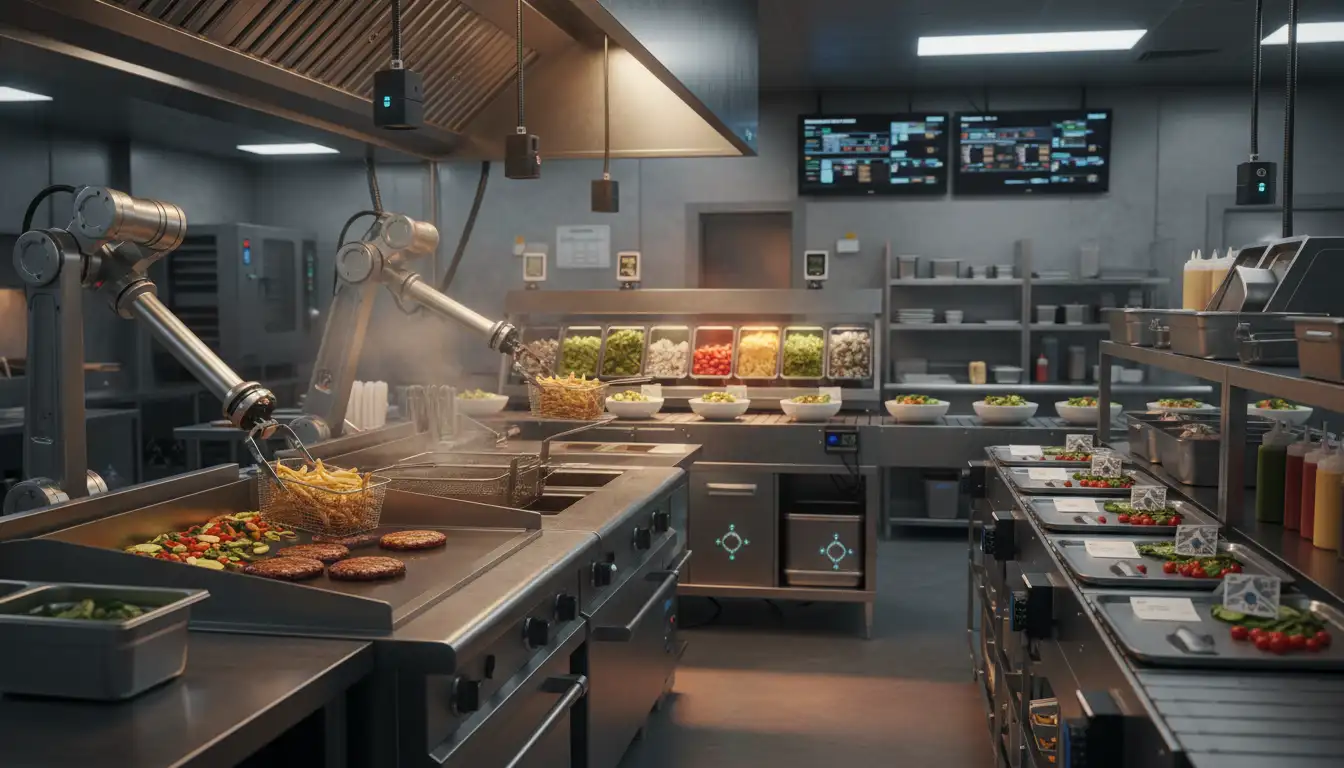
Importantly, automation is not a single device. It is a connected ecosystem that may include robotic arms, smart commercial kitchens, sensor networks, software scheduling, and data-driven inventory control. When implemented well, it increases reliability and reduces the “human variability” that can harm quality and profitability.
What Food Production Robots Actually Do in a Restaurant
Many people imagine robots only flipping burgers, but the real impact comes from handling repeatable, high-volume steps across the line.
These systems shine in tasks that require precision and repetition. They can maintain consistent temperatures, repeat the same motion thousands of times, and reduce contamination risks by limiting unnecessary human contact with food. When paired with modern restaurant technology trends—like predictive ordering and demand forecasting—automation can also help kitchens prepare smarter, not just faster.
The United States: A Major Testing Ground for Kitchen Robotics
The USA has become a high-visibility hub for kitchen robotics because the market rewards scale, consistency, and speed. Large chains and multi-unit operators can justify the upfront investment and then replicate systems across locations. American restaurants are also heavily influenced by delivery growth and ghost kitchens, where production efficiency matters more than dining-room aesthetics.
In practice, many US operators begin with partial automation: one station, one process, one measurable improvement. A fry station or a prep task becomes the first step. Over time, restaurants layer in more automation—integrating sensors, inventory tracking, and automated scheduling—until the kitchen starts behaving like a coordinated production system.
This “modular rollout” is why automated restaurant concepts have gained traction. Rather than waiting for a fully robotic restaurant, owners assemble a high-efficiency workflow that gradually reduces bottlenecks.
Beyond the USA: How Other Countries Approach Automated Food Service
While the US often emphasizes speed and scalable operations, other regions adopt food production robots for different reasons.
Japan has long embraced robotics and precision machinery in daily life, including food environments. Automation here often prioritizes cleanliness, consistent craftsmanship, and compact efficiency. Robots that portion ingredients accurately or assist with repetitive preparation steps can help maintain high standards with fewer staff.
China is notable for rapid experimentation and large-scale deployment of smart systems. Some dining environments integrate automation into logistics: ingredient delivery, tray movement, order routing, and kitchen-to-table handoffs. This supports high-volume meal production and minimizes wasted motion in busy urban settings.
In parts of Europe, automated solutions frequently appear in compact formats like kiosks, transit hubs, and small-footprint concepts. Operators may use contactless food preparation and robotic pizza assembly to serve consistent meals in locations where labor is expensive or staffing is difficult.
The result is not one global model, but many local interpretations—each shaped by culture, economics, and consumer expectations.
Restaurant Redesign: Kitchens, Layouts, and New Operating Models
Food production robots change how restaurants design space. Traditional kitchens are built for human movement: wide aisles, multiple prep stations, and flexible work zones. Robotic kitchens can compress or reorganize that space because machines can operate in tighter, more structured layouts. Automation can also reduce the need for certain front-of-house storage areas if inventory is tracked and replenished with precision.
Ghost kitchens and dark kitchens highlight this redesign. These delivery-only facilities focus on production efficiency, not ambiance. A kitchen robotics setup can run predictable menu items for multiple virtual brands, maximizing throughput and optimizing food tech innovation in a controlled environment.
Even dine-in restaurants can benefit. Some brands treat automation as part of the experience by making robotic systems visible. Others hide the robotics and spotlight hospitality, letting staff focus on service, storytelling, and guest satisfaction while the back-of-house runs with industrial consistency.
Consistency, Safety, and Portion Control: Key Benefits
One of the strongest business cases for kitchen robotics is consistency. Robots do not “freestyle” portion sizes when they are tired. They replicate recipes with reliable measurements, supporting brand standards across locations. This consistency reduces refunds, improves reviews, and increases repeat customers.
Food safety is another major advantage. Robots can operate with controlled handling, timed cooking cycles, and sensor-based temperature verification. Smart commercial kitchens can also integrate cleaning alerts, maintenance schedules, and tracking systems that support hygienic automation. In high-volume settings, these controls reduce the chance of mistakes that lead to food quality problems.
Portion control is equally important for profitability. Precise dispensing reduces over-serving and helps manage ingredient costs. Over time, waste reduction can become one of the most valuable returns on an automation investment.
The Human Factor: What Happens to Staff and Chefs?
Automation changes roles more than it eliminates them—especially in restaurants that care about brand identity. Robotic kitchen assistants typically handle repetitive production tasks, while humans move toward supervision, quality control, customer interaction, and problem-solving. In many environments, automation can reduce burnout by removing the most physically demanding tasks.
Chefs and culinary leaders still matter, but their work evolves. They design recipes that run consistently inside autonomous cooking systems, select ingredients that fit automated processes, and test menus for “robot-friendly” execution without sacrificing flavor. The best operators use automation to protect craftsmanship, not replace it—freeing people to focus on creativity, plating, hospitality, and innovation.
Training also changes. Staff may learn to manage systems, monitor outputs, swap components, and troubleshoot basics—skills that can raise wages and create new career paths in restaurant operations.
Real Risks: Consumer Perception and Maintenance Dependability
Despite the momentum, challenges remain. Some diners worry that machine-made meals feel less “human,” less authentic, or too industrial. Brands must address this perception through transparency, ingredient quality, and the overall dining experience. When restaurants communicate that automation improves cleanliness and consistency—while humans still define taste and hospitality—customers often respond more positively.
Maintenance is another critical factor. A broken robot can disrupt production far more than a single staff absence. Restaurants must plan for redundancy, service agreements, spare parts, and rapid technical support. Successful deployments treat maintenance planning as part of the operating model, not as an afterthought.
The Future of Dining: Data-Driven Personalization
The next frontier is personalization. As restaurant technology trends integrate ordering apps, customer profiles, and nutritional preferences, automated food service can produce meals tuned to specific constraints—less sodium, higher protein, allergen controls, or calorie targets. With precise portioning and recipe execution, robots can deliver consistency at the individual level, not just the brand level.
In the long run, food production robots may help restaurants serve better meals at scale—reducing waste, improving safety, and enhancing customer experience. The restaurants that succeed will be those that balance automation with hospitality, using technology to amplify what people value most about dining.
Conclusion
Food production robots are redesigning restaurants in the USA and worldwide by improving consistency, increasing speed, and stabilizing operations under labor pressure. From ghost kitchens and high-volume chains to tech-forward dine-in concepts, culinary automation is becoming a strategic advantage. The future of dining will not be purely robotic or purely human. It will be a hybrid model where smart systems handle repetition and precision, while people deliver creativity, warmth, and memorable experiences.