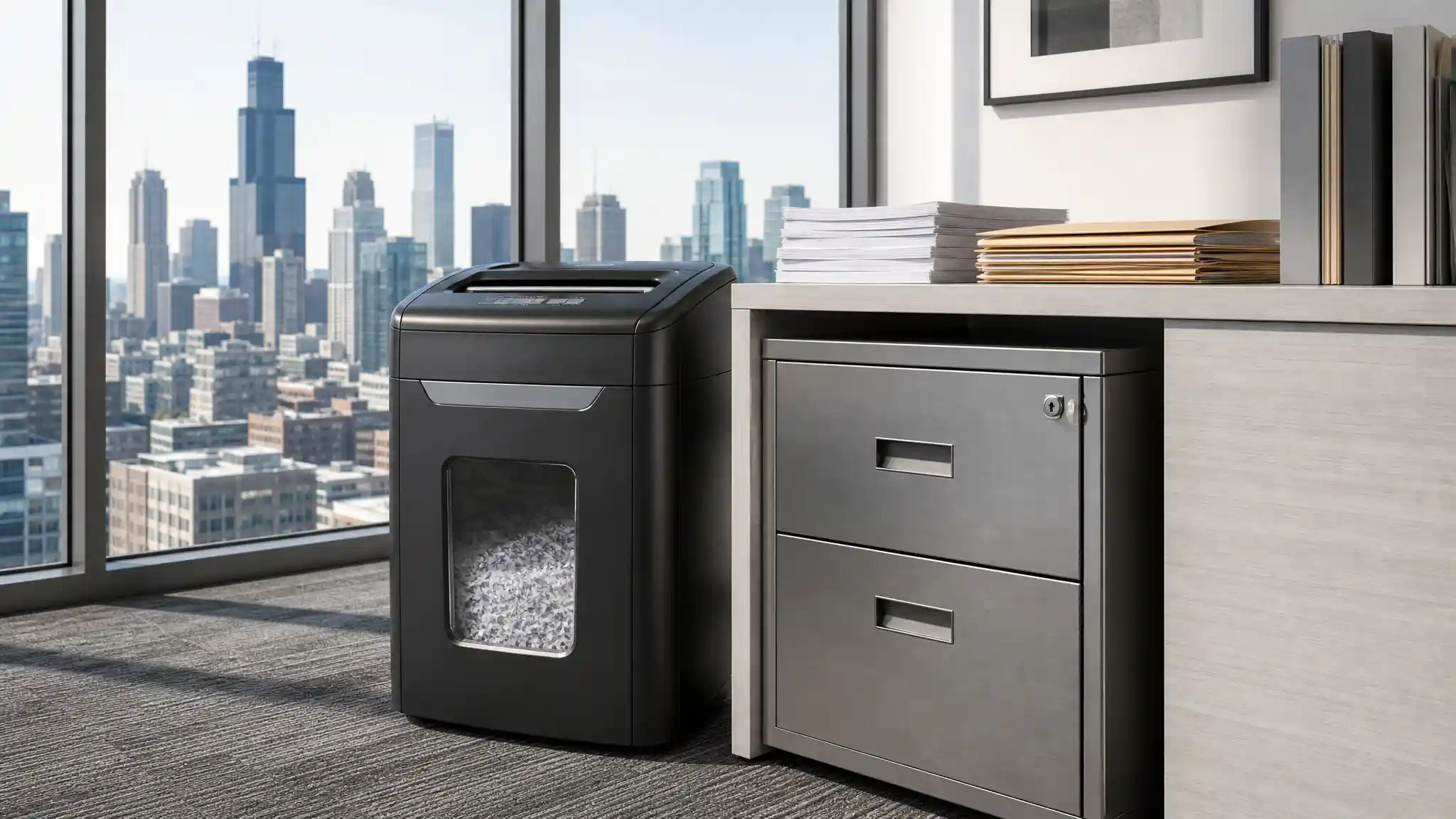

Protecting sensitive corporate information, financial statements, and client records remains a paramount concern for companies across the Windy City. Operating in a bustling commercial hub demands strict compliance with federal privacy regulations and Illinois state data protection statutes. Whether managing a prestigious legal firm in the Loop, running an expanding healthcare practice in Streeterville, or maintaining a boutique accounting consultancy in River North, businesses handle massive volumes of printed confidentiality daily. Investing in high-performance document destruction hardware shields your enterprise against corporate espionage, unauthorized surveillance, and devastating identity theft.
The Regulatory Landscape and Data Protection in Illinois
Chicago enterprises operate under intense regulatory oversight where physical data breaches trigger severe legal liability, administrative audits, and crippling severe financial penalties. Federal frameworks such as the Health Insurance Portability and Accountability Act, the Fair and Accurate Credit Transactions Act, and the Gramm-Leach-Bliley Act require organizations to implement robust safeguards for physical paper disposal. Concurrently, the Illinois Personal Information Protection Act mandates thorough destruction procedures for records containing personally identifiable information, tax records, medical charts, and biometric identifiers. Discarding intact documents into standard outdoor recycling bins invites catastrophic compliance failures and exposes proprietary company strategies to unscrupulous bad actors.
Modern commercial shredding machines provide the necessary security level to guarantee complete alignment with municipal, state, and international data disposal guidelines. Installing reliable on-site shredding units empowers internal administrative staff to destroy proprietary documents immediately upon expiration, effectively eliminating chain-of-custody vulnerabilities associated with off-site disposal services.

Understanding Security Levels and Cutting Mechanisms
Security professionals evaluate shredder performance via the international DIN 66399 classification standard, which establishes specific particle dimensions for various tiers of document destruction. Standard strip-cut units slice sheets into basic vertical ribbons, offering minimal protection because determined adversaries can easily assemble the pieces using automated reconstruction software. Consequently, high-stakes urban environments require modern cross-cut shredder systems or micro-cut shredder technology to ensure complete illegibility.
A standard cross-cut model operating at the P-4 security rating cuts an ordinary letter-sized page into hundreds of confetti-like pieces, satisfying general corporate compliance requirements. However, organizations handling sensitive intellectual property, executive payroll, or government contracts require micro-cut shredder machines meeting P-5 or high security shredder specifications up to P-7. These advanced units pulverize standard sheets into thousands of minuscule particles, rendering manual or digital data extraction completely unfeasible.
Evaluating Sheet Capacity, Duty Cycles, and Continuous Runtime
Selecting the ideal shredding hardware requires assessing daily document volume, sheet capacity per pass, and internal thermal management. Smaller desktop shredders often overheat after brief duty cycles of five to eight minutes, interrupting daily office workflow and reducing administrative efficiency. Growing corporate teams require heavy-duty motors paired with integrated cooling fans to handle high-volume destruction continuously without forced cooldown pauses.
The manual feed opening should comfortably accept staple-bound reports, plastic credit cards, paper clips, and laminated badge cards without stalling. High-throughput office environments benefit tremendously from automated feed shredder designs, which allow administrative personnel to drop a large stack of several hundred documents into an enclosed security chamber and walk away while the machine processes the entire batch independently.
Jam Prevention and Workplace Safety Innovations
Workplace safety and operational convenience represent crucial considerations when selecting office shredders. Premium commercial shredders incorporate smart touch sensor technology that automatically halts the hardened steel cutters if fingers or hands touch the paper entry throat. This safety mechanism protects employees from accidental injuries during rapid, high-volume feeding sessions.
Furthermore, advanced anti-jam system engineering prevents motor burnout and operator frustration by actively monitoring stack thickness before insertion. If an employee inserts too many sheets, intelligent sensor arrays reverse the feed direction instantly, prompting the user to adjust the bundle. Precision motor engineering and sound dampening insulation also maintain quiet operation shredder standards, keeping acoustic disruption well below sixty decibels in modern open-concept office environments.
Maintenance Routines to Ensure Long-Term Reliability
Heavy commercial usage generates significant friction, intense heat, and fine cellulose residue within the precision-milled steel cutting shafts. Without proper lubrication, cutting blades dull rapidly, motor strain increases, and internal mechanical gears risk premature structural failure. Office managers should establish a systematic maintenance protocol that applies specialized shredder lubricant oil or pre-saturated sharpening sheets across the cutting blades after every major wastebasket evacuation.
Routine cleaning of optical feed sensors with compressed air eliminates compacted paper dust that could otherwise trigger false bin-full or feed-error alerts. Regularly monitoring the pullout waste bin level prevents shredded confetti from packing tightly into the cutter head, thereby extending the overall lifespan of the motor assembly and preserving optimal cutting torque across long productive years of heavy service.
Cost-Benefit Analysis: On-Site Hardware vs. External Services
Many enterprise leaders weigh the financial considerations of purchasing dedicated office shredders against contracting outsourced mobile destruction vendors. While third-party shredding contracts require recurring monthly collection fees, on-site hardware represents a one-time capital investment that delivers immediate physical document destruction. Maintaining dependable in-house shredding capabilities eliminates third-party handling risks, reduces recurring operational expenses, and ensures that sensitive files never leave company premises before full physical eradication.
Recommended Commercial Hardware: Fellowes Powershred 99Ci
For Chicago organizations seeking an exceptional balance of continuous run time, robust capacity, and advanced jam prevention, the Fellowes Powershred 99Ci 100% Jam Proof Cross-Cut Paper Shredder stands out as a premier commercial choice available on Amazon.com. This heavy-duty office shredder processes up to eighteen sheets per pass into crisp P-4 cross-cut particles, easily destroying heavy cardstock, staples, paper clips, credit cards, and optical discs. Its continuous-duty motor operates for up to thirty minutes before requiring a brief cool-down period, while its SafeSense protection technology and ultra-quiet motor make it an ideal operational asset for shared corporate spaces. Investing in this reliable machine guarantees complete document protection and long-term compliance peace of mind across all modern downtown corporate departments.
Fellowes Powershred 99Ci 100% Jam Proof Cross-Cut Paper Shredder