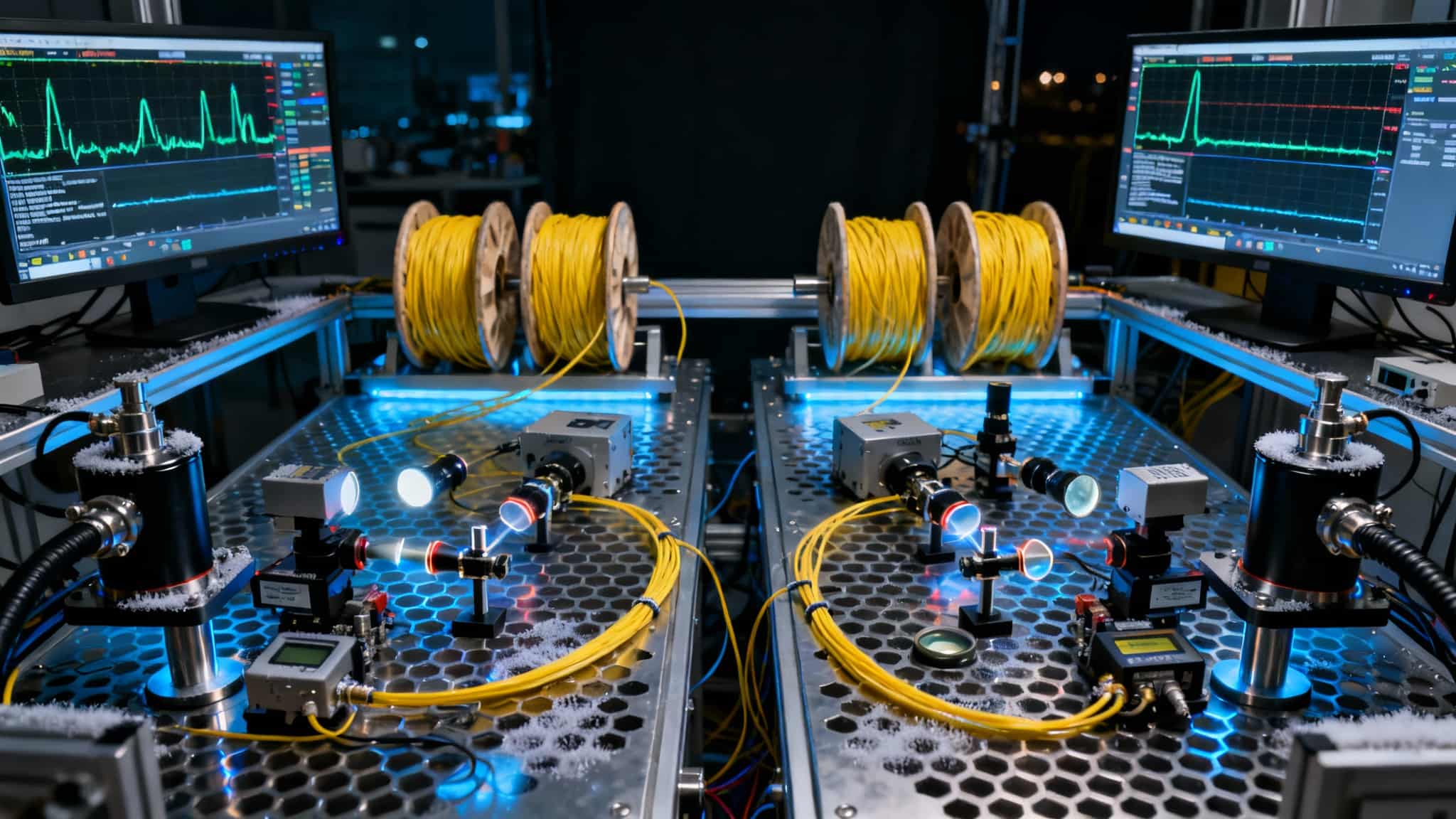

The emerging quantum internet promises a new paradigm of connectivity—one that uses the principles of quantum mechanics to enable ultra-secure communication, distributed quantum computing, and networked quantum sensing. At the heart of this vision are quantum internet nodes and a groundbreaking approach to cryptography often dubbed “teleported key sharing.” While no information literally travels faster than light, quantum teleportation allows the state of a qubit to be transmitted using pre-shared entanglement and classical communication. When combined with quantum key distribution (QKD) and entanglement swapping, this enables secure, scalable key agreement across long distances with security guarantees rooted in physics, not computational assumptions.
In this article, we unpack how quantum internet nodes operate, how teleported key sharing works conceptually, and why this architecture could redefine cybersecurity. We’ll also cover real-world challenges, use cases, and the roadmap from today’s quantum networks to tomorrow’s large-scale quantum internet.
What is a Quantum Internet Node?
A quantum internet node is a device that can create, store, process, and route quantum information. Practically, a node includes:
- Quantum processors or memories (e.g., trapped ions, superconducting qubits, NV centers in diamond, neutral atoms).
- Single-photon sources and detectors for quantum communication.
- Classical control electronics and software to orchestrate protocols.
- Interfaces to convert stationary qubits (in memory) to flying qubits (photons) and back, often via photonic interconnects at telecom wavelengths.
Nodes play three critical roles:
- Entanglement generation: Creating entangled qubit pairs locally or with distant nodes.
- Entanglement distribution: Sending one half of an entangled pair through optical fiber or free-space links to another node.
- Entanglement management: Performing quantum operations like Bell-state measurements and entanglement swapping to extend entanglement over multiple hops.
Quantum Teleportation and “Teleported Key Sharing”
Quantum teleportation is an elegant protocol that enables the seamless transfer of an unknown qubit’s state from a sender (Alice) to a receiver (Bob) by leveraging two powerful resources.
- A shared entangled pair between Alice and Bob.
- Two classical bits sent from Alice to Bob after a joint measurement.
Importantly, teleportation does not clone the state, and no usable information travels in the quantum channel by itself. The security emerges because an eavesdropper cannot copy or intercept quantum states without disturbing them (no-cloning theorem) and any measurement attempt is detectable by higher error rates.
“Teleported key sharing” is a colloquial umbrella term for key agreement techniques that leverage teleportation and entanglement-based QKD. In practice:
- Entanglement-based QKD (like the Ekert 91 protocol) uses shared entanglement between nodes to derive correlated random bits that form a secret key.
- Teleportation can be used to transfer quantum states reliably across the network, facilitating device-independent or measurement-device-independent QKD architectures that reduce vulnerabilities from imperfect hardware.
- Entanglement swapping at intermediate nodes allows distant parties to share entanglement without a direct fiber link, enabling long-range secure key sharing.
The result is a secret key established between remote endpoints with information-theoretic security, verified via Bell inequality tests or error-rate checks, and robust against future quantum computers.
How Entanglement Swapping Extends Distance
Optical fiber losses limit straightforward entanglement distribution to around a few hundred kilometers. Entanglement swapping mitigates this:
- Suppose Node A is entangled with Node R1, and Node B is entangled with Node R2. If R1 and R2 share entanglement and perform a Bell-state measurement on the appropriate qubits, entanglement can be “swapped,” leaving A and B entangled even though they never directly exchanged photons.
- By chaining multiple repeater nodes, the network can create long-distance entanglement. These nodes, sometimes called quantum repeaters, combine quantum memories with heralded entanglement generation to boost rates and reliability.
Although practical, high-rate quantum repeaters remain an engineering challenge, active research is rapidly advancing memory coherence times, photon-matter interfaces, and error mitigation.
Security Foundations and Device Independence
Quantum key distribution anchored in entanglement provides several compelling security properties:
- Information-theoretic security: Key security does not rely on computational hardness assumptions (unlike RSA or ECC).
- Eavesdropping detection: Any interception attempt introduces errors observable in the quantum bit error rate (QBER).
- Device independence (in advanced schemes): Security can be guaranteed even when measurement devices are untrusted, leveraging loophole-free Bell tests. This reduces attack surfaces linked to detector side-channels or imperfect sources.
“Teleported key sharing” in this context emphasizes protocols where the secret key emerges from quantum correlations certified by physics, rather than from classical algorithmic difficulty.
Architecture of a Quantum-Ready Network
A layered quantum internet stacks quantum functionality atop classical control and synchronization:
- Physical layer: Single-photon generation, fiber/free-space channels, quantum memories, frequency conversion to telecom bands, and low-noise detectors (SNSPDs).
- Link layer: Entanglement generation, heralding, and classical acknowledgments to confirm successful pairs.
- Network layer: Entanglement routing, swapping decisions, and resource allocation to meet end-to-end entanglement demands under loss and decoherence constraints.
- Application layer: QKD, blind quantum computation, distributed sensing, clock synchronization, and teleportation-based services.
Hybridization with classical internet infrastructure is key: classical channels carry the feed-forward information, verification data, and session control, while the quantum channels carry fragile photonic qubits and entanglement.
Practical Challenges
- Loss and decoherence: Photons attenuate in fiber (~0.2 dB/km at 1550 nm), and quantum memories have finite coherence times. Solutions: quantum repeaters, better photonic coupling, error detection, and improved materials.
- Rates and scalability: Today’s entanglement generation rates can be low, especially over long distances. Parallelization, multiplexing, and improved sources/detectors will raise throughput.
- Interoperability: Many qubit platforms exist; standard interfaces and frequency conversion are needed for cross-platform networking.
- Error handling: Full quantum error correction is heavy; near-term approaches rely on entanglement purification and high-fidelity operations to manage noise.
- Trust assumptions: Some networks initially rely on “trusted nodes.” Moving toward measurement-device-independent or device-independent QKD reduces trust requirements.
Use Cases Beyond Security
- Networked quantum computing: Teleportation allows remote quantum gates and modular architectures, enabling larger effective quantum processors by linking smaller ones.
- Distributed sensing and timekeeping: Entangled sensors can surpass classical limits (quantum metrology), improving GPS timing, gravitational wave detection, and Earth observation.
- Critical infrastructure defense: Quantum keys can protect SCADA, grid controls, satellite links, and 5G backhaul against both classical and quantum-enabled adversaries.
Roadmap: From Pilot Links to a Global Quantum Internet
- Urban metro links and national backbones: Early QKD deployments over fiber exist; adding entanglement-based nodes and repeaters will extend range and security guarantees.
- Satellite quantum links: Free-space QKD and satellite-based entanglement distribution bridge continents, mitigating fiber loss.
- Standardization and APIs: Common protocols, control-plane APIs, and network orchestration—including quantum-aware SDN—will enable multi-vendor ecosystems.
- Convergence with post-quantum cryptography (PQC): In practice, organizations will adopt hybrid cryptography, combining PQC algorithms with quantum-generated keys for defense-in-depth.
- Incremental commercialization: Banks, governments, and data centers will be early adopters, followed by telcos integrating quantum services as premium offerings.
Why “Teleported Key Sharing” Matters Now
As quantum computers progress, conventional public-key cryptography faces long-term risk. Entanglement-enabled key establishment, validated by quantum tests, provides a future-proof pathway to secure communications. Even before a full quantum internet arrives, organizations can benefit from quantum-safe approaches: deploy PQC today, pilot QKD/QKD-ready infrastructure where feasible, and plan for integration with quantum nodes and repeaters as they mature.
Best Practices for Early Adopters
- Start with hybrid security: Combine PQC with quantum-generated keys to hedge against evolving threats.
- Invest in fiber readiness: Low-loss fiber, compatible amplifiers (for classical channels), and dark fiber planning support quantum pilots.
- Evaluate trust models: Prefer measurement-device-independent QKD where practical to minimize device vulnerabilities.
- Plan for orchestration: Ensure your network operations can accommodate quantum control-plane requirements and precise timing.
- Participate in standards: Engage with industry and academic consortia to align with emerging protocols and certification schemes.
Conclusion
Quantum internet nodes and teleported key sharing represent a step-change in secure communications. By harnessing entanglement, teleportation, and rigorous security proofs grounded in physics, these networks can enable end-to-end confidentiality at scales the classical internet cannot match.Layered hybrid quantum-classical networks enable ultra-secure key distribution, robust quantum networking, and scalable distributed quantum apps.
As research advances and pilot deployments grow, organizations that prepare now—technically and strategically—will be best positioned to leverage the quantum internet’s transformative capabilities.