
Harnessing the power of the sea is no longer a distant promise—it’s a practical pathway to cleaner grids and resilient energy systems. Tidal and wave turbines convert the kinetic and potential energy of ocean movement into electricity, offering predictable, low‑carbon power that complements wind and solar. This article explains how these technologies work, compares their advantages and challenges, outlines environmental and economic impacts, and explores where the sector is headed next.
What are tidal and wave turbines?
- Tidal turbines extract energy from tidal currents driven by the gravitational pull of the moon and sun. They function much like underwater wind turbines, with rotors that spin as water flows past. Because tides are governed by celestial mechanics, their timing and magnitude are highly predictable years in advance.
- Wave energy converters (WECs) capture the up‑and‑down or back‑and‑forth motion of surface waves generated by wind over the ocean. Designs vary—point absorbers bob with waves, oscillating water columns channel air through a turbine, and attenuators hinge along the crests.
Both systems feed electricity to shore via subsea cables connected to transformers and grid interconnection points. Power electronics and control systems optimize output, manage intermittency, and protect devices during storms.
How tidal turbines work
A typical tidal energy system includes:
- Rotor and nacelle: Hydrodynamic blades turn a generator. Variable‑pitch blades regulate torque and maximize efficiency as current speeds change.
- Foundation: Monopiles, gravity bases, or tripod structures anchor the turbine to the seabed, while floating platforms enable deployment in deeper waters.
- Yaw and pitch control: Aligns the rotor with bidirectional tidal flows and maintains optimal angle of attack.
- Electrical takeoff: Medium‑voltage cables carry power to an offshore substation or directly to shore.
Power scales approximately with the cube of current velocity. Sites with peak flows above 2–3 m/s, narrow straits, and tidal channels provide attractive capacity factors and predictable generation profiles that support grid planning.
How wave energy converters work
Wave devices translate motion into electricity through:
- Linear generators: Direct conversion from heave motion to electrical energy.
- Hydro turbines: Pressurized water flow spins a turbine after waves compress air or water columns.
- Hydraulic systems: Pistons and accumulators smooth the irregular wave motion before driving a generator.
Control strategies—such as reactive control or latching—tune the device to the dominant wave period, enhancing energy capture while minimizing structural loads.
Benefits of marine energy
- Predictability and complementarity: Tidal cycles are forecastable, and wave patterns often peak in seasons when solar output wanes, providing a natural complement to wind and PV and improving grid reliability.
- High energy density: Seawater’s density yields substantial power at relatively low flow speeds, allowing compact devices to generate meaningful output per rotor area.
- Low visual and land‑use impact: Subsurface installations preserve coastal viewsheds and reduce land competition with agriculture or urban uses.
- Decarbonization of coastal and island grids: Marine energy can displace costly diesel generation in remote communities and supply power for offshore platforms, aquaculture, and desalination.
Challenges and considerations
- Cost and scale: Capital and installation costs remain higher than mature renewables. Standardization, larger manufacturing runs, and shared infrastructure are key to lowering levelized cost of energy (LCOE).
- Harsh marine environment: Corrosion, biofouling, and extreme storms require robust materials, protective coatings, modular components, and accessible maintenance strategies (e.g., tow‑to‑port).
- Grid connection and permitting: Subsea cabling, interconnection capacity, and multi‑jurisdictional permitting can add complexity and timelines.
- Environmental stewardship: While impacts are generally low and site‑specific, developers must assess collision risk for marine mammals and fish, underwater noise during installation, benthic disturbance, and electromagnetic fields from cables. Mitigation includes seasonal work windows, bubble curtains for pile driving, adaptive monitoring, and cable burial.
Economics and project models
Early projects often start as pilot arrays (5–20 MW) to validate performance and operations. Revenue stacking can include:
- Power purchase agreements with utilities seeking firm, clean capacity.
- Corporate offtake for coastal industries and data centers.
- On‑site use for ports, green hydrogen production, or seawater desalination.
Cost reduction levers include:
- Modular designs with shared anchors or moorings.
- Floating platforms enabling standard vessel installation and quick retrieval.
- Digital twins and condition‑based maintenance to minimize downtime.
- Leveraging existing offshore wind infrastructure—ports, cables, and supply chains.
Innovation trends to watch
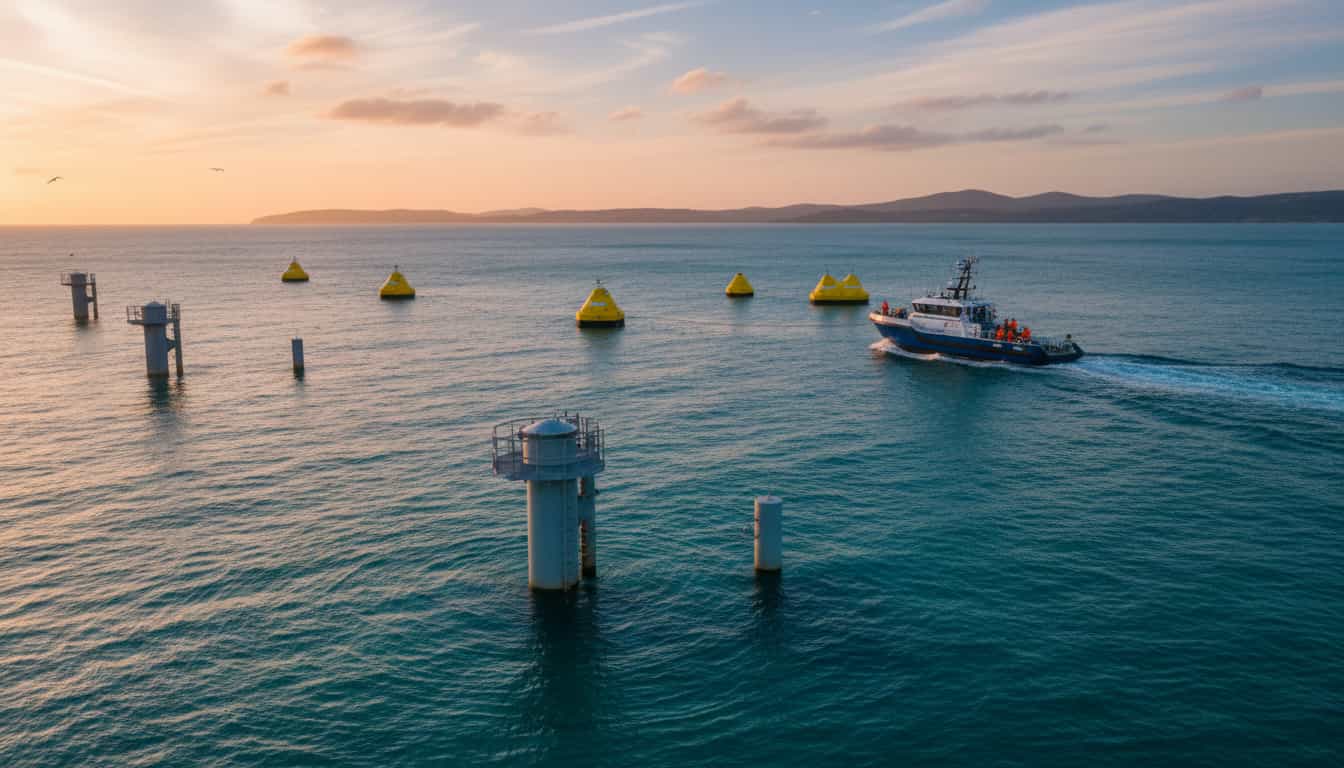
- Floating tidal platforms: Unlock deeper channels and reduce foundation costs.
- Advanced materials: Composite blades, anti‑fouling surfaces, and cathodic protection extend service life.
- Power‑to‑X integration: Pairing marine energy with electrolyzers for green hydrogen smooths variability and decouples production from grid constraints.
- Hybrid ocean farms: Co‑locating wave devices with offshore wind to share moorings, cables, and maintenance vessels.
- AI‑driven controls: Real‑time optimization of blade pitch, PTO damping, and storm survival modes elevates yield and survivability.
Site selection and resource assessment
Developers evaluate tidal range and current maps, wave climate (significant wave height, period, direction), bathymetry, sediment transport, shipping lanes, protected habitats, and grid proximity. Bankable projects align strong resources with favorable permitting regimes, stakeholder engagement (fisheries, shippers, conservation groups), and clear interconnection pathways.
From pilot to commercial scale
The path typically follows:
- Resource mapping and environmental baseline studies.
- Device selection and techno‑economic modeling.
- Permitting and stakeholder consultations.
- Prototype deployment and monitored operation.
- Array expansion, standardization, and long‑term O&M optimization.
As arrays grow, economies of scale reduce LCOE, and performance data derisks financing. Insurance products tailored for marine renewables and government support mechanisms (grants, contracts for difference, tax credits) accelerate commercialization.
Why now?
Global decarbonization targets, electrification of coastal industries, and the need for grid‑friendly renewables put tidal and wave power in the spotlight. With predictable generation, small visual footprint, and synergies with offshore wind and hydrogen, ocean energy is emerging as a strategic pillar in diversified clean‑energy portfolios.
Tidal and wave turbines transform the sea’s perpetual motion into dependable electricity. While challenges remain—cost, durability, and permitting—innovation and scaling are rapidly improving the outlook. For coastal grids and island nations seeking resilient, low‑carbon power, marine energy offers a compelling, increasingly bankable solution.