
Robotaxi Wars in the US: Waymo vs Cruise vs Tesla – Who’s Truly Level 4?
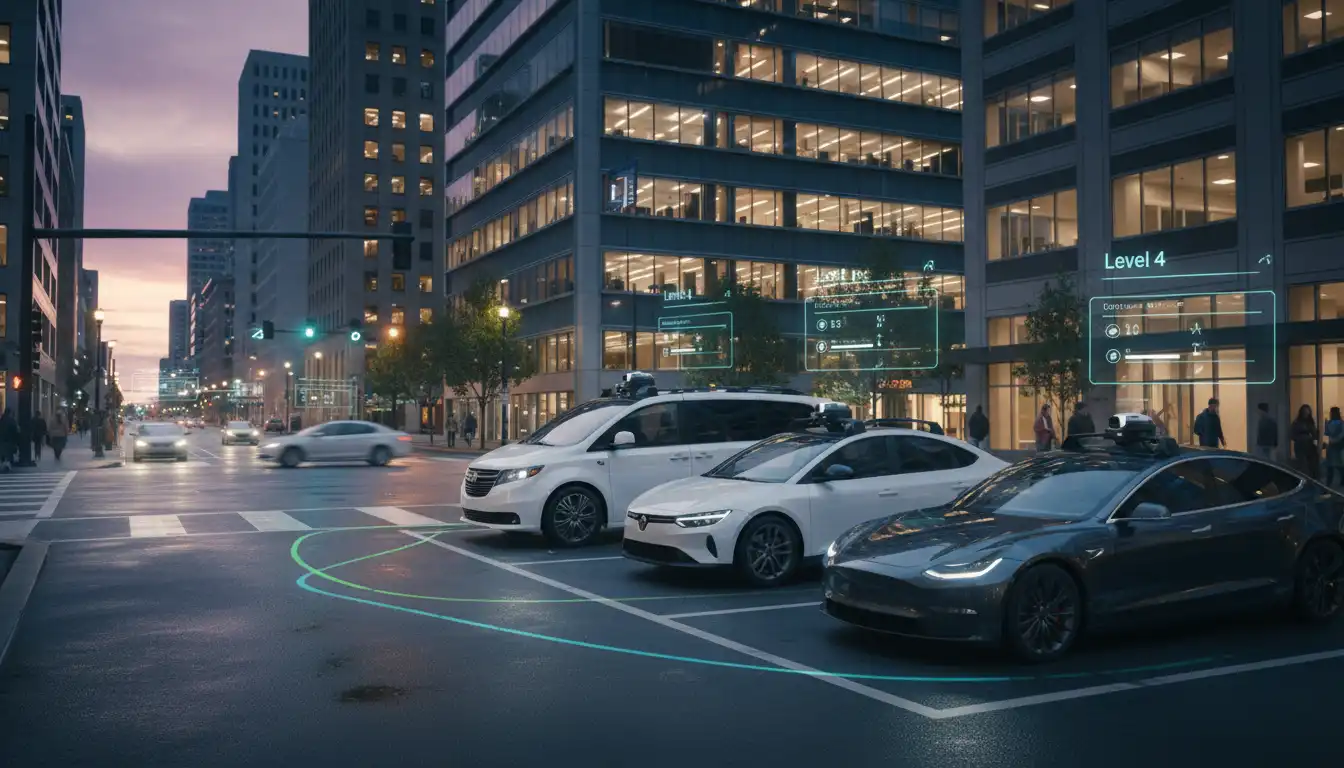
The race to dominate robotaxis in the United States has turned into a three‑way battle between Waymo, Cruise, and Tesla. All three companies promise safer, cheaper, and more convenient transportation powered by artificial intelligence. But behind the ambitious marketing claims lies a crucial technical question: who is truly operating at Level 4 autonomy, and who is still closer to advanced driver assistance?
To understand this “robotaxi war,” we need to look at the SAE autonomy levels, real‑world deployments, regulatory approvals, and the underlying technology strategies of each company.
What Does Level 4 Autonomy Really Mean?
The SAE (Society of Automotive Engineers) defines six levels of driving automation from Level 0 to Level 5. Today’s robotaxi leaders aim for Level 4:
- The system can perform all driving tasks in a specific Operational Design Domain (ODD) (for example, certain cities, mapped areas, or good weather).
- Human intervention is not required within that domain, even if the passenger is not a licensed driver.
- The vehicle can reach a safe fallback position (for example, pull over or stop) if there is a system failure.
Level 4 is very different from Level 2 or Level 2+ driver assistance, where the human driver must constantly supervise and remain responsible. This distinction is at the heart of the debate around Tesla’s Full Self‑Driving (FSD) versus the fully driverless robotaxi services of Waymo and Cruise.
Waymo: The Most Mature Level 4 Robotaxi Today
Waymo, a subsidiary of Alphabet (Google’s parent company), is widely viewed as the closest to true Level 4 autonomy in the US market.
- Fully driverless operations
Waymo operates driverless robotaxis—with no human safety driver—in mapped urban areas such as parts of Phoenix, San Francisco, and Los Angeles, and has been gradually expanding its service zones. Passengers can hail rides through the Waymo app, similar to Uber or Lyft, but the vehicle drives itself from start to finish. - Regulatory approvals and safety data
Waymo has received regulatory approvals in several states to operate a commercial autonomous ride‑hailing service. While incidents do occur, Waymo publishes safety reports and collision data, positioning itself as a methodical and cautious leader in self‑driving technology. - Tech stack: lidar‑heavy and map‑centric
Waymo relies on:- Lidar, radar, and high‑resolution cameras
- HD maps with detailed lane‑level information
- Powerful onboard compute and backend simulation
- Why Waymo is generally considered Level 4
- No steering wheel input from passengers
- No expectation of human supervision
- Ability to complete trips or perform safe stops autonomously
In approved ODDs, Waymo’s vehicles meet the formal definition of Level 4 more clearly than most competitors.
Cruise: Ambitious Level 4 Robotaxis with Setbacks
Cruise, majority‑owned by General Motors, also built its brand around fully driverless robotaxis. For a period, Cruise operated driverless rides in cities like San Francisco, Austin, and Phoenix, positioning itself as a direct rival to Waymo.
- Rapid urban rollout, then regulatory pushback
Cruise focused on dense urban environments, which are some of the hardest places for autonomous driving. After several high‑profile incidents and safety concerns, regulators in California suspended Cruise’s robotaxi permit, forcing the company to scale back and reevaluate safety processes and technical systems. - Technology strategy
Like Waymo, Cruise uses:- Lidar, radar, and cameras
- Detailed mapping and simulation
- End‑to‑end AI models blended with rules‑based logic
- Is Cruise Level 4 today?
Technically, Cruise’s system was designed for Level 4 operation—driverless within constrained ODDs. However, a true Level 4 service requires consistent, reliable performance and regulatory approval. After the suspensions and internal restructuring, Cruise is in a rebuilding phase. It has the architecture of a Level 4 system, but its operational reality is more limited than Waymo’s as of now.
Tesla: Advanced Driver Assistance or Real Robotaxi?
Tesla approaches autonomy very differently from Waymo and Cruise. Its Full Self‑Driving (FSD) package is marketed with lofty promises, including the long‑teased vision of a Tesla Robotaxi fleet made up of customer‑owned vehicles. However, from a technical and regulatory standpoint, Tesla’s system remains Level 2 (or at best Level 2+).
- Driver supervision is mandatory
Tesla’s own documentation instructs drivers to:- Keep hands on the wheel
- Remain attentive at all times
- Be ready to take over immediately
- Camera‑only “vision” strategy
Tesla has committed to a camera‑only perception stack, removing radar and ignoring lidar. It trains large neural networks on billions of miles of driving data, aiming for scalable, software‑driven autonomy. Supporters argue this approach will deliver massive scalability and rapid improvement once the models reach sufficient capability. Critics point out that lack of redundancy and reliance on vision alone adds risk and complexity, especially in poor weather or low‑visibility conditions. - No approved driverless fleet yet
Unlike Waymo and Cruise, Tesla:- Does not operate a regulator‑approved, fully driverless robotaxi service in any US city.
- Has not demonstrated widespread, unattended operation of vehicles without a responsible human in the driver’s seat.
- Is Tesla anywhere near Level 4 right now?
In certain environments, FSD can perform impressive end‑to‑end driving. However, because driver supervision is always legally and practically required, Tesla is currently delivering advanced driver assistance (Level 2), not Level 4. The company may eventually launch a dedicated robotaxi platform, but as of now, it is not operating a true Level 4 service in the US.
Comparing Waymo, Cruise, and Tesla on Level 4 Criteria
To decide who is truly Level 4, we can measure each player against core Level 4 requirements:
- No need for human fallback within ODD
- Waymo: Yes, in its deployed service zones.
- Cruise: Architecturally yes, but operations have been constrained due to safety and regulatory issues.
- Tesla: No, the human driver is always the fallback.
- Regulatory approval for driverless operation
- Waymo: Yes, in multiple cities and states.
- Cruise: Yes historically, but currently under tighter restrictions and rebuilding.
- Tesla: No, only driver‑assist features, not a certified driverless service.
- Business model focused on robotaxi service vs consumer cars
- Waymo: Pure robotaxi, ride‑hailing focus.
- Cruise: Robotaxi and autonomous delivery.
- Tesla: Primarily consumer car sales with a promised future robotaxi network.
Based on these factors, Waymo stands as the clearest example of a Level 4 robotaxi operator in the US today. Cruise retains Level 4 ambitions but is in recovery mode. Tesla’s system, despite aggressive branding, is best understood as Level 2+ driver assistance that aspires to Level 4 in the future.
Why the Distinction Matters for Safety and Trust
Marketing language often blurs the line between “self‑driving” and “driver assistance,” and that confusion can be dangerous. When consumers believe they have a self‑driving car but are actually using Level 2 tech that demands full attention, the risk of misuse grows.
- Waymo and Cruise design their systems so that passengers are not drivers; the AI is the responsible operator within its ODD.
- Tesla still treats occupants as active drivers, even when FSD is engaged.
For regulators, city planners, and everyday riders, understanding who is truly Level 4 is essential for setting policies, designing infrastructure, and deciding whom to trust with large‑scale deployment.
The Future of US Robotaxis
The US robotaxi landscape will continue to evolve rapidly:
- Waymo is likely to expand into more cities and grow ride volume as it refines safety and economics.
- Cruise will focus on restoring regulatory confidence and proving that a high‑density urban robotaxi fleet can operate safely at scale.
- Tesla will push software updates, refine FSD, and may eventually launch a dedicated robotaxi platform or fleet, but it must cross both technical and regulatory thresholds to truly reach Level 4.
In the current moment, when we ask “Who’s truly Level 4?”, the most accurate answer is:
Waymo is the strongest and most credible Level 4 robotaxi operator in the US today, while Cruise is rebuilding and Tesla remains at Level 2 driver assistance, despite its long‑term robotaxi vision.