
Human-Robot Collaboration: Safer Cobots for American Factories and Global Manufacturing
Human-robot collaboration is reshaping the future of manufacturing, especially in American factories that are under pressure to increase productivity, reduce costs, and maintain worker safety. Collaborative robots—better known as cobots—are at the center of this transformation. Unlike traditional industrial robots that operate inside cages, cobots are designed to work side by side with people, sharing the same workspace and complementing human skills.
For American manufacturers competing in a global market, safer and smarter cobots are no longer optional; they are becoming a strategic necessity. As supply chains grow more complex and customer expectations rise, companies need flexible, scalable, and resilient production systems. Human-robot collaboration, when implemented correctly, can help factories achieve these goals while preserving jobs and boosting workforce satisfaction.
What Makes Cobots Different from Traditional Industrial Robots?
Traditional robots are powerful, fast, and often dangerous if a human gets too close. Because of this, they are usually confined to fenced-off areas and perform repetitive tasks in isolation. Cobots, on the other hand, are built with safety and collaboration in mind from day one.
Key differences include:
- Built-in safety features: Cobots typically have force and torque sensors, vision systems, and safety-rated monitored stops. These features allow them to detect unexpected contact and either slow down or stop completely.
- Ease of programming: Many cobots can be programmed via intuitive interfaces or by physically guiding the arm through desired motions. This lowers the barrier for small and mid-sized manufacturers that may not have large automation teams.
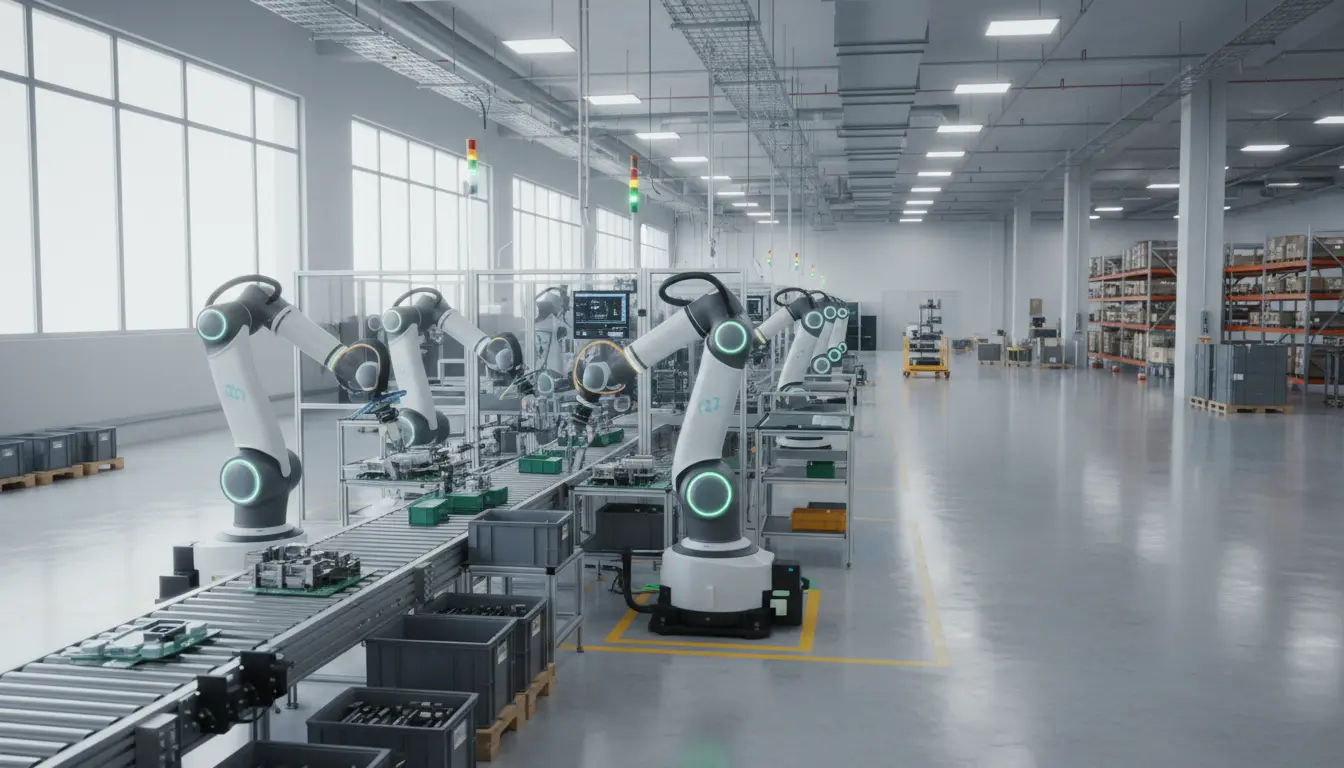
- Flexible deployment: Cobots are generally lighter, more compact, and easier to relocate. This supports high-mix, low-volume production environments common in modern American manufacturing.
These characteristics allow companies to integrate automation into processes that were previously considered too variable or too risky to automate fully.
Why Human-Robot Collaboration Matters for American Factories
American manufacturers face several structural challenges: labor shortages, aging workforces, rising wages, and fierce international competition. Human-robot collaboration offers a practical way to address these issues without resorting to offshoring or lowering standards.
- Mitigating labor shortages
Many factories struggle to fill positions for repetitive, physically demanding, or monotonous work. Cobots can take over tasks such as machine tending, packaging, palletizing, or basic assembly, allowing human workers to move into higher-value roles like quality control, process improvement, and supervision. - Enhancing productivity and consistency
Cobots excel at precision and repeatability. When combined with human problem-solving and adaptability, the result is a more stable, efficient production system. American companies can use cobots to maintain throughput even during demand spikes or staff turnover. - Keeping production onshore
By pairing human expertise with automation, manufacturers can keep production in the United States while remaining cost-competitive with low-cost regions. This supports local economies and shortens supply chains, which has become more important after recent global disruptions.
Safety as the Foundation of Collaborative Robotics
For human-robot collaboration to be truly effective, safety must remain the top priority. Cobot manufacturers and system integrators are investing heavily in safety technologies and standards that minimize risk while preserving productivity.
Some of the most important safety elements include:
- Power and force limiting: Cobots are designed with rounded edges, limited speeds, and force thresholds. If the robot detects an impact beyond a preset limit, it stops automatically, reducing the risk of serious injury.
- Speed and separation monitoring: Advanced sensors, including 3D cameras and LiDAR, track the position of humans in real time. If a person enters a predefined zone, the cobot slows or pauses until the area is clear.
- Safe stop functions and emergency interfaces: Clearly labeled emergency stop buttons, safety-rated control systems, and predictable behavior help workers feel confident working near cobots.
- Compliance with global safety standards: Standards such as ISO 10218 and ISO/TS 15066 provide guidelines for safe human-robot interaction. Companies that follow these frameworks can systematically assess and reduce risk.
Safety is not only a technical issue but also a cultural one. American factories that invest in training, clear procedures, and open communication about cobots often see higher acceptance, less fear, and better cooperation between workers and machines.
Global Manufacturing Trends and the Role of Safer Cobots
Beyond the United States, global manufacturing is shifting toward more agile, distributed production networks. Companies operate factories across multiple regions, each with different labor costs, regulations, and market demands. Safer cobots make it easier to deploy standardized automation solutions worldwide while adapting to local constraints.
Some key global trends include:
- Mass customization: Customers expect more product variants, shorter lead times, and higher quality. Cobots can be reprogrammed quickly to handle new tasks, helping manufacturers respond to changing orders without large capital investments.
- Reshoring and nearshoring: Geopolitical risks and logistics challenges have prompted many companies to bring production closer to end markets. Human-robot collaboration enables high-cost regions to remain competitive by combining advanced automation with skilled labor.
- Sustainability and resource efficiency: Cobots support precise material handling, reduce scrap, and enable more energy-efficient workflows. As sustainability regulations tighten worldwide, these advantages become increasingly valuable.
In this context, safer cobots are not simply tools for cutting labor costs; they are enablers of a more resilient, intelligent, and sustainable global manufacturing ecosystem.
Designing Workflows that Combine Human Strengths and Robot Strengths
The real power of human-robot collaboration appears when factories design workflows that intentionally leverage the unique strengths of both people and machines.
- Humans are creative, adaptable, and good at solving unstructured problems, making judgments, and dealing with variation.
- Cobots are precise, tireless, and reliable, performing high-frequency, repetitive tasks without fatigue or loss of concentration.
Common collaborative scenarios include:
- Hybrid assembly lines: Cobots handle repetitive fastening, gluing, or insertion tasks while humans handle inspection, decision-making, and fine adjustments.
- Assisted heavy lifting: Cobots and collaborative lifting devices reduce physical strain on workers, lowering the risk of musculoskeletal injuries.
- Quality inspection support: Vision-equipped cobots can pre-screen parts for obvious defects, while humans focus on more nuanced or subjective quality checks.
By designing tasks in this way, American factories can improve throughput and quality while making jobs more attractive and less hazardous.
Overcoming Challenges in Implementing Cobots
Despite the benefits, many organizations encounter obstacles when trying to adopt cobots:
- Unclear ROI calculations: It can be difficult to quantify the full value of human-robot collaboration, which includes reduced injuries, lower turnover, and higher quality.
- Change management and worker concerns: Employees may fear job loss or feel uncomfortable working near robots. Transparent communication, upskilling, and involving workers in the implementation process can reduce resistance.
- Integration complexity: Cobots rarely operate in isolation. Successful deployment requires integrating them with existing machines, conveyors, IT systems, and safety infrastructure.
Forward-thinking American manufacturers address these challenges through pilot projects, cross-functional teams, and close collaboration with robot suppliers and integrators. They treat cobot adoption as a strategic transformation, not just a technology purchase.
The Future of Safer Cobots in American and Global Manufacturing
Looking ahead, the next generation of cobots will be smarter, more responsive, and even safer. Advances in AI, machine learning, and computer vision will enable cobots to better understand their environment, adapt to variations, and anticipate human actions.
We can expect:
- More intuitive interfaces: Voice commands, AR-assisted programming, and no-code platforms that allow almost any worker to teach a robot new tasks.
- Improved situational awareness: Cobots that can recognize tools, parts, and human gestures, leading to smoother, more natural collaboration.
- Adaptive safety zones: Dynamic safety envelopes that change based on the task, speed, and proximity of humans, optimizing both safety and productivity.
For American factories and global manufacturers, this evolution represents a significant competitive opportunity. Companies that start building experience with human-robot collaboration today will be better prepared to harness these technologies as they mature.
Ultimately, safer cobots are not about replacing humans. They are about creating smarter, more humane factories where people and machines jointly deliver higher value. In this vision of the future, American manufacturing can maintain its innovative edge while contributing to a more efficient and sustainable global production landscape.