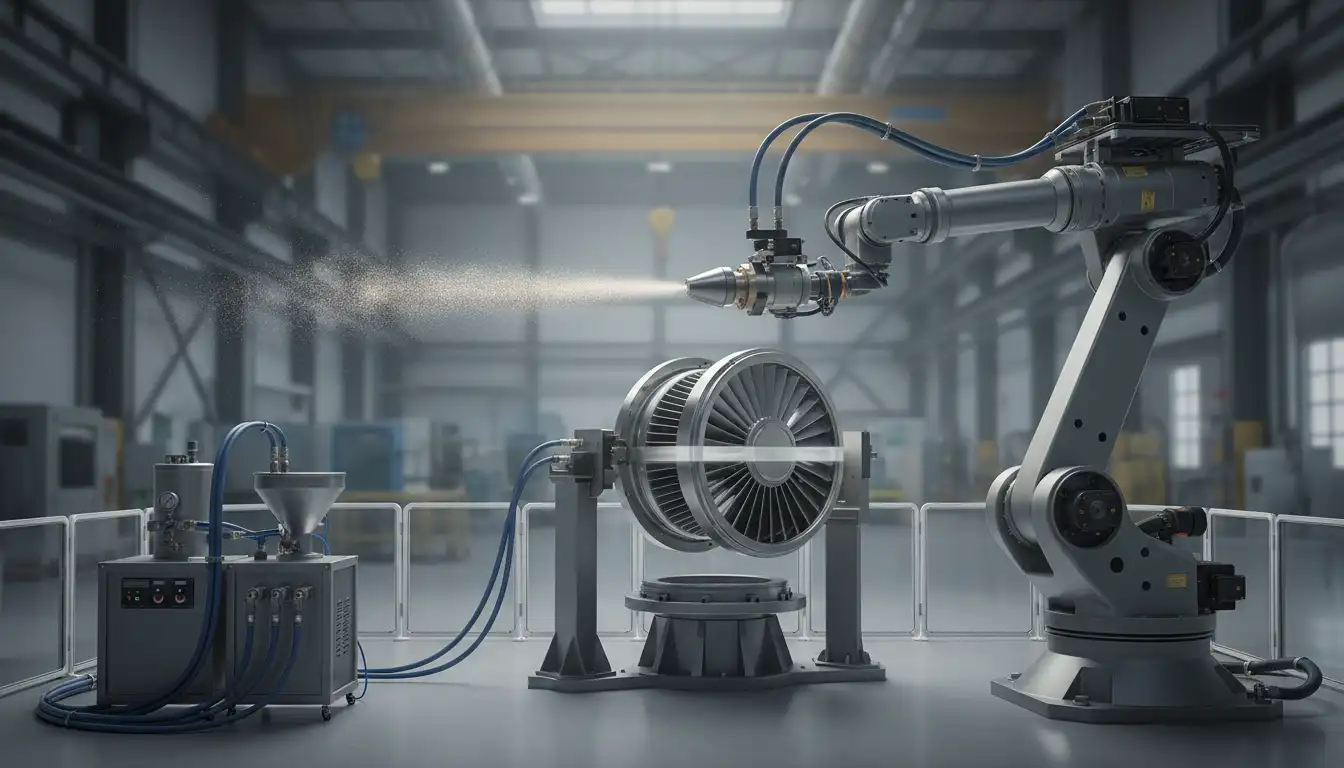

Cold Spray Production for Fast Metallic Coating
Cold spray production is a modern method for fast metallic coating with minimal thermal impact.
Industries use this technology to repair, protect, and upgrade critical metal components efficiently.
The process delivers dense, strong coatings while keeping the base material structure nearly unchanged.
What Is Cold Spray Technology?
Cold spray is a solid-state coating process that uses high-speed metal particles.
These particles travel at supersonic velocity and impact the substrate with extreme kinetic energy.
Bonding occurs through severe plastic deformation at the surface, not by melting the material.
Because temperatures remain below melting points, the process avoids typical thermal spray problems.
How the Cold Spray Process Works
A gas, usually nitrogen, helium, or air, is compressed and heated moderately.
The gas flows through a specially designed nozzle, accelerating metal particles to supersonic speeds.
A powder feeder injects fine metallic or composite particles into this high-velocity gas stream.
When particles strike the substrate, they flatten, deform, and bond to form a dense coating.
Advantages of Fast Metallic Coating with Cold Spray
Cold spray offers very high deposition rates for fast metallic coating on complex components.
Manufacturers can quickly build thick layers, reducing production and repair lead times significantly.
Low process temperature prevents oxidation, melting, and undesirable microstructural transformations.
As a result, coatings maintain original alloy properties and often show enhanced mechanical performance.
Protection of Heat-Sensitive and High-Value Components
Many aerospace and automotive parts cannot tolerate high thermal loads during coating.
Cold spray production protects these heat-sensitive components by minimizing thermal distortion and stresses.
Thin walls, precision machined areas, and tight tolerances remain stable throughout the coating process.
This stability is critical for high-value components such as turbine blades and structural brackets.
Material Flexibility and Coating Options
Cold spray works with many metals, including aluminum, copper, nickel alloys, titanium, and stainless steel.
Engineers can blend powders to design hybrid or functionally graded coatings with tailored properties.
Lightweight aluminum coatings provide corrosion protection without adding significant mass to parts.
Nickel and titanium coatings deliver improved wear resistance and high-temperature performance in harsh conditions.
Microstructure and Mechanical Properties
Cold-sprayed coatings usually have very low porosity and strong adhesion to the substrate.
The feedstock does not melt, so original phases and microstructural features remain largely preserved.
This structure supports high hardness, good fatigue strength, and reliable corrosion resistance in service.
Such properties are valuable for defense, aerospace, and energy components exposed to demanding loads.
Cold Spray in Repair and Remanufacturing
Cold spray production is widely used for dimensional restoration of worn or damaged components.
Technicians rebuild material on shafts, housings, valves, and other critical parts quickly and accurately.
After spraying, machined surfaces can be finished back to original tolerances and surface quality.
This approach extends component life, reduces waste, and lowers overall maintenance costs for operators.
Role in Additive and Hybrid Manufacturing
Engineers apply cold spray as an additive tool on existing parts or simple substrates.
They build new features, reinforce high-stress zones, and modify geometries without full redesign.
Combined with machining, this hybrid method supports efficient “add and remove” manufacturing strategies.
Companies shorten development cycles and respond faster to custom or low-volume orders.
Process Control and Quality Assurance
Modern cold spray systems offer precise control of pressure, gas temperature, and standoff distance.
Operators tune these parameters to reach critical particle velocity and maximize deposition efficiency.
Real-time monitoring and automated control improve process stability and coating repeatability significantly.
These capabilities support certification and qualification in highly regulated industrial sectors.
Sustainability and Environmental Benefits
Cold spray production aligns well with circular economy and sustainable manufacturing principles.
The process generates minimal fumes and avoids fluxes, binders, and combustion-related emissions.
Repairing components instead of scrapping them reduces material consumption and landfill waste.
Energy demand is usually lower than high-temperature thermal spray or welding-based overlay methods.
Challenges and Considerations
Not every alloy responds equally well to cold spray due to ductility and particle behavior.
Engineers must optimize particle size, velocity, and substrate preparation for strong bonding.
Surface cleaning, grit blasting, and careful masking strongly influence adhesion and coating uniformity.
Ongoing research continues to expand the material range and process window for industrial users.
Industrial Applications of Cold Spray Production
Aerospace companies use cold spray for structural repair, corrosion protection, and lightweight coatings.
Automotive manufacturers apply it to improve wear resistance on shafts, pistons, and transmission components.
Energy and offshore sectors rely on it for corrosion-resistant overlays in aggressive service environments.
Defense organizations exploit cold spray for fast metallic coating on mission-critical hardware and equipment.
Future Outlook for Cold Spray Technology
Demand for longer component life and efficient maintenance will continue to drive cold spray adoption.
Growing experience, better equipment, and more standards will reduce barriers for new applications.
As industries seek cleaner, faster, and more reliable coating methods, cold spray will gain importance.
Companies that invest early can secure performance advantages and stronger sustainability credentials.