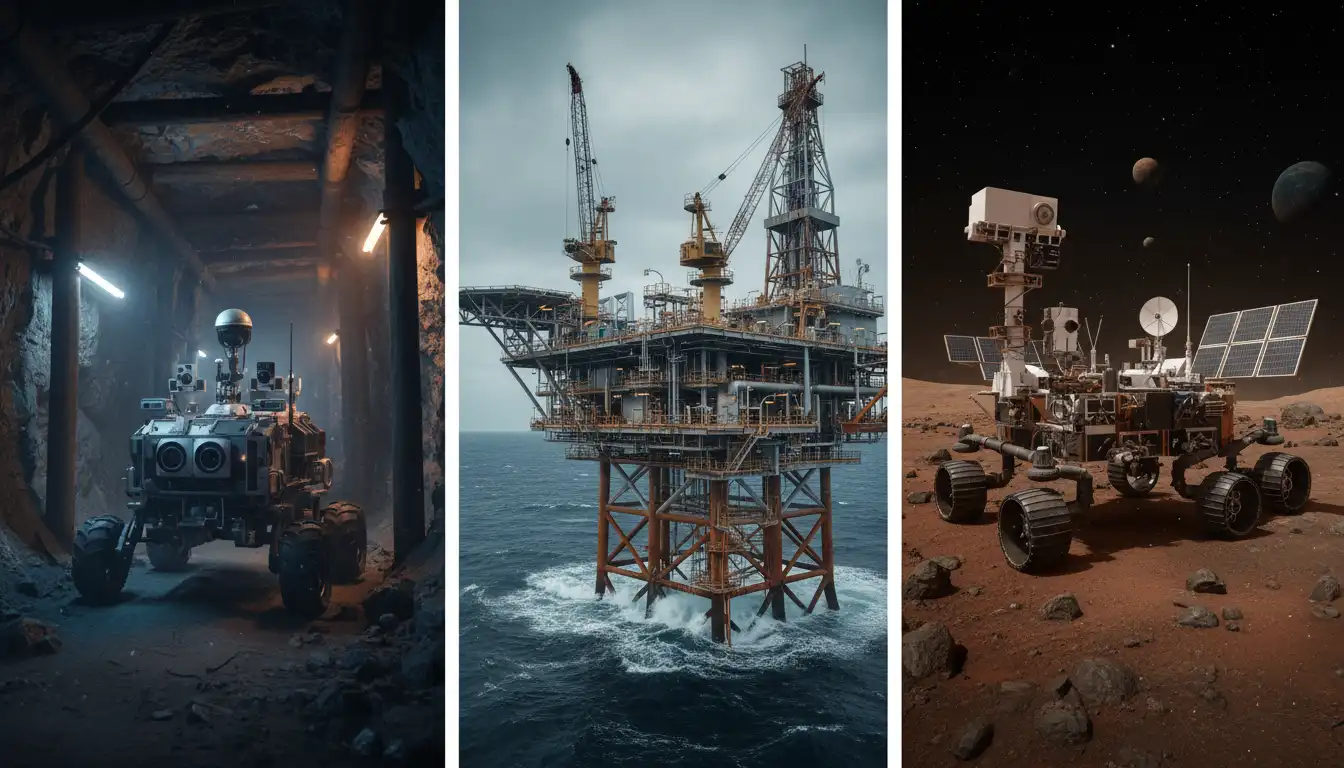

Article: Robotics in Hazardous Environments: Mining, Oil Rigs and Space
Robotics in hazardous environments is transforming how we work in some of the world’s most dangerous industries. From deep underground mines to offshore oil platforms and the vacuum of space, advanced robots are reducing risks to human workers, increasing productivity and enabling operations that were impossible just a decade ago. As sensors, artificial intelligence and autonomous navigation systems evolve, industrial robots are becoming the backbone of modern safety strategies in extreme conditions.
Why Robotics in Hazardous Environments Matters
Many industrial environments are inherently dangerous. In underground mines, workers face explosions, collapsing tunnels, toxic gases and limited visibility. On offshore oil rigs, harsh weather, high pressures, flammable materials and remote locations create constant risk. In space, astronauts must cope with radiation, temperature extremes and the absence of atmosphere. In all these contexts, robotics technology offers a way to shift people away from frontline danger and into supervisory and decision‑making roles.
By deploying robots to perform inspection, maintenance, drilling, transport and emergency response tasks, companies can dramatically reduce accident rates. At the same time, robotic automation improves operational continuity; machines can work continuously without fatigue, and they can enter areas that would be lethal or inaccessible to humans. As a result, robotics in hazardous environments is both a safety solution and a strategic investment in long‑term resilience.
Robotics in Mining: Underground Safety and Efficiency
Mining is one of the earliest industries to adopt heavy automation and mobile robots. Autonomous haul trucks, drilling rigs and loaders are now common in large open‑pit and underground mines. These robotic systems rely on lidar, radar, GPS, inertial sensors and computer vision to navigate complex terrain and avoid collisions, even in dusty, low‑light conditions.
In underground mines, remote‑operated and semi‑autonomous vehicles handle drilling, blasting preparation and ore transport. Human operators supervise from control rooms on the surface, using real‑time video feeds and sensor data to guide decisions. This approach minimizes exposure to rock falls, gas leaks and explosions. Robotic inspection units equipped with gas sensors, thermal cameras and vibration detectors can enter newly blasted or structurally unstable areas to scan for hazards before human entry.
Another significant application is in mine mapping. Swarm robots and autonomous drones create high‑resolution 3D maps of tunnels, shafts and ventilation systems. These digital twins support better planning, structural analysis and predictive maintenance. By combining geospatial data with AI‑driven analytics, mining companies can optimize blast patterns, reduce energy consumption and improve resource recovery, all while keeping people at a safe distance from active faces and hazardous zones.
Robotics on Oil Rigs: Inspection, Maintenance and Risk Reduction
Offshore oil and gas platforms present a unique combination of mechanical complexity, environmental extremes and high‑value assets. Traditionally, human technicians must climb flare stacks, walk along exposed decks and work near high‑pressure systems, often in rough seas and high winds. Robotics in hazardous environments is reshaping this reality through ground, climbing and underwater robots.
On the topside of oil rigs, quadruped robots and tracked inspection units patrol decks, monitor equipment and gather continuous data. They carry high‑resolution cameras, microphones, gas detectors and thermal sensors to identify leaks, overheating components and structural corrosion. Because these robots are ruggedized against salt spray, vibration and temperature changes, they can perform scheduled inspections regardless of weather, improving both safety and asset integrity.
Climbing robots are another breakthrough for riser and flare stack inspection. They adhere to vertical structures using magnetic wheels, vacuum systems or mechanical grips, traveling to heights that would require scaffolding or rope access for human workers. This reduces exposure to falls and minimizes downtime, since inspections can occur while the platform remains partially operational.
Below the surface, remotely operated vehicles (ROVs) and autonomous underwater vehicles (AUVs) maintain subsea pipelines, wellheads and manifolds. These underwater robots handle tasks like valve manipulation, visual inspection and cleaning in high‑pressure, low‑visibility environments that are dangerous and expensive for human divers. Coupled with real‑time data analytics, robotic inspection supports condition‑based maintenance, extending the life of critical offshore infrastructure and reducing the likelihood of catastrophic failures.
Space Robotics: Working Beyond Human Limits
Space is perhaps the ultimate hazardous environment. Vacuum, radiation, microgravity and extreme temperature swings make even simple tasks complex and risky for humans. This is why robotic systems are central to space exploration and orbital operations. From planetary rovers to satellite‑servicing arms, robotics in hazardous environments is literally expanding our reach into the solar system.
Planetary rovers such as those on Mars demonstrate how autonomy and rugged engineering can deliver science in places where humans cannot yet go. These robots navigate rocky terrain, avoid obstacles and conduct experiments with a significant communication delay. Advanced autonomy, path‑planning algorithms and robust mechanical design enable them to survive dust storms, radiation and temperature fluctuations.
In Earth orbit, robotic arms and servicing vehicles perform assembly tasks, repairs and refueling operations. They can capture drifting satellites, manipulate large solar panels and support construction of space stations or future habitats. This reduces the number and complexity of spacewalks required by astronauts, lowering risk and mission cost. As on‑orbit manufacturing and commercial space stations grow, robotics technology will be essential for routine operations and emergency response.
Emerging projects envision teleoperated robots on the Moon or Mars, controlled from nearby orbit or from Earth with assistance from AI. These systems could build landing pads, deploy solar arrays and construct habitats before human crews arrive, turning hazardous, unprepared surfaces into safer, semi‑automated work sites.
Core Technologies Enabling Robotics in Extreme Conditions
Robotics in hazardous environments depends on a combination of hardware durability and intelligent software. Key enablers include:
- Ruggedized mechanical design: Sealed housings, shock‑absorbing structures and specialized materials allow robots to withstand dust, moisture, vibration, radiation and corrosive chemicals.
- Advanced sensors: Lidar, radar, ultrasonic sensors, multispectral cameras, gas detectors and thermal imagers provide rich situational awareness, even in low visibility or underwater.
- Autonomous navigation and control: AI‑powered algorithms enable robots to localize themselves, map their surroundings, avoid obstacles and plan safe paths in dynamic, unstructured environments.
- Edge computing and connectivity: Onboard processors analyze sensor data in real time, while secure communication links transmit summaries and alerts to human supervisors for higher‑level decisions.
- Human‑robot collaboration interfaces: Intuitive control panels, augmented reality overlays and haptic feedback devices make it easier for operators to supervise multiple robots, switch between autonomy and manual control and respond quickly to anomalies.
As these technologies mature, robots become more capable of handling complex tasks with minimal supervision, making them suitable for 24/7 deployment in high‑risk settings.
Safety, Regulation and Ethical Considerations
While robotics in hazardous environments improves safety, it also introduces new challenges. Organizations must ensure that robotic systems are reliable, cyber‑secure and compliant with industry standards. Failure modes must be carefully studied; a malfunctioning robot on an oil rig or near sensitive mining equipment could create new risks instead of reducing them.
There are also workforce implications. Some manual roles will shrink, while demand grows for robot technicians, data analysts and AI specialists. Responsible adoption strategies focus on reskilling and upskilling existing staff, turning former field workers into remote operators and maintenance experts who understand both the environment and the technology.
Clear safety protocols, transparent decision‑making and ongoing monitoring are essential. When human and robotic teams work together, procedures must define how authority transfers between autonomous control and human intervention, especially during emergencies.
The Future of Robotics in Hazardous Environments
Looking ahead, robotics in hazardous environments will become more adaptive, more autonomous and more tightly integrated into industrial ecosystems. Swarms of small robots may collaborate to inspect massive mines, oil fields or orbital infrastructure. Self‑healing systems could diagnose and repair themselves without human intervention. AI models trained on vast operational datasets will anticipate failures before they occur, enabling predictive maintenance at scale.
Ultimately, the goal is not to replace humans entirely, but to relocate them from the line of fire to positions of oversight, innovation and strategic control. As robotics in hazardous environments evolves, it will redefine what is possible in some of the toughest workplaces on — and off — our planet.