
Best University Laboratory Printers: A Comprehensive Guide for Academic Excellence
Modern universities rely heavily on advanced laboratory infrastructure to support research, innovation, and education. Among the most critical yet often underestimated components of this infrastructure are laboratory printers. From engineering faculties to biomedical research centers, the right printer significantly improves workflow efficiency, data accuracy, and experimental documentation.
This article explores the best university laboratory printers, explains their key features, and guides academic institutions toward smarter purchasing decisions.
Why Laboratory Printers Matter in Universities
University laboratories operate under unique conditions. They demand high precision, consistent output, and long-term reliability. Unlike standard office printers, lab printers must handle technical drawings, chemical labels, research charts, and high-resolution images without error.
A well-chosen printer:
- Reduces downtime during experiments
- Ensures accurate labeling and documentation
- Supports interdisciplinary research needs
- Enhances compliance with safety and archival standards
Universities that invest in professional-grade lab printers protect both their research quality and operational efficiency.
Key Printer Types Used in University Laboratories
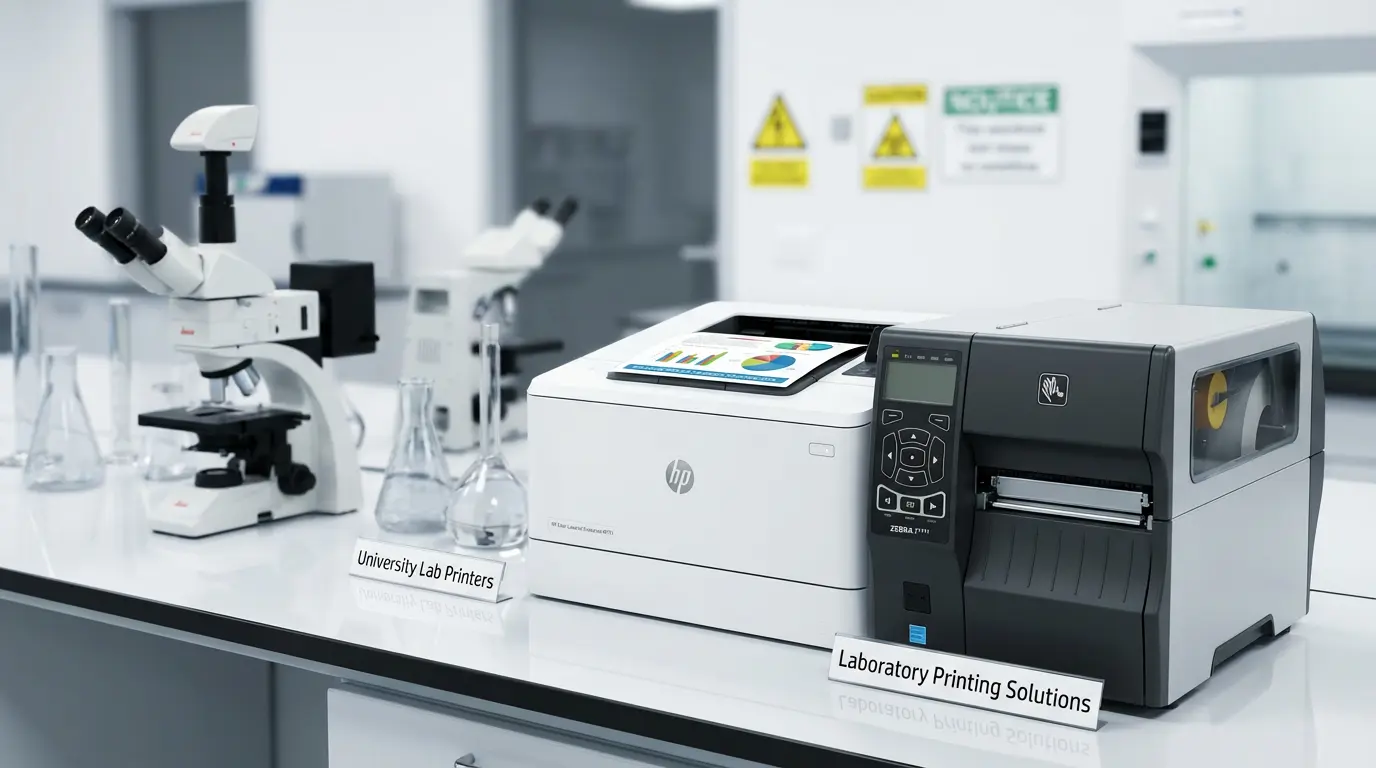
Different academic disciplines require different printing solutions. Universities typically deploy several printer categories across their labs.
1. Laser Printers for Research Documentation
Laser printers dominate university labs due to their speed and precision. They handle dense scientific texts, graphs, and monochrome reports efficiently.
Advantages:
- High-speed printing
- Low cost per page
- Sharp text output
Laser printers suit physics, chemistry, and mathematics departments where documentation accuracy is critical.
2. Inkjet Printers for High-Resolution Output
Inkjet printers play a crucial role in biology, medical imaging, and environmental science labs.
Advantages:
- Superior color accuracy
- Ideal for images and charts
- Supports specialty papers
These printers excel in printing microscopic images, color-coded data, and research posters.
3. Label Printers for Laboratory Safety
Proper labeling prevents costly mistakes and safety risks. Label printers support chemical storage, sample tracking, and equipment identification.
Advantages:
- Chemical-resistant labels
- Fast barcode printing
- Compliance with safety standards
University labs rely on label printers to maintain order and meet regulatory requirements.
4. 3D Printers for Engineering and Design Labs
Engineering and architecture faculties increasingly integrate 3D printers into their labs.
Advantages:
- Rapid prototyping
- Hands-on learning
- Supports STEM innovation
3D printers transform theoretical concepts into physical models, enhancing student engagement.
Essential Features to Look for in University Lab Printers
Choosing the right printer involves more than brand recognition. Universities should evaluate technical and operational factors carefully.
Print Accuracy and Resolution
Scientific data demands precise reproduction. Printers with high DPI (dots per inch) ensure clarity in charts, formulas, and images.
Durability and Duty Cycle
University labs run printers daily. Devices with high monthly duty cycles handle heavy workloads without frequent maintenance.
Connectivity and Network Support
Modern lab printers integrate seamlessly with campus networks. Ethernet, Wi‑Fi, and secure printing features simplify multi-user access.
Compatibility with Lab Software
Printers must support CAD software, statistical tools, and research platforms commonly used in academia.
Sustainability and Cost Efficiency in Academic Printing
Universities prioritize sustainability. Energy-efficient printers with low power consumption align with green campus initiatives.
Key sustainability factors include:
- Duplex printing
- Recyclable cartridges
- Energy Star certification
Cost efficiency also matters. Printers with affordable consumables reduce long-term expenses without sacrificing quality.
Security Considerations for Research Environments
Research data protection is critical. University lab printers must support:
- Secure print release
- User authentication
- Encrypted network communication
These features prevent unauthorized access to sensitive research materials.
Top Use Cases Across University Departments
Laboratory printers support diverse academic applications:
- Chemistry Labs: Chemical labeling and safety documentation
- Medical Faculties: Diagnostic images and reports
- Engineering Labs: CAD drawings and prototypes
- Environmental Science: Field data charts and maps
- Computer Science: Technical documentation and test outputs
A versatile printer portfolio ensures consistent performance across departments.
How Universities Can Optimize Printer Deployment
Centralized print management helps universities control costs and performance.
Best practices include:
- Assigning printers by lab function
- Monitoring usage analytics
- Scheduling preventive maintenance
- Training staff and students
Strategic deployment maximizes printer lifespan and productivity.
Recommended Amazon Product for University Laboratories
One highly rated option available on Amazon.com is the:
Brother HL‑L8360CDW Color Laser Printer
Why it fits university labs:
- High-speed color laser printing
- Strong network security features
- Reliable performance under heavy workloads
- Cost-efficient toner usage
This model supports both research documentation and color data visualization, making it suitable for multidisciplinary academic labs.
Future Trends in University Laboratory Printing
The future of lab printing moves toward:
- Cloud-based print management
- AI-powered maintenance alerts
- Eco-friendly materials
- Integration with laboratory information systems (LIMS)
Universities adopting these innovations gain a competitive edge in research efficiency.
Conclusion
Selecting the best university laboratory printers requires a balance of performance, reliability, security, and sustainability. By understanding departmental needs and focusing on long-term value, universities can create printing environments that support academic excellence and innovation.
A thoughtful printer investment strengthens research integrity, enhances safety, and improves the overall laboratory experience for students and faculty alike.