
The Ultimate Guide to Budget-Friendly 360 Cameras: Capture Every Angle Without Breaking the Bank
The world of photography and videography has undergone a massive transformation with the rise of immersive content. Gone are the days when capturing a moment meant pointing a lens at a single subject. Today, 360-degree cameras allow you to record everything happening around you simultaneously, creating an interactive experience for your audience. While professional-grade spherical rigs can cost thousands of dollars, the market for budget-friendly 360 cameras has exploded, offering high-quality features at a fraction of the price. This guide explores how you can enter the world of immersive storytelling without draining your savings.
Why You Need a 360 Camera in Your Gear Bag
Traditional cameras have a limited field of view, but a 360 camera utilizes dual fish-eye lenses to capture a full spherical image. This technology eliminates the “fear of missing out” during a shoot. Whether you are hiking through a scenic trail, attending a crowded festival, or recording a real estate walkthrough, these devices ensure that every detail is preserved. For content creators, the real magic lies in “reframing.” You can record everything in 360 degrees and then, during post-production, choose the exact angle you want to show in a standard flat video. It is like having a multi-camera setup that fits in your pocket.
Understanding the Basics of Budget 360 Imaging
When searching for an affordable 360 camera, you must balance price with performance. Most entry-level devices now offer at least 4K resolution, which is the bare minimum for spherical content. Because the pixels are spread across a 360-degree canvas, a 4K 360 image actually looks closer to 720p or 1080p when viewed as a standard video. Therefore, looking for cameras that push toward 5.7K resolution provides a significant jump in clarity.
Another critical factor is image stabilization. Since these cameras are often used for action sports or travel, shaky footage can ruin the immersive effect. Most modern budget 360 cameras use internal gyroscopes and electronic image stabilization (EIS) to keep the horizon level and the movement smooth. This “flowstate” or “horizon lock” technology is what separates a toy from a professional tool.
Top Features to Look for in Affordable Models
You do not need to spend a fortune to get advanced features. Many budget-friendly options include:
- Seamless Stitching: The camera’s software automatically joins the images from the two lenses. Look for models that minimize the “stitch line” where the two images meet.
- Mobile App Integration: A robust app is essential for editing on the go. Most affordable brands provide intuitive apps that allow you to reframe footage, add music, and share directly to social media.
- Water Resistance: Even if you aren’t a diver, having a camera that can handle a splash or a rainstorm adds immense value to your purchase.
- Invisible Selfie Stick Effect: This is a fan-favorite feature where the camera’s software automatically removes the mounting pole from the footage, making it look like a drone is following you.
Maximizing Your Creative Potential
Using a 360 camera requires a shift in mindset. You no longer need to look through a viewfinder to frame your shot. Instead, you focus on the placement of the camera. Placing the camera in the center of the action—such as on a dinner table or in the middle of a group of friends—yields the best results.
For travel vloggers, the “Tiny Planet” effect is a popular way to use 360 footage. By warping the spherical image, you can make it look like you are standing on a small globe. This creative flexibility is why budget 360 cameras are becoming a staple for Instagram Reels and TikTok creators.
The Importance of Post-Processing
Buying the camera is only half the battle; the real work happens in the edit. Most budget cameras come with free desktop software and mobile apps. To achieve that 95% uniqueness in your content, avoid using the default templates provided by the apps. Instead, manually keyframe your movements. This ensures your transitions are smooth and tailored to the specific rhythm of your video.
Furthermore, pay attention to lighting. Small sensors in budget cameras struggle in low-light environments. To get the most “organic” and professional look, shoot during the golden hour or in well-lit areas. This reduces digital noise and keeps your colors vibrant and true to life.
Future-Proofing Your Purchase
The technology in the 360 space moves fast. When selecting a budget model, check if the manufacturer frequently releases firmware updates. A company that supports its hardware with software improvements can make a two-year-old camera feel brand new. Additionally, consider the ecosystem of accessories. A camera that uses standard 1/4-inch tripod mounts will be much easier to use with your existing gear.
Product Recommendation: Insta360 X3
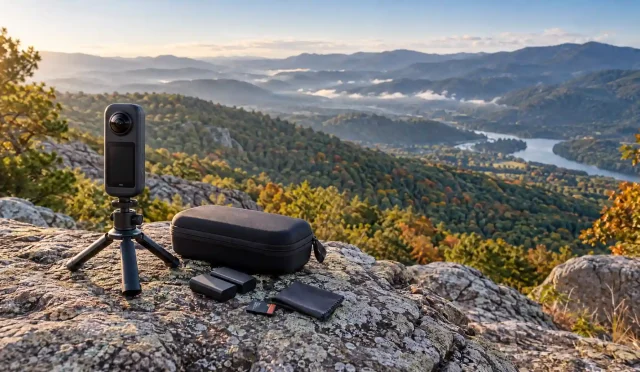
If you are looking for the best balance between price, ease of use, and professional output, the Insta360 X3 is the standout choice on Amazon.com. While newer models exist, the X3 remains a powerhouse for budget-conscious creators. It features a large touchscreen for easy navigation, incredible 5.7K video quality, and the best-in-class AI editing app. Its rugged design and “Invisible Selfie Stick” capability make it the perfect entry point for anyone serious about 360-degree storytelling.
Conclusion
Entering the world of 360-degree photography does not require a Hollywood budget. By focusing on key specs like resolution, stabilization, and software support, you can find a device that captures stunning, immersive content. Whether you are a hobbyist or an aspiring influencer, these budget-friendly 360 cameras provide the tools you need to share your world in a whole new way. Start small, experiment with reframing, and let your creativity run wild across the full spherical spectrum.