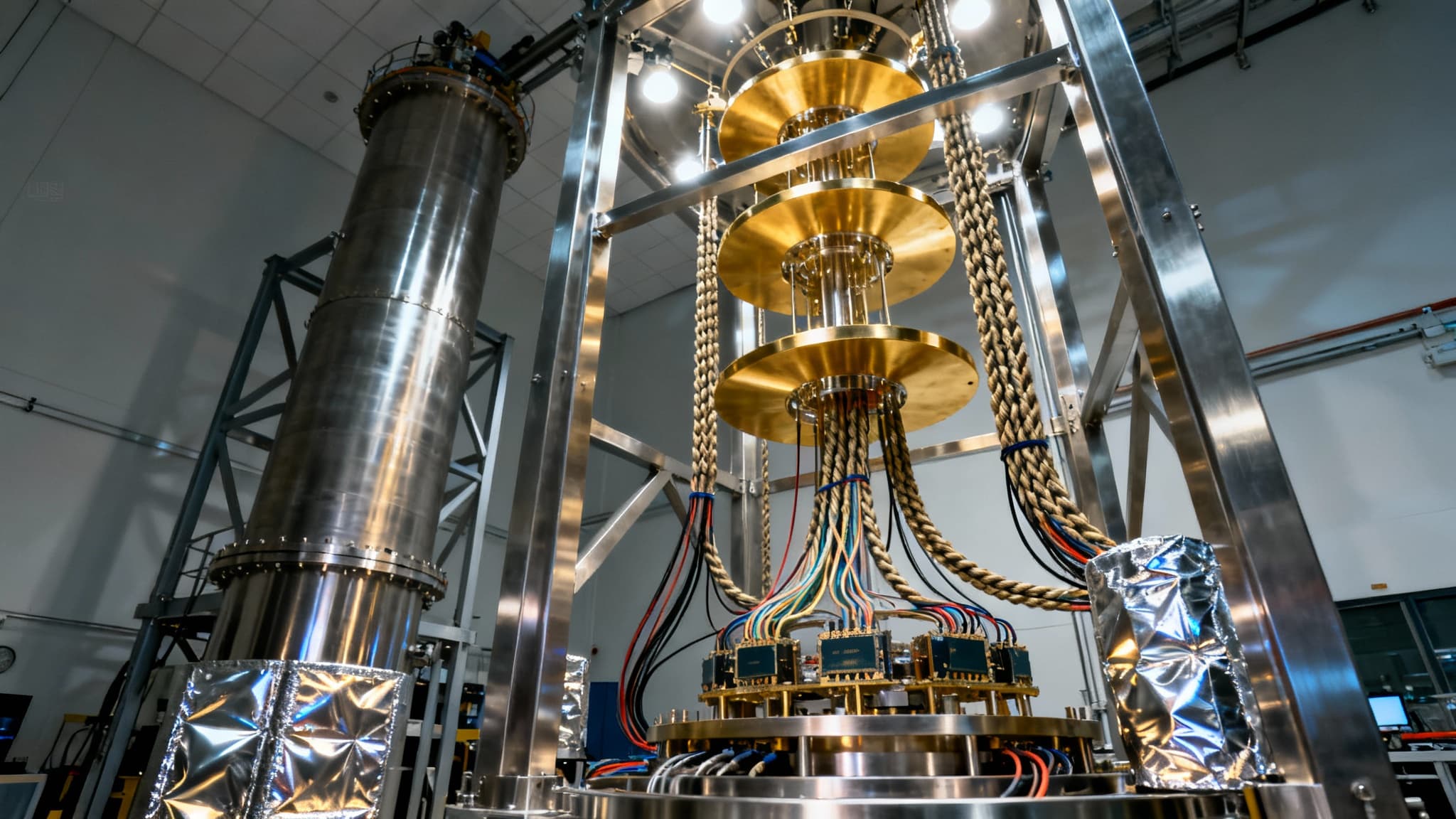

The computing world is on the brink of a major transformation driven by quantum computer chips. Unlike traditional silicon-based processors that rely on bits—values of either 0 or 1—quantum processors leverage qubits. Qubits have the extraordinary property of existing in a state of superposition, which allows them to represent multiple values simultaneously. This characteristic makes quantum computing exponentially faster at solving certain problems that are computationally intractable for classical computers.
In the United States, significant investments are being made by tech giants, startups, and government institutions to push the boundaries of quantum processor design. The aim is not only to accelerate computation but also to reshape industries including cryptography, drug discovery, financial modeling, and artificial intelligence.
This article will explore the fundamentals of quantum computer chips, how qubits work, recent technological breakthroughs, potential real-world use cases, and the challenges that must be overcome before the quantum revolution becomes mainstream.
What Are Quantum Computer Chips?
Quantum computer chips are the hardware backbone of quantum computing systems. Essentially, they are integrated circuits engineered to control and maintain qubits in precise quantum states. Unlike semiconductor chips found in modern laptops or smartphones, quantum chips require advanced materials, cryogenic environments near absolute zero, and complex control systems to function correctly.
A traditional transistor-based chip increases performance by shrinking transistor sizes and increasing transistor count. In contrast, a quantum chip improves performance by increasing the number of stable qubits and enhancing their coherence times—the duration in which qubits maintain stability without outside interference.
Qubits and Their Unique Characteristics
The power of quantum computing rests in the fundamental difference between qubits and classical bits. Key quantum properties include:
- Superposition:
A qubit can represent both 0 and 1 at the same time, enabling parallel computation. - Entanglement:
When qubits are entangled, the state of one immediately influences the state of another, no matter the distance. This property is vital for quantum speed-up in algorithms. - Coherence:
Qubits must maintain their quantum state long enough to complete calculations. Loss of coherence, or decoherence, is one of the greatest engineering hurdles in quantum computing.
Different physical realizations of qubits exist:
- Superconducting qubits (used by IBM and Google)
- Trapped ion qubits (used by IonQ and Honeywell)
- Topological qubits (still experimental, explored by Microsoft)
- Photon-based qubits (for optical quantum computing)
The Technological Breakthroughs in Quantum Chips
Between 2019 and 2024, rapid advances were made, with U.S.-based companies reaching major milestones.
- Google Sycamore Processor: Demonstrated “quantum supremacy” by performing a task in about 200 seconds that would take the world’s most powerful supercomputer 10,000 years.
- IBM Eagle: IBM unveiled a 127-qubit processor, pushing the boundary of quantum scaling.
- Intel Horse Ridge: Focused on cryogenic control chips to manage large-scale quantum systems.
These breakthroughs highlight the shifting focus from proof-of-concept experiments to practical, scalable quantum processors.
Real-World Applications
The practical power of quantum chips lies in their ability to revolutionize industries:
- Cryptography and Cybersecurity:
Quantum algorithms like Shor’s algorithm can break traditional RSA encryption in seconds, forcing the adoption of post-quantum cryptography. - Pharmaceuticals and Drug Discovery:
Quantum simulations can model molecular interactions at unprecedented accuracy—cutting down timelines for discovering new drugs. - Artificial Intelligence and Machine Learning:
Quantum neural networks and quantum machine learning models promise exponential speedups compared to classical AI. - Finance and Risk Modeling:
From portfolio optimization to fraud detection, the financial industry sees immense potential in quantum-enhanced computation. - Supply Chain and Logistics:
Complex optimization tasks, such as global logistics routing, can be solved more efficiently.
Challenges in Quantum Computing
Despite the promise, commercial quantum adoption faces several core challenges:
- Error Correction:
Quantum computers are extremely error-prone. Developing scalable error correction mechanisms is still an unsolved issue. - Scalability:
Moving from dozens of qubits to thousands or millions (required for general-purpose applications) is a massive engineering challenge. - Cryogenic Systems:
Most quantum chips operate near absolute zero. This makes hardware bulky, expensive, and difficult to scale. - Interference and Decoherence:
Even slight vibrations, electromagnetic signals, or temperature fluctuations can collapse quantum states. - Workforce Gap:
Quantum technology requires highly specialized researchers and engineers, a scarce resource globally.
The Global Race Toward Quantum Dominance
The U.S. government and private sector are investing billions to ensure leadership in the quantum race. Initiatives like the National Quantum Initiative Act, passed in 2018, aim to strengthen American quantum research and secure technological dominance. Countries like China, Germany, and Canada are also heavily investing, making quantum computing a centerpiece of geopolitical and economic competition.
Future Outlook
As quantum chips improve in qubit number, stability, and architecture, the world is moving toward hybrid computing models—where classical computers and quantum processors complement each other. Tech companies will likely offer cloud-based quantum computing services, giving researchers and businesses access to quantum power without managing their own quantum hardware.
In the next decade, quantum chips may not replace classical processors but will serve as accelerators for specialized tasks—similar to how GPUs revolutionized AI. The moment we achieve fault-tolerant, large-scale quantum computing, we will witness a paradigm shift comparable to, or greater than, the birth of the internet.
Quantum computer chips represent an extraordinary leap forward in computational power. From the use of qubits to the principles of superposition and entanglement, they hold the potential to tackle problems that were once thought impossible. Although challenges like error correction and scalability must still be addressed, progress made in the U.S. and globally suggests that the quantum revolution is near.
For industries in finance, healthcare, logistics, AI, and cybersecurity, the emergence of quantum computing is not just an incremental improvement—it’s a transformation that may define the next technological era.