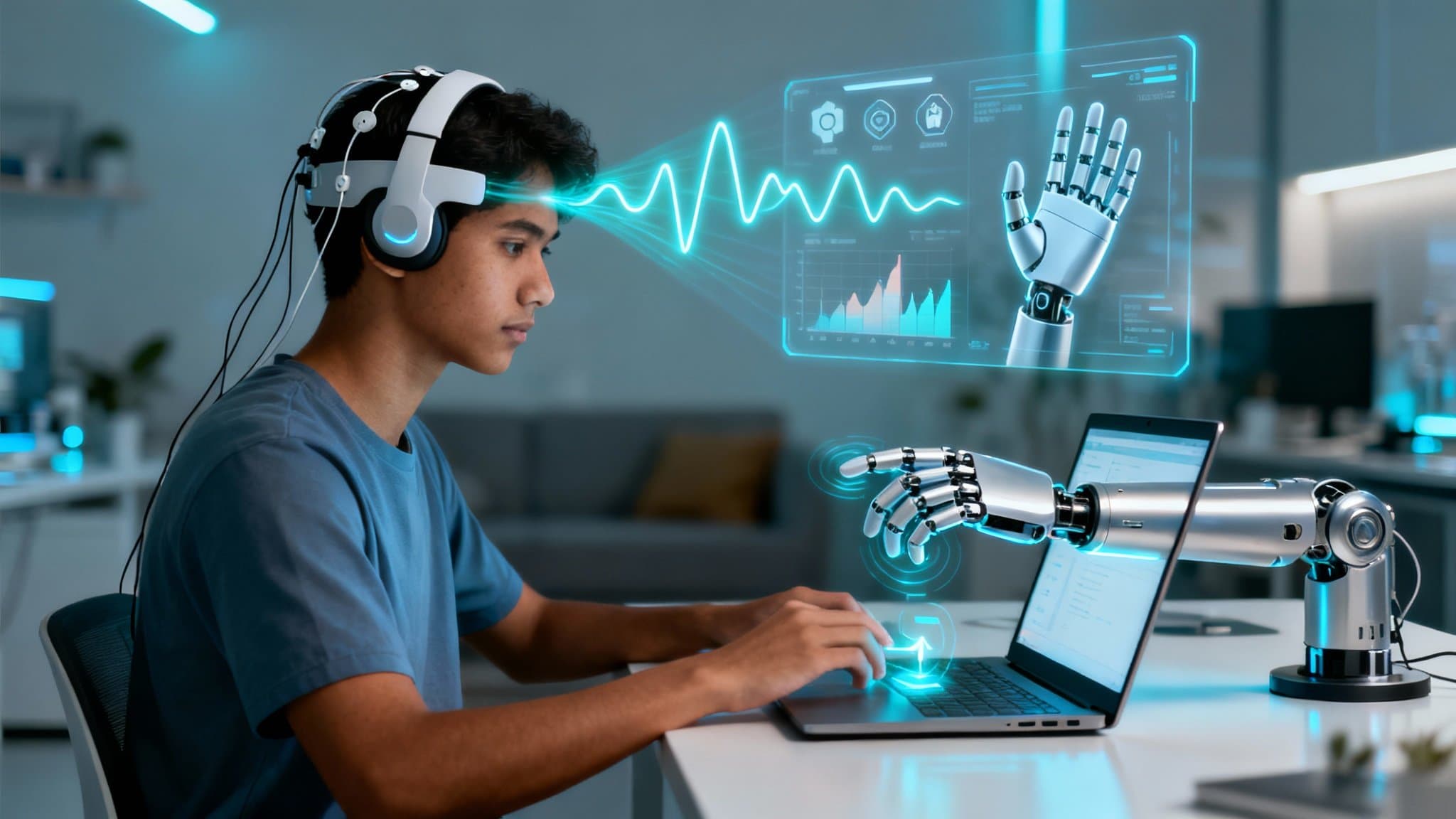

The idea of controlling machines with nothing but our thoughts has long fascinated both scientists and science fiction enthusiasts. Today, what once seemed like a futuristic dream is rapidly becoming a reality thanks to brain-computer interfaces (BCIs). BCIs are systems that create a direct communication pathway between the human brain and external devices, allowing signals from the brain to be translated into commands for machines. From medical applications that help disabled individuals regain independence to futuristic possibilities like controlling smart homes or even vehicles with thought alone, the potential of BCIs is enormous.
What is a Brain-Computer Interface?
A brain-computer interface (BCI) is a revolutionary technology that bypasses traditional muscle-based communication. Instead of relying on speech, touch, or movement, BCIs read neural signals and convert them into digital instructions. These systems usually rely on non-invasive or invasive methods to record brain activity.
- Non-invasive BCIs: These use methods like electroencephalography (EEG) to detect brain signals via electrodes placed on the scalp. This technology is safe and commonly used in research, though it often provides lower resolution.
- Invasive BCIs: These involve surgically implanted electrodes directly into the brain to capture highly accurate signals. While more powerful and precise, they carry higher medical risks.
By decoding electrical activity patterns in the brain, BCIs allow a person to control a cursor on a screen, type words, manipulate robotic arms, or even control a wheelchair—all without physical movement.

The Science Behind BCIs
The human brain consists of billions of neurons that communicate via electrical impulses. When people think about moving their hand, for example, certain neurons in the motor cortex fire. BCIs detect these signals and then translate them into specific commands for an external system. Machine learning and artificial intelligence play a critical role in decoding these complex signals into accurate actions.
Advancements in neural decoding algorithms, combined with improvements in sensor hardware, have made BCIs far more efficient than they were just a decade ago. Today, real-time signal processing enables mind-controlled systems that respond almost instantly.
Current Applications of BCIs
While BCIs are still in their early stages of development, they already have several practical and life-changing applications, especially in the healthcare sector.
- Medical Prosthetics
BCIs allow amputees or paralyzed individuals to control prosthetic limbs with their minds. This gives them greater independence and restores some natural mobility. - Communication for Locked-In Patients
Patients suffering from conditions like ALS (amyotrophic lateral sclerosis) often lose the ability to speak or move. With BCIs, they can communicate by selecting letters or words on a computer screen purely through brain activity. - Neurorehabilitation
Stroke and injury patients may use BCIs combined with virtual reality or robotics to retrain neural pathways. This greatly enhances recovery. - Mental Health Applications
Researchers are exploring how BCIs might help treat depression, anxiety, or PTSD by monitoring specific brain patterns and stimulating areas that promote healthy mental states. - Gaming and Entertainment
Several companies are testing BCIs that allow gamers to control characters or interact with digital worlds hands-free, creating the ultimate immersive experience.
BCI in the United States
The United States has become a global leader in BCI research and commercialization. Organizations like DARPA (Defense Advanced Research Projects Agency) have heavily invested in neurotechnology, exploring ways BCIs can help soldiers, veterans, and disabled individuals.
Meanwhile, innovative companies such as Neuralink, Kernel, and Synchron are pioneering commercial BCI solutions. Elon Musk’s Neuralink, for instance, is developing brain chips capable of extremely high-bandwidth communication between humans and computers. If successful, this could revolutionize both healthcare and everyday human-computer interaction.
Benefits of BCIs
- Independence for Disabled Individuals: BCIs empower people who are paralyzed or severely disabled, allowing them to live more fulfilling lives.
- Enhanced Human-Technology Interaction: Instead of typing or touching screens, users could one day browse the internet, send emails, or even drive vehicles using thought commands.
- Bridging Humans and AI: Future BCIs might enhance cognitive function or create seamless connections between humans and artificial intelligence.
Challenges and Risks
Despite their promise, BCIs also raise several challenges:
- Medical Risks
Invasive BCIs require brain surgery, which involves significant risks such as infections or long recovery times. - Data Privacy
Brain data is deeply personal. If misused, it could compromise individual freedom or be exploited by corporations or governments. - Ethical Questions
If BCIs can one day enhance intelligence or memory, how do we prevent misuse or inequality between “enhanced” and non-enhanced people? - Accessibility
Developing affordable BCIs remains a major challenge, as most technologies are expensive and limited to research labs or clinical settings.
The Future of Brain-Computer Interfaces
The future of BCIs looks incredibly promising. In the near term, expect advancements in non-invasive BCIs that make them more accurate and comfortable for everyday use. Gesture-free device control, accessible communication tools, and neuro-gaming will soon become more widespread.
Long-term visions include treating neurological disorders, augmenting memory, and enabling direct brain-to-brain communication (also called “telepathy via technology”). In addition, BCIs combined with AI may allow humans to interact with machines in ways we cannot imagine today.
Brain-computer interfaces represent more than just a scientific breakthrough—they signify a fundamental shift in how humans can interact with technology. By harnessing the brain’s electrical signals, BCIs promise to redefine medicine, communication, and digital interaction. While challenges related to ethics, privacy, and medical safety remain, the progress being made signals a transformative future where thought-controlled devices become part of everyday life.