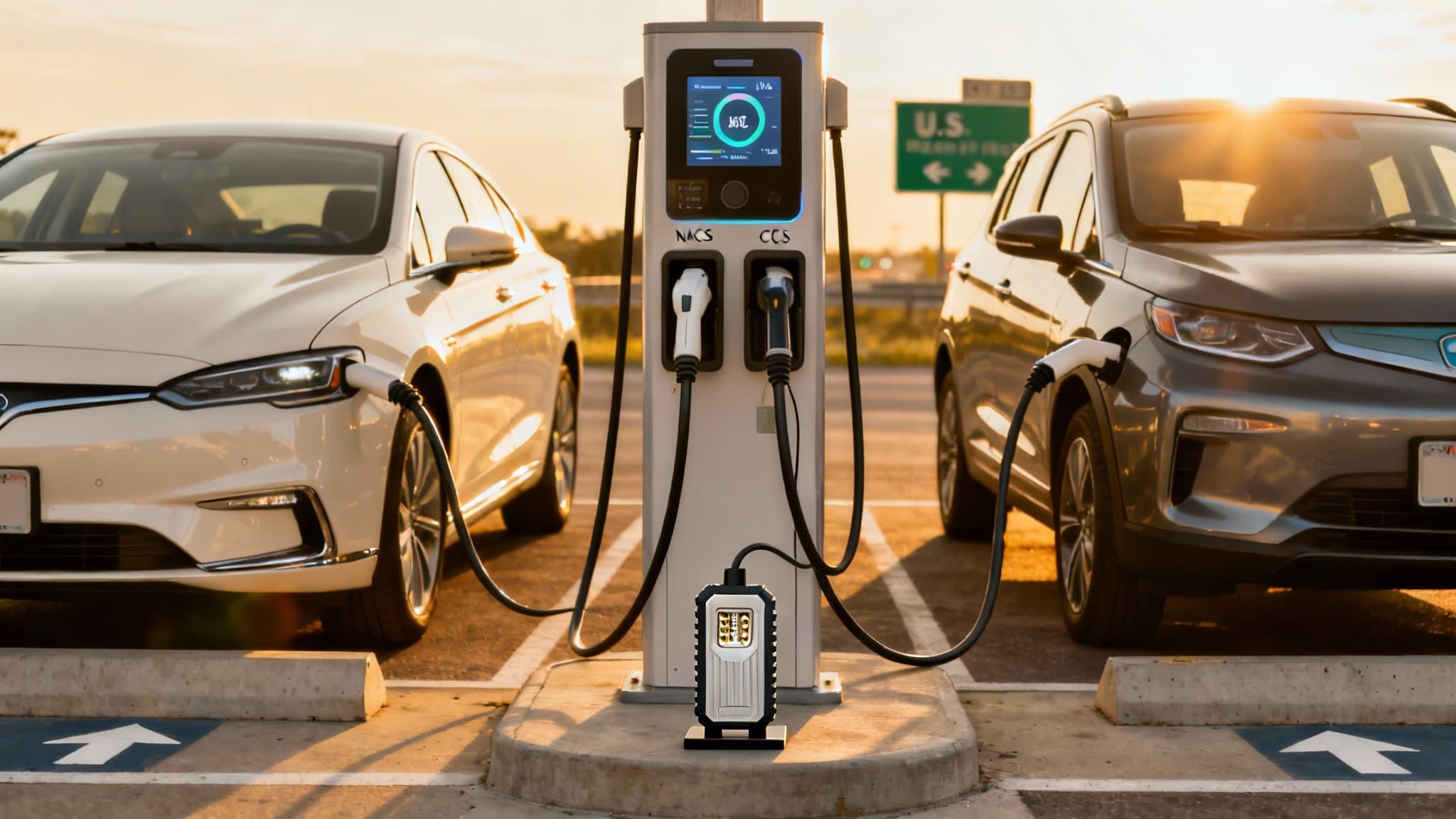

Electric vehicle adoption in the United States is accelerating, and with it comes a crucial question for drivers: which charging standard should you plan around—CCS or NACS—and how do adapters fit into the picture? Understanding connector types, charging speeds, network availability, and vehicle compatibility will help you make informed decisions about home charging, road trips, and long-term vehicle ownership.
This guide explains the differences between CCS (Combined Charging System) and NACS (North American Charging Standard), outlines current market momentum, clarifies how adapters work, and provides practical recommendations for EV owners and fleets. It’s written for U.S. readers and optimized for search with relevant LSI keywords at the end.
What Is CCS?
CCS is a widely adopted DC fast-charging standard in North America and Europe. Technically, CCS combines AC and DC pins into a single connector:



- AC charging uses the upper Type 1 (J1772) portion.
- DC fast charging uses two additional high-power pins below.
Key characteristics:
- Power levels: Typically up to 150 kW on many public stations, with high-power chargers (HPC) delivering 200–350 kW where supported.
- Network coverage: CCS is supported by major U.S. networks such as Electrify America, EVgo, ChargePoint DC fast sites, and others.
- Vehicle compatibility: Historically dominant among non-Tesla vehicles (e.g., GM, Ford, VW Group, Hyundai, Kia, BMW, Mercedes). Many 2024–2026 models are shifting to adopt NACS ports but still maintain CCS compatibility via adapters during the transition.
Pros:
- Broad cross-brand support and regulations-ready in multiple markets.
- High peak power potential on modern HPC sites.
Cons:
- Plug size is bulkier than NACS.
- User experience varies by station; reliability and uptime can be inconsistent depending on the operator and site maintenance.
What Is NACS?
NACS, popularized by Tesla and later opened for industry adoption, is a compact connector used for both AC and DC charging on the same plug. It is the native interface for Tesla vehicles in North America and is increasingly being adopted by other automakers.
Key characteristics:
- Power levels: Tesla’s Superchargers frequently deliver 150–250 kW on many sites; new hardware can go higher depending on site and vehicle.
- Network coverage: The Tesla Supercharger network—especially with Magic Dock or NACS-enabled stalls—offers extensive U.S. coverage and strong reliability.
- Vehicle compatibility: Tesla vehicles use NACS natively. Many U.S. automakers (Ford, GM, Rivian, Volvo, Polestar, Mercedes-Benz, Nissan, Hyundai, Kia, BMW, Toyota, and others) have announced plans to ship NACS ports on new models or provide adapters for CCS vehicles to access NACS stations.
Pros:
- Compact, ergonomic connector with strong user experience.
- Access to the Supercharger network, known for reliability and widespread coverage.
Cons:
- Transition period may require adapters for non-Tesla vehicles.
- Not all Superchargers are immediately accessible to every non-Tesla model; access depends on station configuration, software authorizations, and adapter availability.
Charging Speed: Real-World vs Spec Sheets
Both standards can support high power, but real-world speed depends on:
- Vehicle’s maximum DC charge rate and battery temperature.
- State of charge (SoC) and the vehicle’s charge curve.
- Station capabilities, site load sharing, and cable cooling (liquid-cooled cables enable sustained high current).
- Software integration between vehicle and station.
In practice, a modern EV on a well-maintained 250–350 kW site—CCS or NACS—can add significant range in 10–20 minutes, but actual results vary by model and conditions.
Reliability and User Experience
Reliability comes from:
- Station uptime and maintenance.
- Plug-and-charge authentication (ISO 15118) or seamless app-based sessions.
- Cable reach and port location on the vehicle.
- Transparent pricing and idle fees.
Tesla’s NACS user experience has set a high bar, particularly for Tesla owners, with streamlined plug-in-and-charge. CCS networks continue to improve with better hardware, software updates, and plug-and-charge support on newer vehicles. As NACS expands beyond Tesla, expect more uniform user experiences across brands, but verify compatibility before long trips.
Adapters: Bridging CCS and NACS During the Transition
Adapters allow vehicles with one port type to use stations with another connector. The two common scenarios are:
- CCS vehicle accessing NACS (Tesla) stations with a CCS-to-NACS adapter.
- Tesla or other NACS-equipped vehicle accessing CCS stations with a NACS-to-CCS adapter.
Important considerations:
- Power and protocol support: Not all adapters support DC fast charging; some are AC-only. For DC, ensure the adapter is certified for your vehicle and supports your target power levels.
- Vehicle firmware: Some vehicles require specific software versions to authenticate and communicate through the adapter.
- Thermal performance: High-power charging generates heat. Quality adapters use robust materials and may include thermal sensors to manage current.
- Physical strain: Adapters add length and weight. Avoid cable stress on the vehicle port; use strain relief where possible and ensure cables reach comfortably.
- Certification and safety: Choose UL-listed or OEM-approved adapters when available. Avoid unknown brands for DC high-power charging.
Practical tip:
- Keep both an AC adapter (for Level 2 destination charging) and, if supported, a DC fast-charging adapter in your trunk. Label them clearly to avoid mix-ups.
Home Charging Implications
At home, most charging is Level 2 (AC) using J1772 or NACS:
- Tesla home products use NACS. Non-Tesla EVs can use a J1772 connector, often with a simple adapter for Tesla Wall Connector if authorized.
- Many third-party Level 2 EVSEs ship with J1772 plugs; Tesla owners use a compact J1772-to-NACS adapter.
- For resale and future-proofing, consider a wall unit or wiring that can accommodate either a NACS-ready EVSE or a J1772 unit with the appropriate adapter. A 60A circuit (48A continuous charging) is a common sweet spot for modern EVs.
Road Trip Planning in the U.S.
- Check both CCS and NACS coverage along your route using reputable apps. Confirm power levels and connector types at each stop.
- Identify stations with amenities, 24/7 access, lighting, and backup stalls nearby.
- For non-Tesla vehicles, verify access to Tesla Superchargers on your route, whether Magic Dock is available, and whether your adapter supports DC fast charging.
- Always have a Plan B station, especially in rural corridors or during peak holiday travel.
Fleet and Commercial Considerations
- Mixed fleets should inventory port types and standardize on adapters and charging workflows.
- Evaluate depot charging around AC Level 2 for routine operations; use DC fast charging for turn-around vehicles.
- For public-facing stations, offering both CCS and NACS cables on the same pedestal improves utilization and future-proofs investment.
- Look for OCPP-compliant hardware, ISO 15118 plug-and-charge support, and robust uptime SLAs from network partners.
The Market Trajectory: Convergence on NACS in North America
The U.S. market is converging on NACS for new vehicles and public chargers, while CCS will remain relevant for many years due to the large installed base. Expect:
- More dual-cable DC fast chargers offering both NACS and CCS plugs.
- OEM-issued adapters to ensure backward compatibility.
- Rapid software improvements that streamline authentication, pricing transparency, and reliability across networks.
For consumers, this means better interoperability and fewer charging headaches over time. In the near term, adapters are the bridge; in the long term, native NACS ports and dual-standard stations will dominate.
Buyer’s Checklist
- Vehicle port: Identify whether your EV uses CCS or NACS.
- Adapters: Purchase certified AC and, if supported, DC adapters compatible with your car. Confirm rated kW.
- Cables and reach: Ensure the station cable comfortably reaches your port without strain, especially when using adapters.
- Network apps: Set up accounts and payment methods ahead of road trips. Enable plug-and-charge if your vehicle supports it.
- Firmware: Keep your vehicle software updated to improve compatibility and charging performance.
Bottom Line
Both CCS and NACS are capable of fast, reliable charging when deployed and maintained properly. With the U.S. market aligning around NACS and widespread adapter availability, EV ownership is getting simpler. Plan with adapters during the transition, prioritize reliable stations, and you’ll have a smooth charging experience today and better interoperability tomorrow.