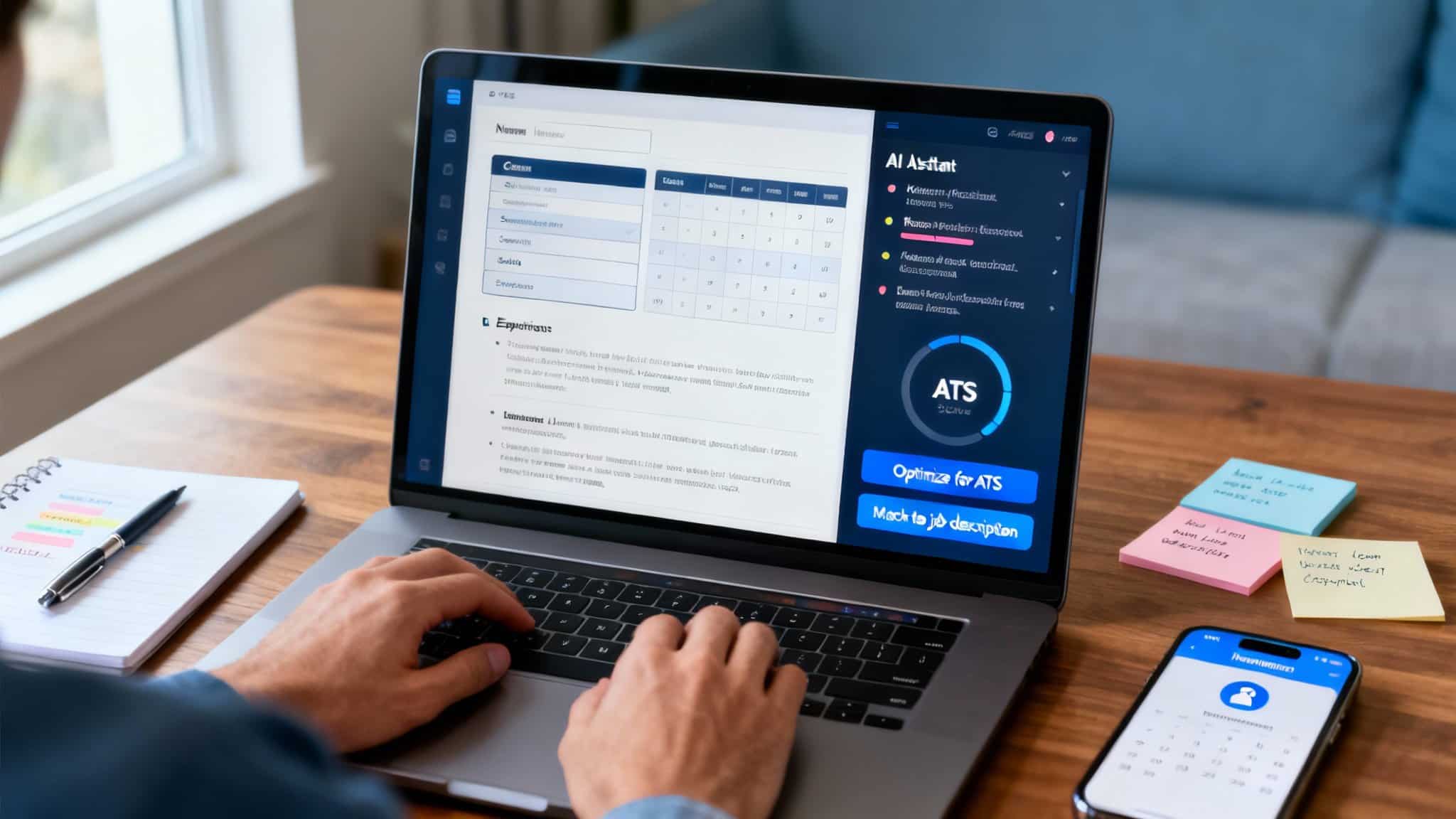

In today’s competitive U.S. job market, job seekers need every legitimate advantage to get noticed. Artificial Intelligence (AI) has transformed how resumes and cover letters are written, screened, and evaluated. Applicant Tracking Systems (ATS) are now standard at most mid-size and enterprise American employers, and generative AI tools can help candidates craft targeted, professional documents that beat the bots and impress hiring managers. This guide explains how to use AI effectively to write an ATS-friendly resume and a compelling cover letter tailored to U.S. standards, while preserving authenticity, clarity, and ethical integrity.
Why AI Matters for Resumes and Cover Letters
AI accelerates routine writing tasks, analyzes job descriptions for keywords, and suggests stronger phrasing. For U.S. roles, AI can:
- Extract core skills from job postings and map them to your experience.
- Optimize for ATS readability with clean formatting and targeted keywords.
- Generate multiple tailored versions for different roles or industries.
- Improve tone, grammar, and clarity to match professional U.S. business standards.
However, the most effective documents still require human oversight. AI should enhance, not replace, your unique achievements, voice, and career narrative.
Building an ATS-Friendly Resume With AI
- Select the right format
- Use a reverse-chronological format for most U.S. roles. Functional-only resumes can raise red flags unless you’re making a major career change.
- Keep layout simple: consistent headings, left-aligned text, and standard fonts (Calibri, Arial, Times New Roman, 10–12pt).
- Use a clean, parsable structure
- Sections: Name and contact info, professional summary, core skills, experience, education, certifications, optional projects or publications.
- Avoid tables, text boxes, columns, images, and graphics that may break ATS parsing.
- Save as PDF and DOCX when possible; some ATS systems still prefer DOCX.
- Write a results-driven summary
- With AI, prompt for a 3–5 line summary tailored to the job description, emphasizing industry, years of experience, and signature wins.
- Example: “Data analyst with 6+ years in fintech, improving churn prediction by 18% and automating reporting pipelines to save 12 hours/week.”
- Optimize skills for keyword alignment
- Use AI to extract hard and soft skills from the posting, then match them to your real strengths.
- Group by category: Technical (e.g., Python, SQL, Tableau), Methodologies (Agile, A/B testing), Soft skills (stakeholder communication).
- Use exact or close keyword variants used in the U.S. market (e.g., “Project Management” vs. “Program Management” when appropriate).
- Convert responsibilities to quantified achievements
- Use AI to rewrite bullets with the STAR method (Situation, Task, Action, Result) and metrics.
- Replace “Responsible for managing campaigns” with “Led 8 end-to-end campaigns, increasing CTR by 24% and reducing CPA by 17%.”
Other
- Align titles and terminology to U.S. norms
- Localize job titles to U.S.-recognized equivalents without misrepresentation (e.g., “HR Generalist” vs. “People Operations Associate” depending on market usage).
- Ensure spelling is American English (utilize AI to convert “organise” to “organize,” etc.).
- Use action verbs and industry language
- Start bullets with dynamic verbs: led, built, scaled, automated, launched, optimized, negotiated, implemented, architected.
- Ensure consistency in tense (current role: present; past roles: past).
- Keep length and density balanced
- Target 1 page for early career, 2 pages for mid-senior roles. U.S. hiring managers value brevity with substance.
- Avoid dense paragraphs; keep bullets to 1–2 lines.
- Pass a final ATS and readability check
- Ask AI to evaluate for keyword coverage vs. the job description.
- Run a grammar and clarity pass; ensure inclusive, bias-free language.
Crafting a Persuasive AI-Enhanced Cover Letter
- Follow U.S. business conventions
- Header with your contact info, date, employer name, and address if available.
- Professional greeting: “Dear Hiring Manager” if no name is known.
- Keep to 250–400 words, 3–4 concise paragraphs.
- Personalize with specifics
- Use AI to extract company priorities from the job posting, careers page, and recent press releases, then integrate 1–2 tailored insights.
- Example: “I’m excited by your recent Series B funding and expansion into healthcare analytics.”
- Lead with a strong hook
- In the first 1–2 sentences, match one of your top achievements to a key requirement in the job description.
- Example: “At Acme, I reduced data pipeline costs by 30% while cutting reporting latency from 12 hours to 45 minutes.”
- Bridge your experience to their needs
- Use one paragraph to show how your skills translate directly to their roadmap, tech stack, or customer segment.
- Name relevant tools and outcomes mentioned in the job post.
- Close with confidence and clarity
- Reiterate impact, show enthusiasm, and request next steps.
- Example: “I’d welcome the opportunity to discuss how my experience can accelerate your analytics roadmap this quarter.”
- Keep tone human and authentic
- Use AI to polish phrasing, not to inflate claims.
- Read aloud and refine for natural voice; avoid buzzword stuffing.
Ethical and Practical Tips When Using AI
- Accuracy over embellishment: Never claim skills or certifications you don’t possess.
- Protect privacy: Remove sensitive data, confidential metrics, or client names unless publicly shareable.
- Maintain your voice: Ask AI to keep a plain, direct tone aligned with your industry.
- Verify facts: Double-check AI-generated dates, titles, metrics, and company names.
- Bias check: Use inclusive language and avoid terms that could imply age, health, or other protected characteristics.
U.S.-Specific Details to Remember
- Include city and state (or “Remote”) instead of full address.
- Add LinkedIn URL and portfolio/GitHub where relevant.
- Education: list degree, institution, and graduation year if it helps; for senior roles, year can be optional.
- Work authorization: If relevant, state “U.S. Citizen,” “Green Card,” or “Authorized to work in the U.S.” Avoid listing visa details in the resume unless requested.
- Avoid a photo, marital status, or date of birth; these are not standard in the U.S.
How to Prompt AI for Best Results
- Provide a mini-brief: industry, role target, 5–10 achievements with metrics, and the job description.
- Ask for three tailored versions: conservative corporate, standard professional, and high-impact growth-stage style.
- Request a keyword audit: “Compare my resume to this job description and list missing hard skills.”
- Run consistency checks: “Ensure tense consistency, U.S. spelling, and remove redundant phrases.”
Quick Example Prompts You Can Use
- Resume tailoring: “Rewrite my resume bullets for this job description. Add quantifiable outcomes and keep each bullet under 22 words.”
- Keyword extraction: “List the top 20 hard skills in this posting and categorize by tools, languages, and methodologies.”
- Cover letter: “Draft a 300-word cover letter with a strong opening and a specific metric-driven example from my bullets 3 and 7.”
Final Quality Checklist Before You Apply
- File names: Use “Firstname_Lastname_Resume.pdf” and “Firstname_Lastname_CoverLetter.pdf”.
- Links: Verify LinkedIn, portfolio, and email links work.
- Consistency: Titles, dates, and company names aligned across resume, cover letter, and LinkedIn.
- Readability: 1-inch margins, 10–12pt font, adequate white space.
- ATS test: Plain text paste of resume should preserve structure and order.
AI can dramatically improve the precision, clarity, and competitiveness of your resume and cover letter for the U.S. job market. The key is strategic collaboration: use AI for speed, structure, and keyword alignment, while you provide authentic achievements, nuanced context, and a personal voice. With this approach, you’ll pass ATS filters and make a strong, credible impression on hiring managers.