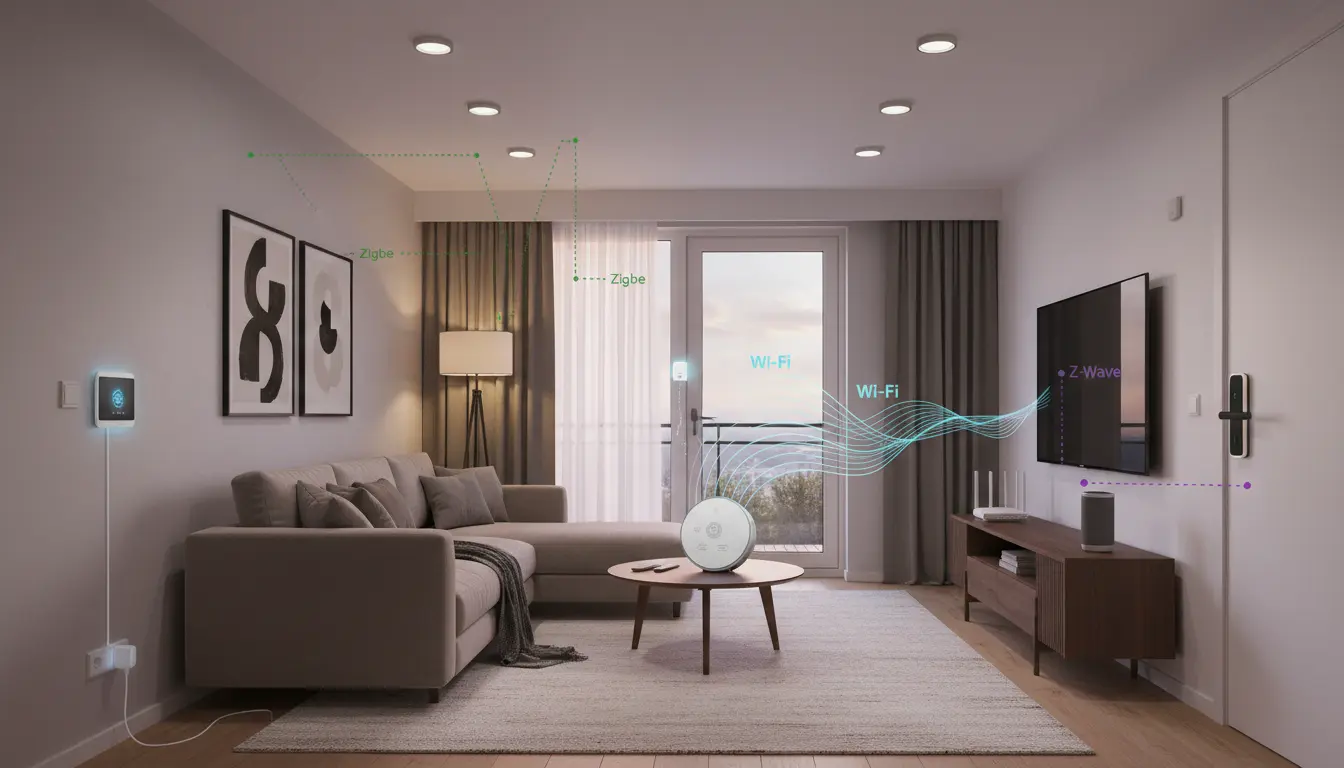

Wi‑Fi vs Zigbee vs Z‑Wave: Smart Home Protocols, Range, Security, and Interoperability Guide: Building a smart home today means choosing the right wireless protocol to connect your devices reliably, securely, and efficiently. While Wi‑Fi dominates home networking, low-power protocols like Zigbee and Z‑Wave are often better suited for sensors, switches, and automation hubs. Each option has unique strengths and trade-offs in range, bandwidth, energy usage, interoperability, and security. This guide compares Wi‑Fi, Zigbee, and Z‑Wave in practical terms so you can pick the best protocol for your setup—and avoid compatibility headaches down the road.
What Are These Protocols?
- Wi‑Fi: High-bandwidth wireless networking standard (2.4 GHz and 5 GHz, plus newer 6 GHz with Wi‑Fi 6E). Great for video streams, voice assistants, cameras, and general internet access. Power-hungry compared to Zigbee and Z‑Wave.
- Zigbee: Low-power, low-bandwidth mesh protocol operating mostly at 2.4 GHz globally (with some regional sub‑GHz variants). Designed for smart home sensors, bulbs, switches, and automation with excellent battery life.
- Z‑Wave: Low-power, low-bandwidth mesh protocol operating on sub‑GHz frequencies that vary by region (e.g., 908.42 MHz in North America, 868.4 MHz in Europe). Known for robust range, less interference, and strong device interoperability.
Range and Reliability
- Wi‑Fi: Strong throughput but shorter effective range through walls, especially at higher frequencies (5/6 GHz). Congestion and interference are common in apartment buildings. Great for devices that need high data rates but may struggle with battery sensors.
- Zigbee: Mesh networking allows each powered device (e.g., plugs, bulbs) to relay signals, extending coverage across floors and rooms. However, 2.4 GHz can suffer interference from busy Wi‑Fi channels and microwaves. Proper channel selection and strategic placement of repeaters improve reliability.
- Z‑Wave: Also mesh-based, but sub‑GHz operation typically yields better penetration through walls and less interference. Fewer channels, but generally more stable links in dense environments. Range per hop is often superior to Zigbee, requiring fewer repeaters in many homes.
Winner for range/reliability in typical homes: Z‑Wave (slight edge), with Zigbee close behind if the mesh is well-designed. Wi‑Fi is best for high-bandwidth devices, not for low-power distributed sensors.
Power Consumption and Battery Life
- Wi‑Fi: Highest power draw. Battery-powered Wi‑Fi sensors exist, but they require aggressive sleep strategies and still drain faster. Best for mains-powered devices like cameras, smart displays, and routers.
- Zigbee: Extremely efficient for battery-powered sensors (door/window, motion, temperature). Multi-year battery life is common.
- Z‑Wave: Similarly power-efficient, delivering multi-year battery life on sensors and locks.
Winner for battery devices: Tie between Zigbee and Z‑Wave; both are designed for low-power operation.


Bandwidth and Use Cases
- Wi‑Fi: High bandwidth for video, audio, and rich data. Ideal for cameras, TVs, smart speakers, and hubs that need internet access.
- Zigbee: Low bandwidth—perfect for status updates, control messages, and automations. Ideal for lighting, sensors, and switches.
- Z‑Wave: Similar low bandwidth profile focused on control and telemetry. Great for locks, sensors, thermostats, and scene controllers.
Winner for bandwidth-heavy tasks: Wi‑Fi. For control and automation, Zigbee/Z‑Wave excel.
Interoperability and Ecosystem Support
- Wi‑Fi: Universally supported but lacks a unified smart home control standard on its own. Interoperability depends on platform (Apple Home, Google Home, Alexa) and device integrations.
- Zigbee: Widely adopted by major brands (e.g., Philips Hue, IKEA TRÅDFRI) and supported by many hubs. That said, Zigbee profiles and vendor variations can cause compatibility quirks unless your hub supports them well.
- Z‑Wave: Historically strong interoperability due to stricter certification. Device inclusion is often smoother across certified hubs. Regional frequency differences mean you must buy region-appropriate devices.
- Matter and Thread context: Matter aims to unify smart home control across ecosystems. Thread is a low-power mesh network (like Zigbee/Z‑Wave but IP-based) that many Matter devices use. If you’re starting fresh, consider Matter/Thread-capable devices where possible—but Zigbee and Z‑Wave remain excellent and mature for today’s installs.
Winner for “it just works”: Z‑Wave has a slight edge on device-to-device consistency, while Zigbee wins on breadth and availability. Wi‑Fi depends heavily on cloud/app integrations.
Security Considerations
- Wi‑Fi: WPA2/WPA3 keep networks secure if configured properly. Cloud-connected devices can add risk; prioritize reputable brands, frequent firmware updates, and router-level network segmentation (e.g., dedicated IoT VLAN or guest network).
- Zigbee: Uses AES-128 encryption. Security depends on trusted joining and strong keys. Use secure pairing, update hubs regularly, and avoid mixing unknown vendors with lax firmware update practices.
- Z‑Wave: Also uses strong encryption (S2 framework significantly improved security). Ensure your hub and devices support S2 and keep firmware current.
Best practices: Keep your hub updated, use secure inclusion modes, segment your IoT network, and choose well-supported ecosystems.
Setup Complexity and Hubs
- Wi‑Fi: No hub required for basic connectivity, but smart functionality may rely on cloud services or platform apps.
- Zigbee: Requires a compatible hub/bridge (e.g., a dedicated Zigbee hub, multiprotocol hub, or some smart speakers and routers that include Zigbee radios). Mesh health improves with a few mains-powered repeaters.
- Z‑Wave: Requires a Z‑Wave hub. Because it’s region-locked by frequency, ensure your hub and devices match your country’s band.
Hubs that support multiple radios (e.g., Zigbee + Z‑Wave + Thread) simplify mixed-device setups and future-proofing.
Interference and Channel Planning
- Wi‑Fi vs Zigbee: Both often share the 2.4 GHz spectrum. Place Zigbee on a channel that avoids overlap with your Wi‑Fi’s primary channel (e.g., Wi‑Fi on channel 1 or 11, Zigbee on channel 15/20/25, depending on your region and hub options).
- Z‑Wave: Operates sub‑GHz, so it sidesteps most 2.4 GHz congestion. Still, choose hubs with good radio placement and avoid putting hubs inside metal cabinets or behind large appliances.
Costs and Availability
- Wi‑Fi: Modules are ubiquitous; device prices vary widely. Hidden cost is higher energy usage for sensors.
- Zigbee: Devices are affordable and plentiful. Many budget-friendly options exist without sacrificing reliability when paired with a good hub.
- Z‑Wave: Often slightly pricier per device, but you gain robust range and strong interoperability.
Total cost of ownership can favor Zigbee for large installations due to device pricing and easy expansion.
Practical Recommendations
- For cameras, video doorbells, smart speakers: Choose Wi‑Fi.
- For lighting, motion/door sensors, temperature/humidity sensors: Choose Zigbee for cost-effective scale and battery life—ensure good channel planning and a few reliable mains-powered repeaters.
- For door locks and critical automations where range and reliability are paramount: Consider Z‑Wave, especially in homes with thick walls or heavy 2.4 GHz congestion.
- For mixed ecosystems or future Matter adoption: Use a hub that supports multiple radios (Zigbee/Z‑Wave/Thread) and prioritize brands with strong update histories.
- Small apartments: Zigbee works great, with minimal repeaters. Wi‑Fi for bandwidth devices.
- Large houses or multi-floor setups: Z‑Wave can reduce the number of repeaters needed; Zigbee still works well with proper mesh planning.
Bottom Line
- Choose Wi‑Fi for high-data devices and when you don’t want a hub.
- Choose Zigbee for affordable, scalable sensor and lighting networks with excellent battery life.
- Choose Z‑Wave for robust range, minimal interference, and highly consistent device interoperability—especially for locks and mission-critical automations.
Whichever you pick, a quality hub, sensible network segmentation, and regular firmware updates will do more for reliability and security than the protocol alone.