
Ransomware Protection: Backup Strategies and the 3-2-1 Rule
Ransomware remains one of the most disruptive cyberthreats facing organizations and individuals. It encrypts critical files, halts operations, and pressures victims to pay for decryption keys that may never work. While prevention tools like EDR, anti-malware, and email filtering are essential, the most reliable path to recovery is having robust, well-tested backups. Among backup best practices, the 3-2-1 rule stands out as a timeless, vendor-agnostic strategy that dramatically improves resilience. This article explains how the 3-2-1 backup rule works, why it’s still relevant against modern ransomware, and how to implement it with practical, SEO-friendly guidance.
What is Ransomware and Why Backups Matter
Ransomware is malicious software that encrypts your data and demands a payment to restore access. Modern strains can move laterally across networks, target backups, and exploit misconfigurations. Even when defenses are strong, zero-day vulnerabilities and social engineering can lead to compromise. That’s why recovery planning—especially backup strategy—is non-negotiable. If your backups are independent, immutable, and tested, you can restore quickly without paying a ransom.
The 3-2-1 Backup Rule Explained
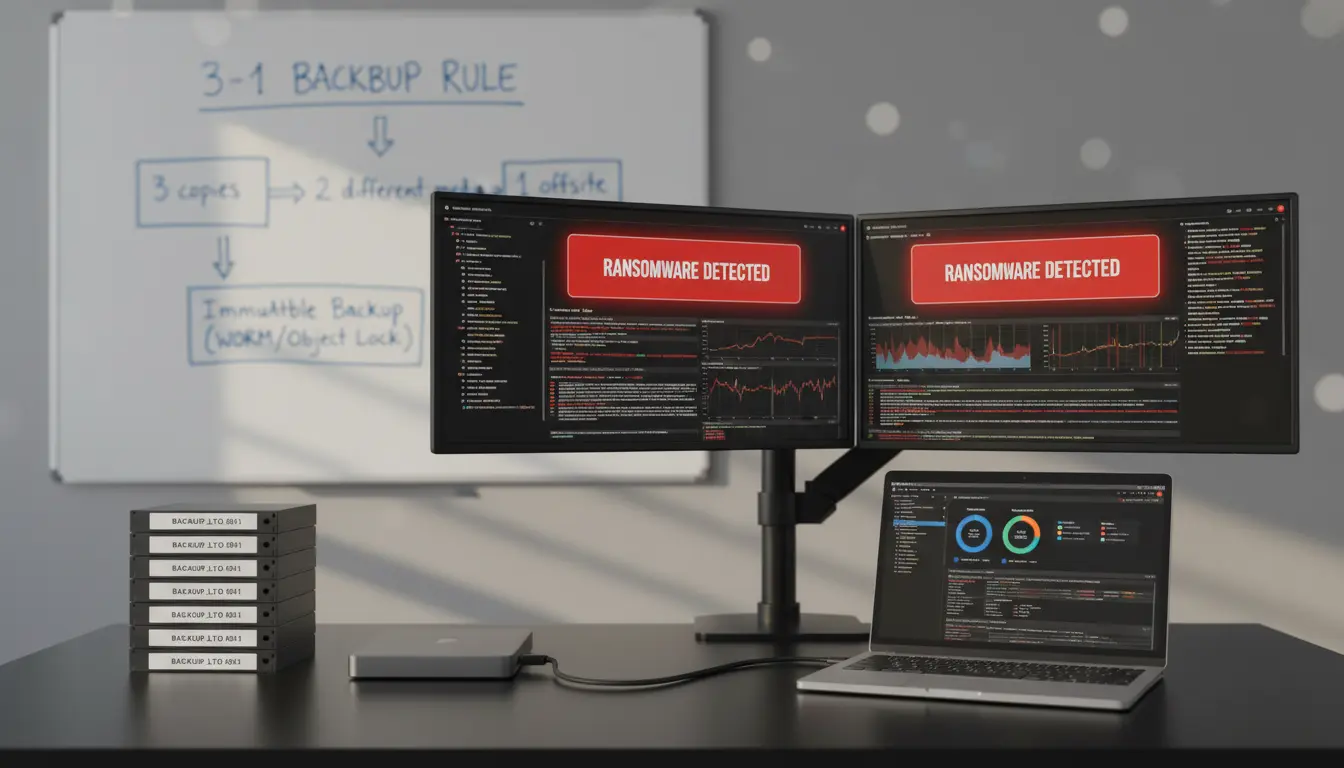
The 3-2-1 rule is simple but powerful:



- Keep 3 copies of your data: the production dataset plus two backup copies.
- Store copies on 2 different media: for example, local disk and object storage, or NAS and tape.
- Keep 1 copy offsite: physically separated or logically isolated from your primary environment.
This structure reduces single points of failure and provides layers of redundancy. If ransomware encrypts primary systems and attached storage, you still have an offsite or offline copy to restore from.
Why the 3-2-1 Rule Still Works Against Modern Ransomware
- Defense in depth: Multiple copies on distinct media limit blast radius. If one medium is compromised, another remains safe.
- Offsite separation: Cloud object storage or an offsite tape vault resists data-center outages, fires, or targeted attacks.
- Isolation options: Offline or air-gapped media and immutable storage make it far harder for ransomware to encrypt backups.
- Rapid RTO/RPO control: Local backups enable fast restores for common incidents; offsite copies protect against catastrophic events.
Evolving the Rule: 3-2-1-1-0 and Immutability
Attackers increasingly target backup catalogs and repositories. Two enhancements are becoming mainstream:
- 3-2-1-1-0: Add 1 offline or immutable copy and aim for 0 backup restore errors after validation. This means enabling object lock/immutability (e.g., S3 Object Lock, immutability on backup appliances) and running regular recovery tests to catch corrupt chains or missing dependencies.
- Tamper-proof retention: Use write-once, read-many (WORM) controls and legal holds to make critical recovery points non-deletable for a set retention period.
Choosing Backup Media: Pros and Cons
- Local disk/NAS: Fast backups and restores, great for short RPO/RTO. Risk: Often accessible over the network; must be hardened and isolated.
- Tape: Naturally offline when vaulted, cost-effective for large archives. Slower restores; requires process discipline.
- Cloud object storage: Durable, elastic, and geographically redundant with options for immutability and lifecycle policies. Requires careful IAM and cost management.
- Backup appliances: Purpose-built platforms with hardened OS, role-based access, and immutable snapshots. Evaluate vendor lock-in and ensure export/DR options.
Implementation Blueprint for the 3-2-1 Rule
- Data classification and scope
- Identify mission-critical systems, databases, file shares, and SaaS data. Prioritize workloads with the highest business impact.
- Define RPO/RTO targets
- RPO (Recovery Point Objective): How much data you can afford to lose (e.g., 1 hour).
- RTO (Recovery Time Objective): How fast you must be back online (e.g., 4 hours).
- Architect the layers
- Copy 1: Primary production data.
- Copy 2: Local backup (different medium) for fast restore.
- Copy 3: Offsite/immutable backup (cloud object storage with object lock or tape vaulting).
- Harden your backup platform
- Isolate backup networks and admin consoles. Enforce MFA and RBAC. Disable direct domain trust if possible. Use dedicated service accounts with least privilege.
- Enable immutability and air-gapping
- Turn on object lock, WORM, or immutable snapshots. For tape, ensure regular eject-and-vault cycles. For disks, consider periodic offline replicas.
- Encrypt and protect credentials
- Encrypt data at rest and in transit. Store repository keys and secrets in a secure vault. Rotate credentials regularly.
- Schedule and rotate backups
- Daily incrementals, weekly fulls, and monthly archival are common. Align schedules with change rates and RPO.
- Verify and test restores
- Automate backup verification. Perform quarterly recovery drills including bare-metal or mass-VM restores. Document runbooks and measure actual RTO/RPO achieved.
- Monitor and alert
- Watch for backup job failures, unusual deletion spikes, or unexpected encryption behavior. Integrate with SIEM for anomaly detection.
- Document and train
- Create a ransomware recovery playbook. Ensure ops teams can execute restores under pressure, including from immutable layers.
Protecting Backups from Ransomware
- Use separate administrative identities and MFA for backup consoles.
- Restrict network paths to repositories; segment with firewalls or private endpoints.
- Disable interactive logins on backup service accounts.
- Turn on anomaly detection features in backup software (e.g., unusual change rates).
- Keep backup servers patched and minimize installed software to reduce attack surface.
- Maintain offline or logically isolated copies that are not continuously writable.
Cloud-Native Notes
For cloud workloads, combine:
- Cross-region replication for disaster recovery.
- Versioning and object lock for immutability.
- Service control policies (SCPs) or org policies to prevent disabling retention.
- Private connectivity and KMS with strict key policies.
SaaS Applications and 3-2-1
“Shared responsibility” means SaaS vendors protect platform availability, not your data versions. Use third-party backup tools or platform-native exports to create independent copies. Apply 3-2-1 principles: keep a local copy, a cloud copy with immutability, and test restores to a sandbox tenant.
Incident Response and Recovery Workflow
- Detect and isolate: Quarantine infected endpoints and networks quickly.
- Preserve evidence: Snapshot logs and memory for forensics.
- Validate clean backups: Identify restore points prior to encryption or exfiltration.
- Rebuild in stages: Restore core identity services (AD/IdP), then critical apps and databases.
- Reset credentials and rotate keys: Ensure attackers can’t re-enter.
- Post-incident review: Update controls, backups, playbooks, and user education.
Compliance and Reporting Advantages
Adhering to the 3-2-1 approach helps demonstrate due diligence for frameworks like ISO 27001, NIST CSF, and various sector regulations. Immutable retention supports legal hold and regulatory requirements, while documented test restores show operational readiness.
Common Pitfalls to Avoid
- Keeping all copies online and hot-mounted to the same domain.
- Overlooking backup of configuration data, identity providers, and license servers.
- Not testing restores at scale or assuming “verification = recovery.”
- Using a single vendor feature without true separation of duties or media diversity.
- Failing to budget egress, retrieval, or long-term storage costs for cloud backups.
Practical Checklist
- 3 copies, 2 media, 1 offsite: validated and documented.
- At least 1 immutable/offline copy with enforced retention.
- Quarterly full recovery drills with measured RTO/RPO.
- RBAC + MFA + network segmentation for all backup components.
- Continuous monitoring and anomaly alerts for repositories.
- Clear, step-by-step recovery runbooks accessible offline.
By implementing a disciplined 3-2-1 strategy—augmented with immutability, isolation, and rigorous testing—you transform ransomware from a business-ending crisis into a recoverable incident. The goal is not only to back up data, but to restore it quickly, cleanly, and confidently when it matters most.