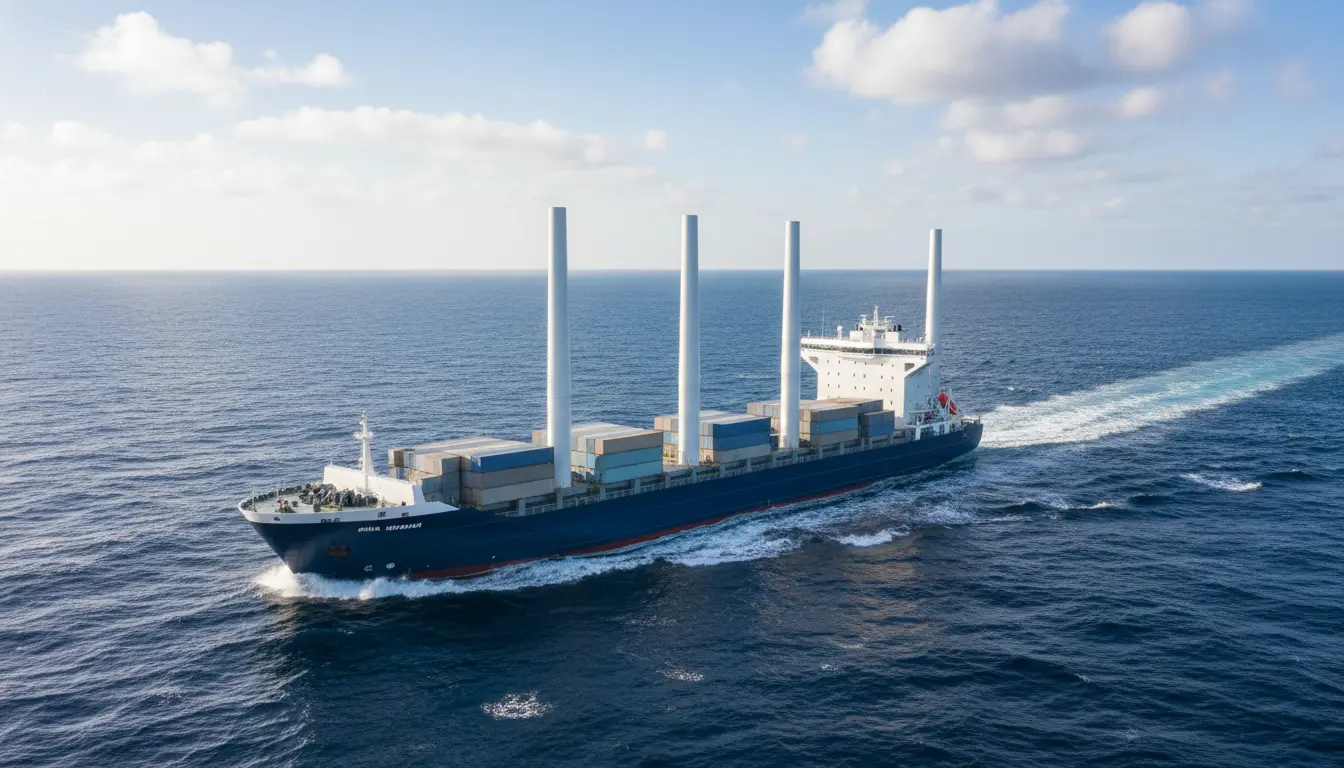

Wind-Powered Cargo Ships: The Future of Sustainable Ocean Freight
The global shipping industry moves close to 90% of world trade but also contributes significantly to greenhouse gas emissions. As regulations tighten and customers demand greener logistics, one solution stands out: the wind-powered cargo ship. These wind-assisted large vessels use modern wind technologies to reduce fuel use, cut emissions, and support truly sustainable shipping.
What Is a Wind-Powered Cargo Ship?
A wind-powered cargo ship is a commercial vessel that uses the energy of the wind to support its main engine. Unlike traditional sailing ships, these vessels combine:
- Conventional diesel or alternative-fuel engines
- Advanced wind-assist systems such as:
- Rigid wing sails
- Flettner rotor sails
- Towing kites
- Vertical or foldable wing structures
This hybrid setup means the ship does not depend solely on wind. Instead, wind energy provides additional thrust, allowing the engine to run at lower power while maintaining speed and schedule reliability on international routes.
How Modern Wind-Assisted Technology Works
Wind-assisted propulsion is based on modern aerodynamics and automation. Key components include:
- Aerodynamic devices: Sails, rotors, or kites generate lift and forward thrust when the wind flows around them.
- Sensors and control systems use real-time data on wind direction, wind speed, and ship speed to optimize performance.
- Automated systems continuously adjust the angle and position of sails or rotors for maximum efficiency with minimal crew input.
Some ships use Flettner rotors, which spin to create the Magnus effect and generate powerful lift. Others deploy large kites that fly high above the sea surface, where winds tend to be stronger and more constant. These technologies transform free, renewable wind energy into usable propulsion for large commercial vessels.
Environmental Benefits of Wind-Assisted Cargo Ships
One of the strongest arguments for wind propulsion is its environmental impact. By reducing engine load, wind-assisted cargo ships can:
- Cut fuel consumption by 10–30% or more, depending on route and technology
- Lower CO₂ emissions, sulfur oxides (SOx), and nitrogen oxides (NOx)
- Support compliance with IMO emission targets and regional regulations
- Decrease the overall carbon footprint of global supply chains
When combined with low-carbon fuels such as green methanol, ammonia, or advanced biofuels, wind assistance becomes a powerful lever for deep decarbonization. This is especially vital for deep-sea shipping, where full electrification is not yet practical for long voyages.
Economic Advantages and Return on Investment
Beyond sustainability, wind-assisted shipping offers strong economic incentives:
- Lower fuel bills: Fuel is one of the largest cost drivers in shipping. Even a small percentage reduction translates into large savings over a vessel’s lifetime.
- Attractive payback periods: Many early adopters report that investments in rotor sails or wing sails can pay back in just a few years.
- Protection against fuel price volatility: By relying partially on wind, shipowners reduce exposure to unstable oil and fuel markets.
- Future-proofing against carbon costs: As carbon pricing and stricter fuel standards expand, the economic value of every ton of fuel saved will increase.
This combination of cost savings and risk reduction makes wind-powered cargo ships a strategic investment rather than a niche experiment.
Retrofitting Existing Ships vs. Newbuild Designs
Wind propulsion is not only for new vessels. There are two main pathways:
- Retrofit installations
- Rotor sails or wing sails can be mounted on existing bulk carriers, tankers, and Ro-Ro vessels.
- Retrofitting extends the economic life of ships while improving energy efficiency and emissions performance.
- Newbuild wind-optimized designs
- Shipyards and designers are creating hulls and deck layouts specifically optimized for multiple sails or rotors.
- These ships integrate wind propulsion systems from the start, achieving even higher efficiency and better stability.
Both approaches accelerate decarbonization of the global fleet and help meet climate targets without waiting for entirely new fuel infrastructures to mature.
Operational Considerations and Crew Workload
Modern wind-assisted cargo ships are designed to fit seamlessly into existing operations:
- Automated control: Systems are managed from the bridge through intuitive interfaces.
- Minimal additional crew effort: There is no need for traditional sail-handling. Most actions are automatic or require only a few commands.
- Port and navigation flexibility:
- Many systems can be folded or retracted for port entry, bridge clearance, or severe weather.
- Safety standards and classification rules are being updated to ensure secure integration with global maritime traffic.
This means ship operators can adopt wind propulsion without fundamentally changing crew skills or voyage planning methods.
Digital Optimization and Smart Routing
Digital tools amplify the benefits of wind-powered cargo ships. Voyage optimization software and data analytics help operators:
- Analyze weather forecasts, wave conditions, and currents
- Plan routes that maximize exposure to favorable winds
- Balance fuel savings with schedule reliability and safety
Machine learning models can refine performance predictions over time, using real operational data from each voyage. As more ships share data, the entire fleet can learn how to use wind more effectively, turning every journey into a new source of insight and efficiency.
Branding, Market Differentiation, and Customer Demand
Adopting wind-assisted technology also creates clear marketing advantages:
- Visible commitment to sustainability: Tall rotors or futuristic wing sails make a strong visual statement in ports and shipping lanes.
- Stronger relationships with eco-conscious clients: Shippers and brands with net-zero targets actively look for low-carbon transport options.
- Competitive positioning: Early adopters can offer greener freight services and may be better positioned for future regulations and customer expectations.
In a market where environmental performance is becoming a key decision factor, operating a wind-powered cargo ship can be a powerful brand asset.
The Future of Wind-Assisted Large Vessels
As technology costs fall and regulatory pressure rises, wind-powered cargo ships are moving from pilot projects to mainstream adoption. In the coming years, we can expect:
- More standardized solutions for retrofits and newbuilds
- Closer collaboration between shipyards, technology providers, and classification societies
- Integration of wind propulsion with alternative fuels, batteries, and other efficiency measures
- Wider recognition of wind as a core pillar of maritime decarbonization strategies
Ultimately, the wind-assisted large vessel is not a nostalgic return to the age of sail. It is a high-tech response to the urgent need for cleaner, more resilient global shipping. By combining proven physics with advanced digital tools, wind-powered cargo ships offer a practical, scalable path toward low-emission ocean freight.