
Most Useful Tips and Hidden Settings for DJI Osmo Action Users
The DJI Osmo Action is a compact yet powerful action camera that can deliver truly professional results. But its real potential appears not just when you hit record out of the box, but when you learn the right settings, hidden features, and practical field tricks.
Below is a detailed, SEO‑friendly guide (in English) with active sentences and clear sections, plus LSI keywords, a meta description, and a final product recommendation from Amazon.
1. Start Strong: Essential First‑Time Setup
1.1 Choose the Right Resolution and Frame Rate
Match your resolution and frame rate to how you’ll use the footage:
- For daily vlogs and social media:
4K 30fpsor2.7K 30fpsworks great.
- For sports and fast action:
- Use
4K 60fpsor higher frame rates for smoother motion.
- Use
- For slow motion shots:
1080p 120fpsor higher (if available) gives you dramatic slow‑mo.
As a simple rule: the faster the action, the higher the fps you should choose.
1.2 Enable Image Stabilization (RockSteady, etc.)
One of the strongest advantages of the Osmo Action family is its electronic image stabilization:
- Keep RockSteady (or equivalent) turned on for:
- Running, biking, skiing, or any shaky handheld footage.
- Turn stabilization off when:
- Your camera sits on a tripod and you want the most natural, detailed image.
Tuning stabilization correctly makes your videos look far more professional and watchable.
2. Color, Picture Profile, and ISO Settings
2.1 Choose the Best Color Profile for Your Workflow
Your color profile controls how flat or punchy your footage looks:
- Standard / Normal profile:
- Ideal if you don’t want to spend much time editing.
- Great for quick social media uploads.
- D‑Cinelike or flat profile (name may vary by model):
- Better for color grading in post‑production.
- Gives more dynamic range and flexibility.
If you upload regularly to YouTube or do serious edits, using a flat profile with light grading will make your footage stand out.
2.2 Control ISO and Exposure for Cleaner Footage
To avoid noisy, grainy video:
- Keep ISO as low as possible:
- Daytime:
ISO 100–400is usually ideal. - Night: Try not to go far beyond
ISO 800unless it’s absolutely necessary.
- Daytime:
- Use exposure control wisely:
- Set an ISO range (e.g., 100–800) to prevent extreme jumps.
- Adjust shutter speed according to motion. Faster shutter for fast action, slower shutter for smoother motion blur.
Slightly underexposing and correcting in post can sometimes look better than blowing out highlights.
3. Semi‑Hidden Features and Power User Settings
3.1 Use Custom Shooting Modes (Custom Profiles)
Save time in the field by creating Custom Modes with your favorite settings:
- Example setup:
- C1: 4K 30fps, RockSteady on, Standard color (daily vlog).
- C2: 4K 60fps, RockSteady on, wide FOV (sports/action).
- C3: 1080p 120fps, stabilization on (slow motion scenes).
With custom profiles, you switch from vlog to action to slow‑mo in seconds, without digging through complex menus.
3.2 Optimize Quick Access Menus and Shortcuts
Your quick settings menu and button shortcuts can be incredibly powerful:
- Add your most‑used options:
- Resolution, fps, color profile, stabilization, FOV.
- Configure physical button behavior:
- One press to start recording, long press for power or a specific mode.
Smart shortcuts mean less time in menus and more time capturing the moment.
3.3 Voice Control and Hands‑Free Operation
If your Osmo Action model supports voice control, take advantage of it:
- Use commands like:
- “Start recording”, “Stop recording”, “Take photo” (commands may vary by firmware and language).
- This is perfect when:
- The camera is mounted on a helmet, chest harness, or selfie stick.
- You’re wearing gloves and can’t easily reach the buttons.
Hands‑free control helps you stay focused on the action, not on the camera.
4. Practical Vlogging and Social Media Tips
4.1 Improve Framing and Perspective
A few small framing tricks can transform your videos:
- Keep your face near the center without cutting off the top of your head.
- Use a short selfie stick for:
- A wider, more flattering angle.
- Less distortion compared to holding the camera too close.
- Choose interesting backgrounds that add context without being too busy.
Think like a storyteller: frame not just yourself, but where you are and what you’re doing.
4.2 Get Better Audio: Mic and Settings
Viewers forgive imperfect image quality more easily than bad audio. To improve sound:
- Turn on wind noise reduction when filming outdoors.
- If possible, use a compatible external microphone plus adapter:
- Ideal for interviews, commentary, or travel vlogs.
- Indoors, reduce echo by filming in less empty rooms or adding soft surfaces.
Clean, clear voice audio instantly raises your production value.
4.3 Use the DJI App for Quick Edits
The official DJI app (such as DJI Mimo, depending on model) gives you quick control:
- Transfer footage to your phone and:
- Trim clips and join them together.
- Add music, text, and simple transitions.
- Adjust speed for time‑lapse or slow motion sequences.
- For vertical content:
- Shoot directly in 9:16 vertical when possible, or crop later in the app.
This mobile workflow makes it easier to stay consistent and post regularly.
5. Shooting in Water, Cold, and Harsh Conditions
5.1 Underwater Recording and Extra Housings
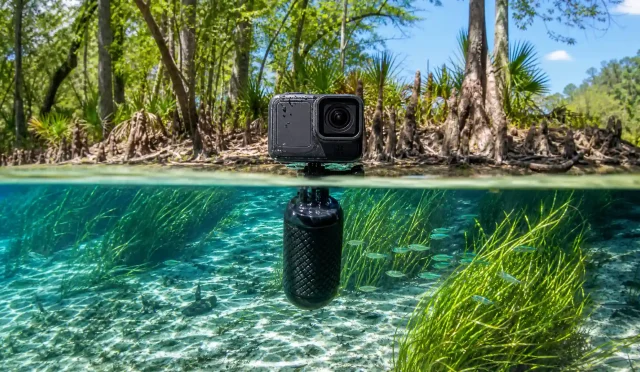
DJI Osmo Action cameras are usually water‑resistant to a specific depth without an extra case, but:
- Always check the exact official rating for your model.
- For deeper diving or frequent underwater use:
- Invest in a dedicated underwater housing.
- Before going into water:
- Make sure all doors and covers are fully closed.
- Check for sand, hair, or debris on the seals to avoid leaks.
After saltwater use, rinse the camera or housing with fresh water to protect seals and materials.
5.2 Shooting in Cold Weather
Cold temperatures can reduce battery performance:
- Keep spare batteries in a warm inner pocket.
- Swap batteries when needed instead of pushing a cold battery to zero.
- Avoid sudden temperature jumps:
- When you come indoors from the cold, let the camera warm up gradually in your bag to reduce condensation.
These small precautions protect both your Osmo Action and your footage.
6. Battery, Storage, and Long‑Term Care
6.1 Extend Battery Life with Smart Settings
To get more recording time per charge:
- Reduce screen brightness to a comfortable but not maximum level.
- Disable unused features:
- Constant Wi‑Fi, Bluetooth, and voice control if you don’t need them.
- Use auto‑sleep:
- Set a short standby timer so the camera turns off the screen when idle.
For all‑day shoots, combine efficient settings with at least one or two spare batteries.
6.2 Choose the Right microSD Card
Your microSD card directly affects reliability:
- Use at least U3 or V30 rated cards for 4K, high‑bitrate video.
- Prefer reputable brands and avoid very low‑cost, unbranded options.
- Periodically format the card in the camera (after backing up, of course).
A good card reduces dropped frames, recording errors, and potential file corruption.
6.3 Clean and Maintain Your Camera
A bit of regular care keeps your DJI Osmo Action looking and working like new:
- Clean the lens and screens with a microfiber cloth, never with paper towels or abrasive fabrics.
- After beach or desert shoots:
- Blow or gently brush off sand and dust before wiping.
- Inspect seals and doors every so often:
- Replace accessories if you see cracks or heavy wear.
Clean optics and intact seals are crucial for sharp, reliable images.
7. Content Strategy and Storytelling with an Action Camera
The best settings won’t save a boring story. To make your videos more engaging:
- Plan a simple structure:
- Intro: who you are and what you’re about to do.
- Middle: action, process, or journey.
- Outro: results, reflections, or a takeaway tip.
- Mix different shot types:
- Wide establishing shots, medium action shots, close‑ups of details.
- Add time‑lapse, hyperlapse, and slow‑motion sequences where they make sense.
- Hook viewers in the first 5–10 seconds:
- Open with your most exciting or visually striking moment.
- Then step back and explain what’s going on.
With a strong narrative and thoughtful editing, your DJI Osmo Action can compete with much more expensive setups.
8. Recommended Product on Amazon
If you’re looking for a powerful, up‑to‑date action camera combo that works great for daily use, travel, and sports, consider:
DJI Osmo Action 6 Essential Combo, Action Camera with 1/1.1″ Square Sensor, Variable Aperture of f/2.0–f/4.0, Cold‑Resistant, 4hrs Battery, Action Camera 4K Ideal for Daily Use
- The 1/1.1″ sensor delivers better low‑light performance and dynamic range.
- The variable aperture (f/2.0–f/4.0) gives you more control over exposure and depth of field.
- Long‑lasting battery life and cold‑resistant design make it a reliable choice for outdoor creators.
This combo is a solid option if you want to upgrade or start fresh with a capable, future‑proof action camera kit.