
Software Project Management: Differences Between Agile and Waterfall and Global Trends
Introduction to Modern Software Project Management
Software Project Management plays a critical role in delivering successful digital products in today’s fast-paced technological environment. Organizations no longer rely on a single methodology to manage software development. Instead, they evaluate different approaches based on flexibility, risk tolerance, team structure, and market demands. Among all methodologies, Agile and Waterfall stand out as the most widely discussed and applied frameworks.
Understanding the differences between Agile and Waterfall is essential for project managers, developers, and business leaders. This article explores their core principles, compares their strengths and weaknesses, and examines global trends shaping software project management in 2026 and beyond.
What Is Waterfall Methodology?
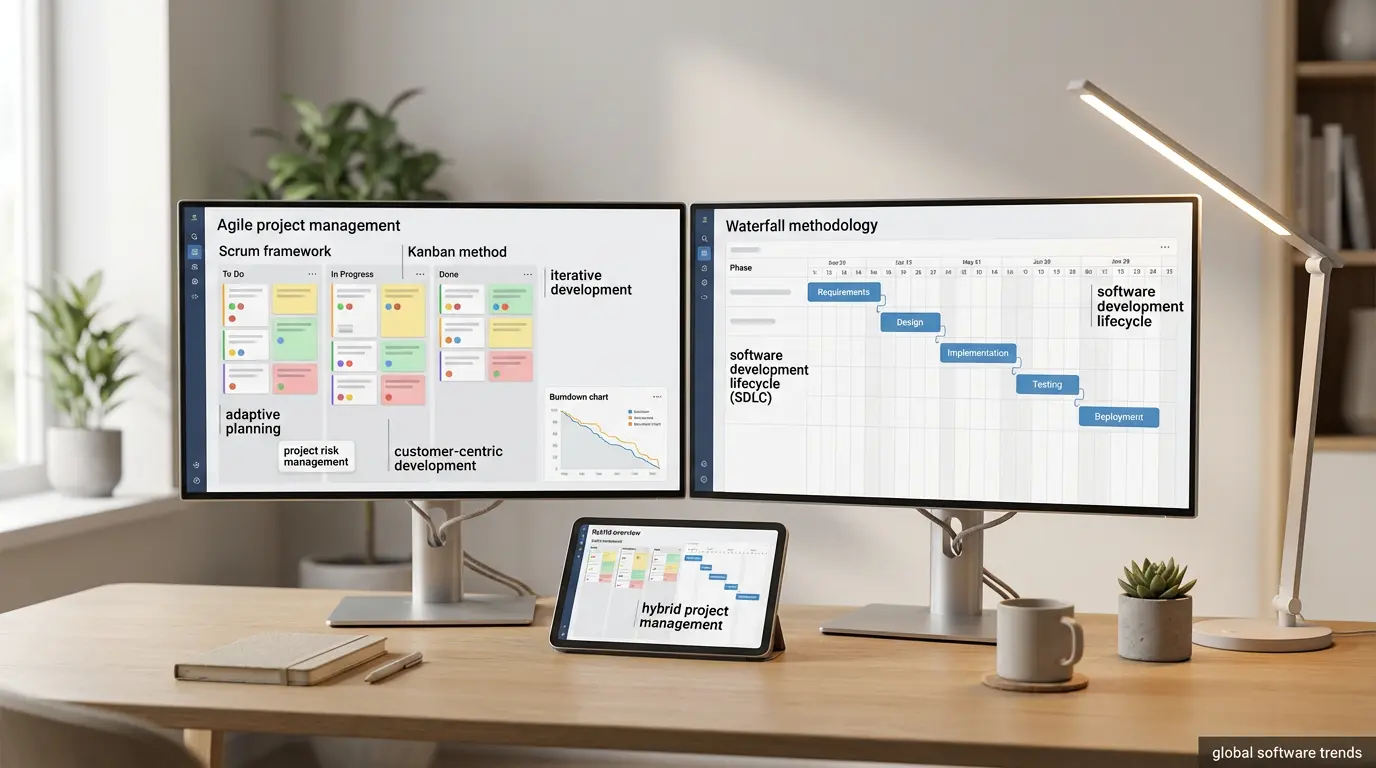
The Waterfall methodology follows a linear and sequential project structure. Teams complete each phase before moving to the next one. Once a phase ends, revisiting it becomes costly and time-consuming.
Typical Waterfall stages include:
- Requirements analysis
- System design
- Implementation
- Testing
- Deployment
- Maintenance
This approach works best when requirements remain stable and clearly defined from the beginning. Industries such as government, construction software, and regulated environments often prefer Waterfall due to its predictability and documentation-heavy structure.
However, Waterfall struggles in dynamic markets where change is inevitable. When customer needs evolve mid-project, teams face delays and budget overruns.
What Is Agile Methodology?
Agile methodology emphasizes flexibility, collaboration, and continuous improvement. Instead of delivering the entire product at the end, Agile teams release functional increments through short development cycles called sprints.
Key Agile principles include:
- Customer collaboration over contract negotiation
- Responding to change over following a fixed plan
- Working software over extensive documentation
Frameworks such as Scrum, Kanban, and Extreme Programming help teams implement Agile effectively. Agile project management allows teams to adapt quickly, reduce risks, and deliver value faster.
Key Differences Between Agile and Waterfall
Project Structure and Flexibility
Waterfall follows a rigid structure, while Agile promotes iterative development. Agile teams embrace change, whereas Waterfall resists modifications once development starts.
Customer Involvement
Agile encourages constant customer feedback throughout the project lifecycle. In contrast, Waterfall limits stakeholder involvement after the requirements phase.
Risk Management
Agile reduces project risk by delivering small, testable increments. Waterfall often uncovers risks late during the testing phase.
Documentation Approach
Waterfall relies heavily on detailed documentation. Agile focuses more on working software and adaptive planning.
Advantages and Disadvantages of Waterfall
Advantages:
- Clear project milestones
- Easy cost estimation
- Strong documentation
- Suitable for fixed-scope projects
Disadvantages:
- Limited flexibility
- Late testing phase
- High cost of changes
- Less customer engagement
Advantages and Disadvantages of Agile
Advantages:
- Faster time to market
- Continuous customer feedback
- Better team collaboration
- Improved product quality
Disadvantages:
- Less predictable timelines
- Requires experienced teams
- Difficult cost estimation
- Can lack documentation discipline
Agile vs Waterfall: Which One Should You Choose?
Choosing between Agile and Waterfall depends on multiple factors:
- Project complexity
- Regulatory requirements
- Team maturity
- Customer availability
Many organizations now adopt hybrid project management models such as Agile-Waterfall or SAFe to balance structure and flexibility.
Global Trends in Software Project Management
Rise of Hybrid Methodologies
Companies increasingly blend Agile and traditional approaches. Hybrid models provide governance while maintaining adaptability.
Remote and Distributed Teams
Globalization and remote work have transformed team collaboration. Agile frameworks adapt well to distributed environments using digital collaboration tools.
AI and Automation in Project Management
Artificial intelligence enhances sprint planning, risk forecasting, and resource allocation. Predictive analytics helps managers make data-driven decisions.
Focus on Business Value Delivery
Organizations now measure success by delivered business value rather than completed tasks. Agile metrics such as velocity and customer satisfaction gain importance.
Increased Demand for Agile Certifications
Certifications like Certified ScrumMaster (CSM) and PMI-ACP continue to gain global recognition.
Future Outlook: Agile Dominance with Strategic Balance
While Agile continues to dominate modern software development, Waterfall still holds relevance in specific contexts. The future of software project management lies in adaptive leadership, continuous learning, and methodology customization.
Project managers who understand both frameworks gain a strategic advantage. They can select, tailor, and combine methodologies to align with organizational goals.