
As the Internet of Things (IoT) extends beyond terrestrial networks into rivers, lakes, and oceans, reliable underwater communication becomes a foundational requirement. Unlike radio frequency (RF) signals that attenuate rapidly in water, acoustic waves travel far longer distances, making acoustic modems the de facto backbone of Underwater IoT (UIoT). From environmental monitoring and aquaculture automation to subsea infrastructure inspection and defense applications, acoustic modems enable sensor nodes, autonomous underwater vehicles (AUVs), and gateways to exchange data under challenging marine conditions. This article explains how acoustic modems work, key performance metrics, network architectures, use cases, deployment best practices, and emerging trends—optimized for SEO with related LSI concepts, while keeping the tone authoritative and clear.
Why Acoustic, Not RF or Optical?
Underwater communication options include RF, optical (LED/laser), and acoustic. RF suffers severe attenuation even at low frequencies and offers only extremely short ranges. Optical links can deliver high data rates but require clear water, precise alignment, and are sensitive to turbidity and biofouling. Acoustic communication, by contrast, supports long-range propagation (hundreds of meters to tens of kilometers) and is robust against moderate turbidity. The trade-off is lower throughput, higher latency, and susceptibility to multipath and Doppler effects. For most UIoT scenarios involving sparse, battery-powered sensors over wide areas, acoustic modems strike the best balance.
How Acoustic Modems Work
Acoustic modems convert digital bits into sound waves using modulation schemes adapted to underwater channels. Common schemes include Frequency-Shift Keying (FSK), Phase-Shift Keying (PSK), and Orthogonal Frequency-Division Multiplexing (OFDM). Advanced implementations incorporate:
- Adaptive modulation and coding to match channel conditions.
- Time-reversal or equalization to mitigate multipath.
- Doppler compensation for moving platforms like AUVs and gliders.
- Forward error correction (FEC) to reduce packet loss.
Transducers act as both speakers and microphones, converting electrical signals to pressure waves and back. Because sound speed in water is roughly 1500 m/s (much slower than RF), propagation delays are nontrivial and must be considered in protocol design.
Key Performance Metrics
- Range: Varies from tens of meters (high-rate links) to tens of kilometers (low-rate links). Range depends on frequency, power, and ambient noise.
- Data rate: Typical UIoT links deliver a few hundred bps to tens of kbps. Short-range OFDM links can exceed 100 kbps in ideal conditions.
- Latency: Determined by propagation delay and retransmissions; can be substantial over kilometer-scale links.
- Reliability: Packet delivery ratio hinges on channel dynamics, interference, and the robustness of MAC and routing layers.
- Power consumption: Critical for long-lived deployments; sleep scheduling and low-duty cycles are standard.
- Band selection: Lower frequencies (e.g., 5–20 kHz) enable longer ranges but lower data rates; higher frequencies (e.g., 100–500 kHz) are for short-range, higher-throughput links.
Network Architectures for Underwater IoT
- Point-to-point links: Sensor-to-gateway or AUV-to-AUV links for simple deployments.
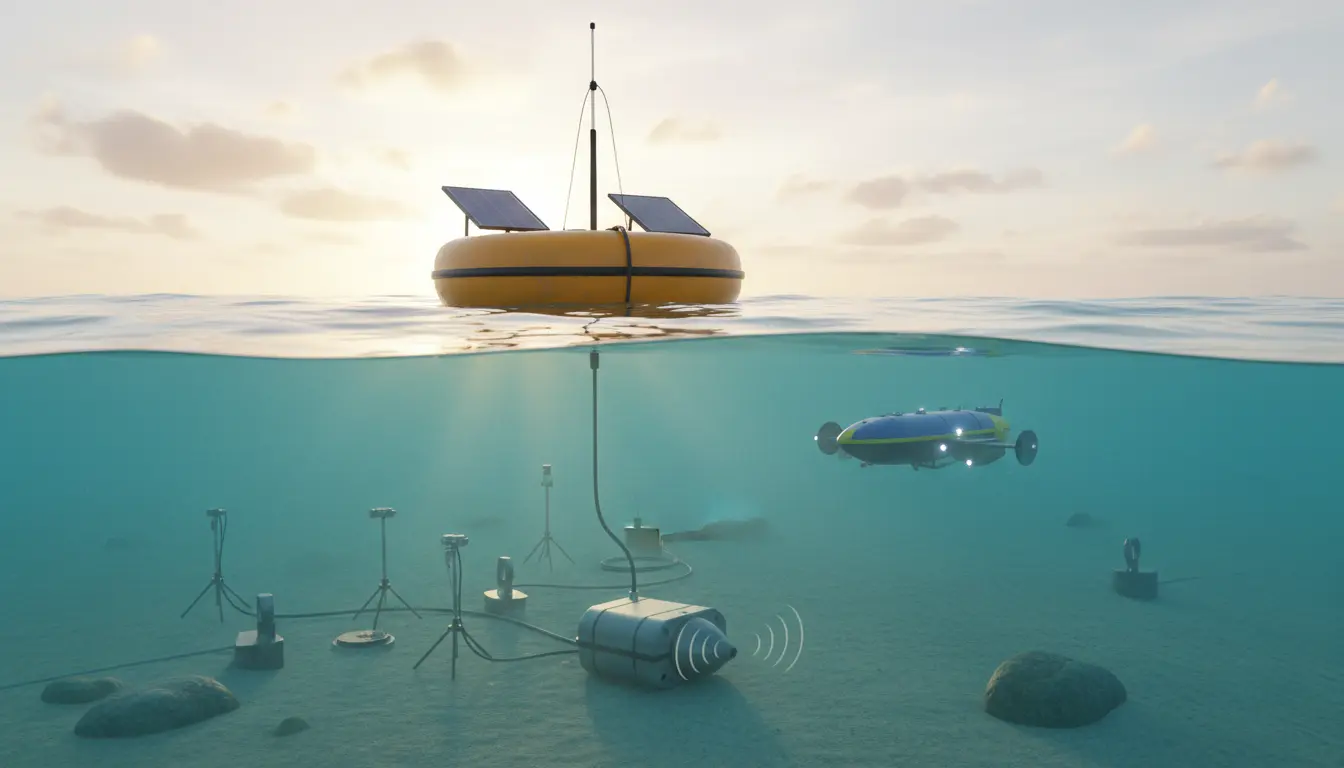
- Star topology: Multiple sensors send data to a surface buoy gateway equipped with an acoustic modem and a cellular/satellite backhaul.
- Multi-hop mesh: Extends coverage and resilience; requires routing protocols tailored to long delays (e.g., delay-tolerant networking).
- Hybrid networks: Combine acoustic (long-range), optical (short-range high-speed), and limited RF (surface) for optimal performance.
- Surface gateways: Buoys or ASVs relay data from underwater nodes to the cloud via LTE/5G or satellite, enabling real-time dashboards and alerts.
Protocols and Standards
While UIoT lacks a single universal standard, the community often adapts:
- MAC protocols with long propagation delays in mind (e.g., tone-based handshake, TDMA frames with guard times, CSMA variants with collision avoidance).
- Routing suited for sparse, dynamic topologies (vector-based routing, pressure-based routing using depth).
- Application layer formats like CBOR/JSON over lightweight transport with compression.
- Time synchronization via acoustic beacons or periodic surface sync to align TDMA slots.
Interoperability initiatives are emerging around open acoustic communication stacks, but vendor-specific protocols still dominate. When planning, evaluate whether you need multi-vendor compatibility or can standardize on a single ecosystem.
Core Use Cases
- Environmental sensing: Temperature, salinity, dissolved oxygen, pH, chlorophyll, and turbidity monitoring for climate research and fisheries management.
- Aquaculture: Feeding optimization, water quality monitoring, and asset tracking in fish farms.
- Offshore energy: Integrity monitoring for pipelines, risers, subsea structures, and corrosion sensors.
- Infrastructure inspection: AUV/ROV missions for bridges, dams, and harbor facilities with acoustic links for command-and-control and data retrieval.
- Disaster response: Rapid deployment of sensor networks to track leaks, contamination plumes, or seabed movement after earthquakes.
- Defense and security: Port and harbor surveillance, UUV coordination, and mine countermeasures.
Deployment Best Practices
- Site survey: Characterize ambient noise (shipping lanes, biologics), temperature/salinity profiles, and bathymetry. Seasonal variations matter.
- Frequency planning: Choose center frequency based on range and data rate objectives; avoid known noise bands.
- Transducer placement: Maintain clear line-of-sight where possible; consider mounting depth to minimize surface multipath and wave noise.
- Power budgeting: Size batteries for worst-case duty cycles; leverage event-driven reporting, compressed payloads, and scheduled wake windows.
- Redundancy: Use multi-hop or dual-modem redundancy where reliability is paramount; consider store-and-forward via AUVs for sparse nodes.
- Biofouling mitigation: Anti-fouling coatings, wipers, or periodic cleaning to preserve optical sensors and transducer performance.
- Security: Employ lightweight encryption and authentication. Acoustic links can be eavesdropped; balance crypto overhead with power and latency constraints.
Integration with Cloud and Data Platforms
Surface gateways bridge acoustic networks to cloud services for storage, analytics, and AI-driven insights. Typical pipeline:
- Edge preprocessing: Outlier filtering, delta encoding, or threshold-based event triggers at the node to reduce transmission volume.
- Backhaul: LTE/5G or satellite uplink from buoy/ASV.
- Cloud ingestion: MQTT or HTTPS endpoints with device identity and per-node topics.
- Analytics: Time-series databases, anomaly detection models, and dashboards for operators.
- Action: Alerts to operations teams; closed-loop control via scheduled acoustic commands (e.g., change sampling rate).
Adopt a digital twin approach to model hydrodynamics, expected sensor ranges, and battery life, then validate with field telemetry.
Challenges and How to Mitigate Them
- Multipath and Doppler: Use modems with adaptive equalization and Doppler tracking; design MAC with retries and interleaving.
- Variable channels: Implement link-quality-based rate adaptation and opportunistic scheduling during low-noise windows (night hours).
- Limited bandwidth: Prioritize payloads, use compact encodings, and send summaries with on-demand retrieval for raw data.
- Synchronization: Favor asynchronous event reporting plus periodic sync frames; consider acoustic beacons for time references.
- Cost and maintenance: Plan for modular components, swappable batteries, and remote diagnostics to reduce vessel time.
Emerging Trends
- AI-enhanced acoustics: On-modem machine learning for channel estimation, beamforming, and adaptive rate control.
- Energy harvesting: Wave, current, or microbial fuel cells to extend node lifetime.
- Interoperable stacks: Open-source PHY/MAC prototypes and cross-vendor compatibility profiles.
- Swarm AUV operations: Collaborative mapping and data muling with acoustic coordination.
- Hybrid optical-acoustic links: Opportunistic high-rate bursts at short range with resilient acoustic fallbacks.
Selecting the Right Acoustic Modem
When choosing a modem for UIoT:
- Match frequency and bandwidth to range and throughput needs.
- Verify support for your preferred MAC/routing stack or APIs for custom integration.
- Check power modes, wake-on-sound capability, and sleep current.
- Evaluate environmental ratings (depth, pressure, temperature), connector standards, and transducer patterns.
- Consider vendor support, firmware update paths, and diagnostic tooling.
Conclusion
Acoustic modems are the enabling technology for Underwater IoT, providing robust connectivity where RF and optical solutions fall short. By understanding channel physics, selecting appropriate hardware, and designing network and application layers around underwater constraints, organizations can deploy scalable, energy-efficient, and reliable UIoT systems that deliver real operational value.