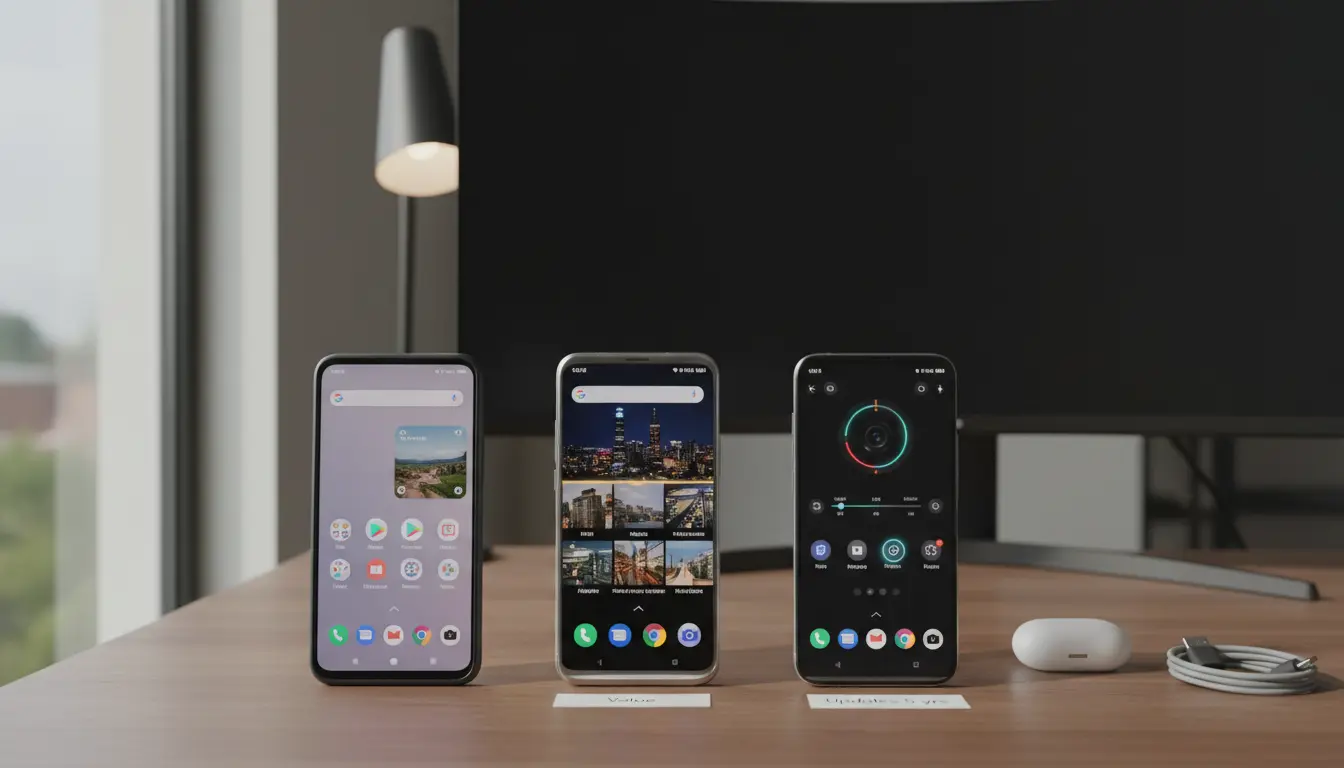

Choosing the right Android phone in 2025 is easier when you match your needs and budget to the right segment. The market now clearly groups into three tiers—budget, mid-range, and flagship—each offering distinct trade-offs in performance, camera quality, battery life, display technology, and software experience. This guide breaks down what to expect from each tier, how to evaluate real-world value, and which features truly matter so you can buy confidently and organically match your device to your daily life.
How to Decide Your Tier
Start with use-cases, not specs:
- Social, messaging, media, and light photography: budget or lower mid-range will suffice.
- Gaming, strong camera, and long-term software support: mid-range or upper mid-range.
- Content creation, desktop modes, AI features, pro cameras, and longevity: flagship.
Also consider how long you intend to keep the device. If you want 4–6 years of reliable use, prioritize software update promises, efficient chips, and durable build quality—traits more common in upper mid-range and flagship models.

Budget Phones (Entry-Level Value)
Budget Android phones have matured. In 2025, a good budget model can deliver smooth daily use, solid battery life, and decent cameras in good light.
What to expect:
- Processor: Efficient 6 nm–8 nm chips with enough power for social apps, browsing, and casual gaming. Look for modern mid-tier silicon (e.g., Snapdragon 6-series or equivalent) over older, hot, or underpowered chips.
- Display: 90–120 Hz LCD or basic OLED around 6.5 inches. OLED is a bonus; a well-tuned LCD is fine if it’s bright and color-accurate.
- Camera: 50 MP main sensors are common, but sensor size and processing matter more than megapixels. Night photos will be acceptable, not spectacular. Ultrawide is a plus; ignore low-quality macro sensors.
- Battery: 5000 mAh is the norm with 18–33 W charging. Focus on efficiency and standby drain, not just battery size.
- Storage/RAM: Aim for 6–8 GB RAM and 128 GB storage; microSD support is still a perk in this tier.
- Software: 2–3 years of Android updates is good for budget models; seek clean or near-stock UI to avoid bloat.
Who should buy:
- Students, secondary-phone users, and anyone who wants reliable basics without premium pricing.
- Users who upgrade every 2 years and don’t need cutting-edge features.
Buying tips:
- Prioritize a balanced spec sheet over a single flashy feature.
- Test camera samples from reviewers rather than trusting megapixel claims.
- Confirm band support and NFC if you use contactless payments.
Mid-Range Phones (The Sweet Spot)
The 2025 mid-range offers the best value for most people, packing near-flagship displays, strong cameras, and long battery life—often with 3–5 years of software support.
What to expect:
- Processor: Snapdragon 7-series or performance-optimized SoCs with integrated AI accelerators. These deliver excellent everyday speed and cooler sustained performance than some flagships.
- Display: 120–144 Hz OLED with high peak brightness (1200–2000+ nits outdoors), HDR support, and good PWM dimming for eye comfort.
- Camera: Larger sensors, stable night mode, useful ultrawide, and improved stabilization. 2x–3x telephoto is rare but a treat if included.
- Battery and charging: 4700–5200 mAh with 30–80 W charging. Focus on real-world screen-on time and battery health features.
- Build: Aluminum frames, Gorilla Glass, and IP54–IP67 splash protection start to appear.
- Software: 3–4 years OS + 4–5 years security updates are increasingly common. Cleaner skins or customizable but efficient interfaces provide a premium feel.
Who should buy:
- Most users. If you want near-flagship experience for less, this is your lane.
- Mobile photographers on a budget, frequent travelers, and gamers who value sustained performance.
Buying tips:
- Look for OIS on the main camera and good EIS in video.
- Check thermal performance in reviews; a cooler phone often lasts longer and keeps performance consistent.
- Consider features like stereo speakers, haptics quality, and Wi‑Fi 6/6E/7 support for a premium daily experience.
Flagship Phones (The No-Compromise Choice)
Flagships in 2025 lean into pro-grade cameras, high-end AI features, luxury build quality, and the longest support windows.
What to expect:
- Processor: Top-tier chips with powerful NPUs for on-device AI (voice, image enhancement, offline assistants) and cutting-edge gaming. Expect elite single-core performance and high-end GPUs.
- Display: LTPO 1–120 Hz OLED with 1500–3000+ nit brightness, precise color calibration, robust eye comfort tech, and minimal bezels. Some models offer variable refresh for battery efficiency.
- Camera: Large sensors, multi-camera arrays with real telephoto (3x–10x), advanced HDR, 4K/8K video, manual/pro modes, and computational photography for low light and motion.
- Battery and charging: All-day battery with smart charging to protect health, 45–120 W wired and fast wireless; reverse wireless charging for accessories.
- Build and extras: IP68, aluminum/titanium, premium haptics, fast storage (UFS 4.0), desktop modes, satellite features in some regions, and robust connectivity including Wi‑Fi 7.
- Software: 4–7 years updates on select models—verify the brand’s official policy.
Who should buy:
- Creators, power users, mobile gamers, and professionals who need the best cameras, displays, and long-term reliability.
- Users planning to keep the phone 4–6+ years.
Buying tips:
- If camera quality matters, prioritize sensor size, OIS on multiple lenses, and real telephoto over digital zoom.
- Check throttling behavior under sustained workloads; a cooler flagship can outperform a hotter one in real life.
- Ensure the brand’s AI features work offline for privacy and reliability.
Key Features That Truly Matter in 2025
- Battery health: Smart charging, adaptive charge limits, and cooler chips extend lifespan.
- Longevity: Update policy, repairability, and availability of parts go a long way.
- Connectivity: 5G bands for your region, eSIM support, Wi‑Fi 6E/7, and Bluetooth LE Audio.
- Display comfort: PWM dimming solutions and anti-flicker modes reduce eye strain.
- Storage speed: UFS 3.1 or 4.0 improves app launch times and camera performance.
- Security: Biometric reliability, timely patches, and a strong privacy dashboard.
How to Compare Two Phones Quickly
- Performance: Look at efficiency and sustained scores, not just peak benchmarks.
- Camera: Compare samples in daylight, low light, portrait, and video stabilization.
- Display: Peak brightness and color accuracy beat raw resolution above 1080p.
- Battery: Real-world SOT and overnight drain matter more than mAh alone.
- Software: Update policy, bloatware, and useful AI features trump gimmicks.
Budget vs. Mid-Range vs. Flagship: Which Should You Choose?
- Choose budget if your priority is affordability, solid basics, and you upgrade sooner.
- Choose mid-range if you want excellent value, strong cameras, and long battery life—ideal for most users.
- Choose flagship if you want the best cameras, AI features, and long-term support and you keep devices for many years.
Remember, the best phone is the one that fits your lifestyle, not the most expensive one. Make your decision based on photography needs, battery life expectations, software longevity, and the ergonomics of a device you’ll hold for hours every day.
Final Checklist Before You Buy
- Confirm regional network bands, NFC, and eSIM.
- Read two or three trusted reviews and watch camera comparisons.
- Check return policy and trade-in values.
- Choose the storage tier you’ll actually need; 256 GB is a safe mid-point for heavy media users.
- Protect your investment with a good case and screen protector—especially for curved displays.