
Finding the right moisture control solution represents a serious challenge for homeowners throughout Pennsylvania. The unique climate across the Keystone State brings heavy summer humidity, frequent spring rainfall, and cold winter conditions that continuously drive excess subterranean moisture straight into foundation walls. Without active climate management, an unconditioned basement quickly transforms into a breeding ground for harmful airborne allergens, structural rot, and pervasive dampness. Investing in the best dehumidifiers for Pennsylvania basements solves these persistent structural threats, restores healthy indoor air quality, and protects your property investment from irreversible moisture damage.
Understanding Pennsylvania Basement Moisture Dynamics
Pennsylvania homes face specific geographic and environmental moisture pressures. Much of the region features dense clay-heavy soils, which readily retain groundwater during heavy Atlantic weather systems and seasonal snowmelt. When this moisture accumulates around your foundation, hydrostatic pressure relentlessly forces water vapor through microscopic pores in concrete block and poured stone walls. Older homes across cities like Philadelphia, Pittsburgh, Allentown, and Lancaster frequently feature legacy stone foundations that naturally breathe and allow moisture vapor infiltration.
Furthermore, warm outdoor air naturally infiltrates subterranean spaces during humid Pennsylvania summers. Because basement surfaces remain significantly cooler than the ambient outside air, incoming warm air quickly cools past its dew point. This temperature disparity creates condensation on exposed cold-water pipes, joists, and concrete slabs. Left unmanaged, relative humidity levels regularly surpass 60 percent, creating the exact microclimate required for toxic black mold expansion and musty odors.



Essential Features to Look for in a Pennsylvania Basement Dehumidifier
Selecting the right unit requires matching machine specifications to the harsh subterranean environment of the northeastern climate. Standard residential units often fail in cold, damp basements because they lack essential engineering safeguards.
Pint Capacity and Real-World Sizing
The Association of Home Appliance Manufacturers rates modern dehumidifier capacity using pints of water removed per 24 hours under standard testing conditions. For damp Pennsylvania basements ranging between 1,000 and 2,500 square feet, a 50-pint modern capacity unit (equivalent to previous 70-pint ratings) provides the necessary extraction velocity. Undersizing a dehumidifier forces the compressor to run continuously, driving up electricity bills while failing to depress relative humidity below critical mold thresholds.
Low-Temperature Operation and Auto-Defrost Capability
Pennsylvania basements routinely drop into the 40-to-55-degree Fahrenheit range during late autumn and early spring. Traditional compressor-based dehumidifiers accumulate frost across their cooling coils when operating in these lower temperatures. Look specifically for models equipped with built-in auto-defrost sensors. This feature automatically cycles off the compressor while running the internal fan to melt accumulated frost, preventing coil freezing and mechanical failure.
Continuous Drainage Options and Built-In Pumps
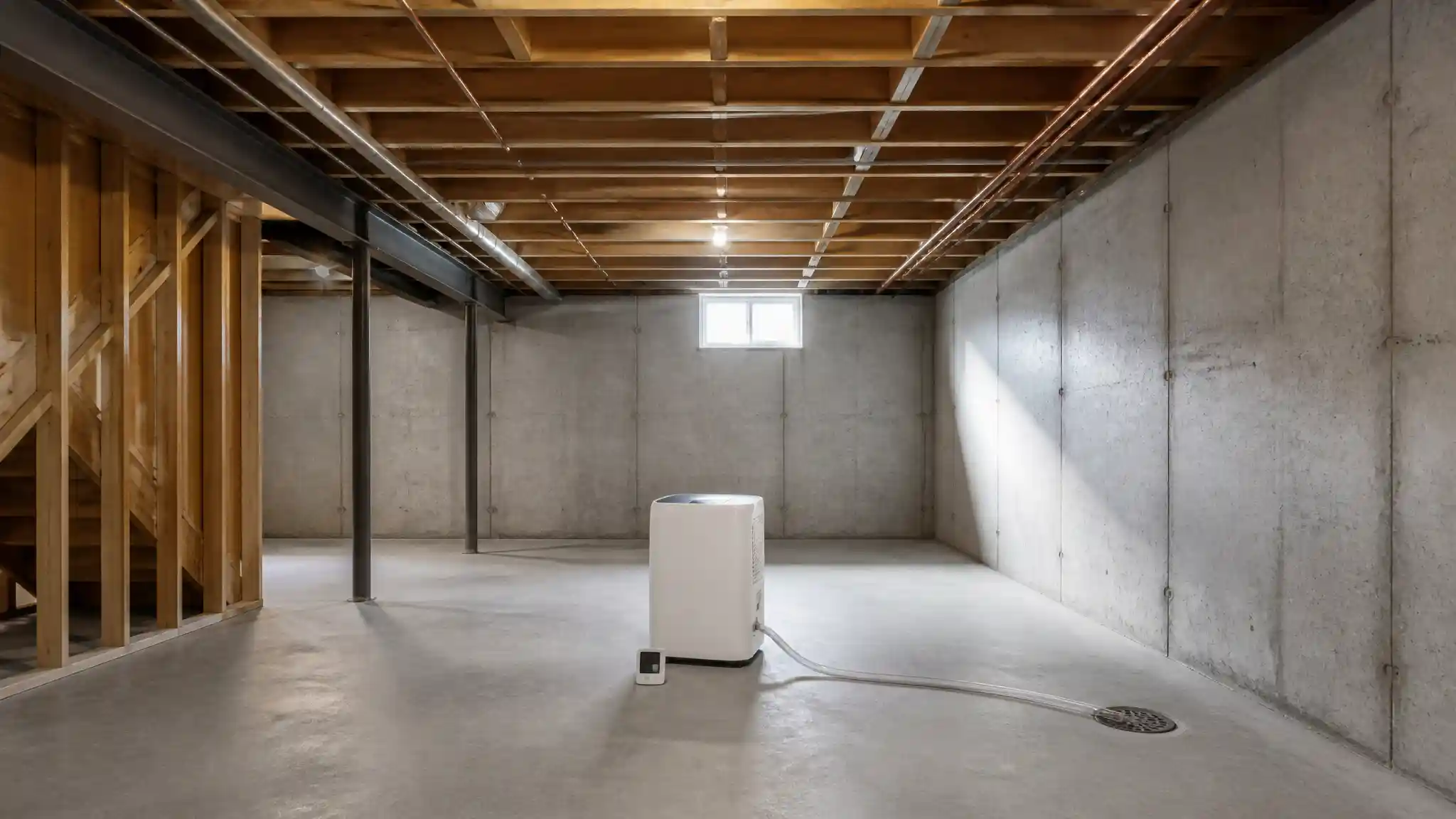
Emptying a manual water collection bucket twice a day quickly becomes tedious and leads to machine shut-offs when full. High-efficiency basement units provide two continuous drainage solutions: standard passive gravity drains and active internal condensate pumps. A built-in pump lifts collected water vertically through clear plastic tubing, discharging moisture directly into an overhead utility sink, elevated drain pipe, or basement egress window.
Energy Star Certification and Operating Costs
Dehumidifiers run for extended cycles throughout Pennsylvania’s humid months from May through October. Choosing an Energy Star certified model ensures advanced refrigeration coils, high-efficiency compressors, and optimized fan blades that consume roughly 15 to 30 percent less electrical energy than non-certified counterparts. This efficiency delivers lower utility expenses while maintaining optimal dry conditions.
Comprehensive Guide to Effective Basement Moisture Control
Placing a powerful unit in the room serves as only one component of comprehensive basement moisture management. You must optimize the surrounding environment to achieve maximum dehumidification efficiency and maintain relative humidity consistently between 35 and 45 percent.
Sealing Air Leaks and Foundation Penetrations
Moist outdoor air constantly enters basements through cracked rim joists, leaky ground-level hopper windows, and unsealed utility pipe penetrations. Applying closed-cell spray foam along the rim joist perimeter and replacing old drafty cellar windows halts outside moisture infiltration. Sealing these gaps prevents your dehumidifier from attempting to condition the entire outdoor atmosphere.
Strategic Unit Placement and Airflow Dynamics
Always position your dehumidifier in a central location away from obstructions. Maintain at least 12 to 18 inches of clearance around all intake grilles and exhaust louvers. Proper clearance allows internal fans to draw damp air from every subterranean corner while circulating dry, warm discharge air throughout the entire perimeter. In compartmentalized or expansive basements, pairing the unit with an auxiliary oscillating circulation fan significantly accelerates drying cycles.
Managing Drainage and Cleaning Washable Filters
Dust, airborne debris, and pet hair rapidly accumulate on the intake filter screen. A clogged filter restricts internal airflow, decreases water extraction efficiency, and places unnecessary mechanical stress on the compressor motor. Clean the reusable nylon filter with warm soapy water every two to three weeks to maintain peak operating performance. Inspect drain hoses monthly to eliminate internal bio-slime and mineral scale buildup that could obstruct continuous discharge.
Preventing Structural Damage and Health Hazards
Uncontrolled subterranean dampness silently compromises home foundations and indoor living environments. High humidity softens organic framing lumber, encourages wood-boring insect infestations, and corrodes mechanical equipment such as water heaters and furnaces. Moreover, the stack effect naturally draws basement air upward into upper living areas, distributing mold spores, dust mites, and damp odors directly into family living spaces. A dedicated high-capacity dehumidifier effectively stops this toxic upward migration at its primary source.
Top Product Recommendation on Amazon
If you want a dependable, heavy-duty moisture solution designed specifically for demanding subterranean conditions, we recommend the Midea 50-Pint Energy Star Smart Dehumidifier with Built-In Pump. Available directly on Amazon.com, this versatile unit effortlessly removes up to 50 pints of moisture per day across spaces up to 4,500 square feet. It features a heavy-duty integrated pump that lifts water up to 16 feet vertically, reliable low-temperature auto-defrost operation, intuitive smart Wi-Fi controls for real-time smartphone monitoring, and an Energy Star Most Efficient rating to keep seasonal operating costs low. Investing in this robust appliance permanently safeguards your foundation integrity, eliminates persistent damp odors, and ensures long-lasting household comfort.