
Best Gaming Monitors for Ohio Esports Enthusiasts
Ohio has rapidly transformed into a vibrant hub for competitive video games, fueled by collegiate leagues at universities across Columbus, Cleveland, and Cincinnati, alongside thriving local LAN centers. For dedicated gamers striving to dominate ranked ladders or bring trophies back to the Buckeye State, choosing the right display makes all the difference between a glorious victory and a frustrating defeat. A monitor does not just render images; it acts as the primary sensory link between your split-second reflexes and the virtual battlefield.
Competitive players need low input lag, rapid pixel response times, sharp screen resolution, and fluid refresh rates to maintain precision during chaotic firefights and clutch maneuvers. This comprehensive guide breaks down the essential hardware requirements for serious players in Ohio, outlines the key features that maximize performance, and highlights the best gaming monitor currently available on the market.
The Rise of Competitive Gaming Across Ohio
Esports culture continues to gain immense momentum throughout the Midwest. Student athletes competing in the Ohio Esports Collegiate conference demand professional-grade hardware to match the intensity of organized tournaments. Meanwhile, regional gaming lounges and community arenas host regular events for titles like Counter-Strike, Valorant, Apex Legends, and Rocket League.
To stay competitive against elite opponents nationwide, local players cannot rely on sluggish consumer displays or standard office screens. Every millisecond counts when tracking targets through smoke grenades or reacting to sudden flank attacks. Investing in a high-performance gaming monitor delivers the visual clarity, high frame rate fluidity, and input responsiveness needed to climb leaderboards and perform consistently in live matches.
Key Display Technologies Defining Esports Performance
Before selecting a display, players must understand how specific hardware specifications directly impact real-time gameplay. While marketing terminology often highlights visual eye-candy, competitive players prioritize clarity, speed, and motion fidelity above all else.
High Refresh Rate and Motion Fluidity
Refresh rate, measured in Hertz (Hz), indicates how many times the screen updates the displayed image every second. Standard panels refresh at 60Hz, which creates noticeable motion blur and stuttering during fast-paced panning. Competitive setups require at least 144Hz, while modern tournament standards now push toward 240Hz, 360Hz, and beyond.
A higher refresh rate drastically smooths fast camera movement, tracks rapid projectile paths with pinpoint accuracy, and reduces perceptual latency. When your computer pushes out 240 frames per second, a 240Hz monitor displays each frame instantaneously, helping you perceive enemy animations sooner than opponents locked to lower refresh displays.
Fast Pixel Response Time and Motion Blur Reduction
Pixel response time measures the speed at which a liquid crystal or OLED sub-pixel transitions from one color shade to another, typically rated in gray-to-gray (GtG) milliseconds. Slow response times result in visible trailing, smearing, and distracting ghosting artifacts behind fast-moving characters.
Top-tier competitive monitors achieve a 1ms GtG response time or ultra-fast sub-millisecond speeds on next-generation panels. Many advanced gaming screens also integrate black frame insertion or backlight strobing technology to practically eliminate perceived motion blur, rendering moving targets as sharply as stationary objects.
Panel Types: Fast IPS vs. OLED vs. TN
Historically, Twisted Nematic (TN) panels dominated competitive gaming arenas due to their blistering raw speed, despite delivering washed-out colors and restrictive viewing angles. Today, Fast IPS (In-Plane Switching) panels combine rapid response times with rich color reproduction and broad viewing angles, making them the universal standard for versatile esports battle stations.
For purists seeking instantaneous responsiveness and infinite contrast, OLED technology represents the new frontier. OLED panels offer near-instantaneous 0.03ms pixel transitions and true black levels, ensuring that enemies hiding in dark corridors remain clearly visible without washing out vibrant scenery.
Adaptive Sync Technologies
Screen tearing ruins competitive focus when your graphics card outputs frame rates out of sync with the monitor refresh cycle. Adaptive synchronization technologies, including AMD FreeSync and NVIDIA G-Sync compatibility, eliminate screen tearing and minimize stuttering dynamically. These features synchronize your refresh rate directly with your GPU render queue without introducing the massive input lag traditionally associated with standard V-Sync settings.
Ergonomics and Eye Comfort Features
Long scrim sessions and tournament weekends require physical comfort. An adjustable monitor stand featuring height adjustment, swivel, tilt, and pivot controls enables optimal ergonomic alignment, reducing neck fatigue and posture strain. Furthermore, flicker-free backlights and certified low blue light emission modes protect competitive players from eye fatigue during late-night practice sessions.
Recommended Competitive Gaming Monitor: ASUS ROG Swift OLED PG27AQDP
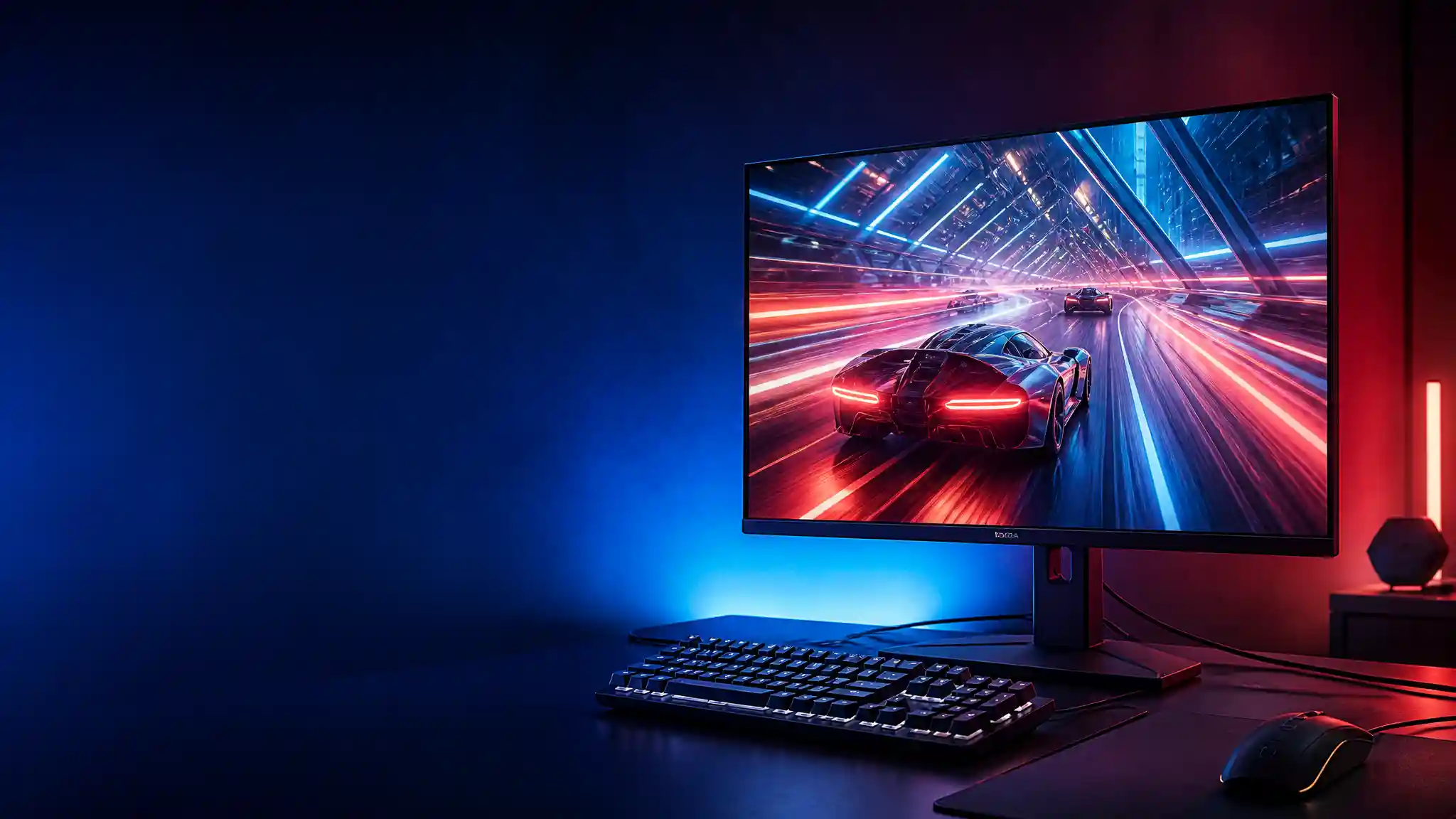
If you want the ultimate competitive display that combines raw tournament-level speed with breathtaking visual clarity, the top recommendation on Amazon.com is the ASUS ROG Swift OLED PG27AQDP.
This 27-inch 1440p (QHD) gaming monitor features an incredible 480Hz refresh rate paired with an ultra-fast 0.03ms GtG response time on a cutting-edge WOLED panel. It delivers unmatched motion clarity, anti-glare micro-texture coating to defeat harsh room reflections, and comprehensive custom heatsink cooling for prolonged panel longevity. With full G-Sync compatibility, low input lag processing, and versatile connectivity ports, it provides Ohio players with an unquestionable competitive edge across every fast-paced esports title.