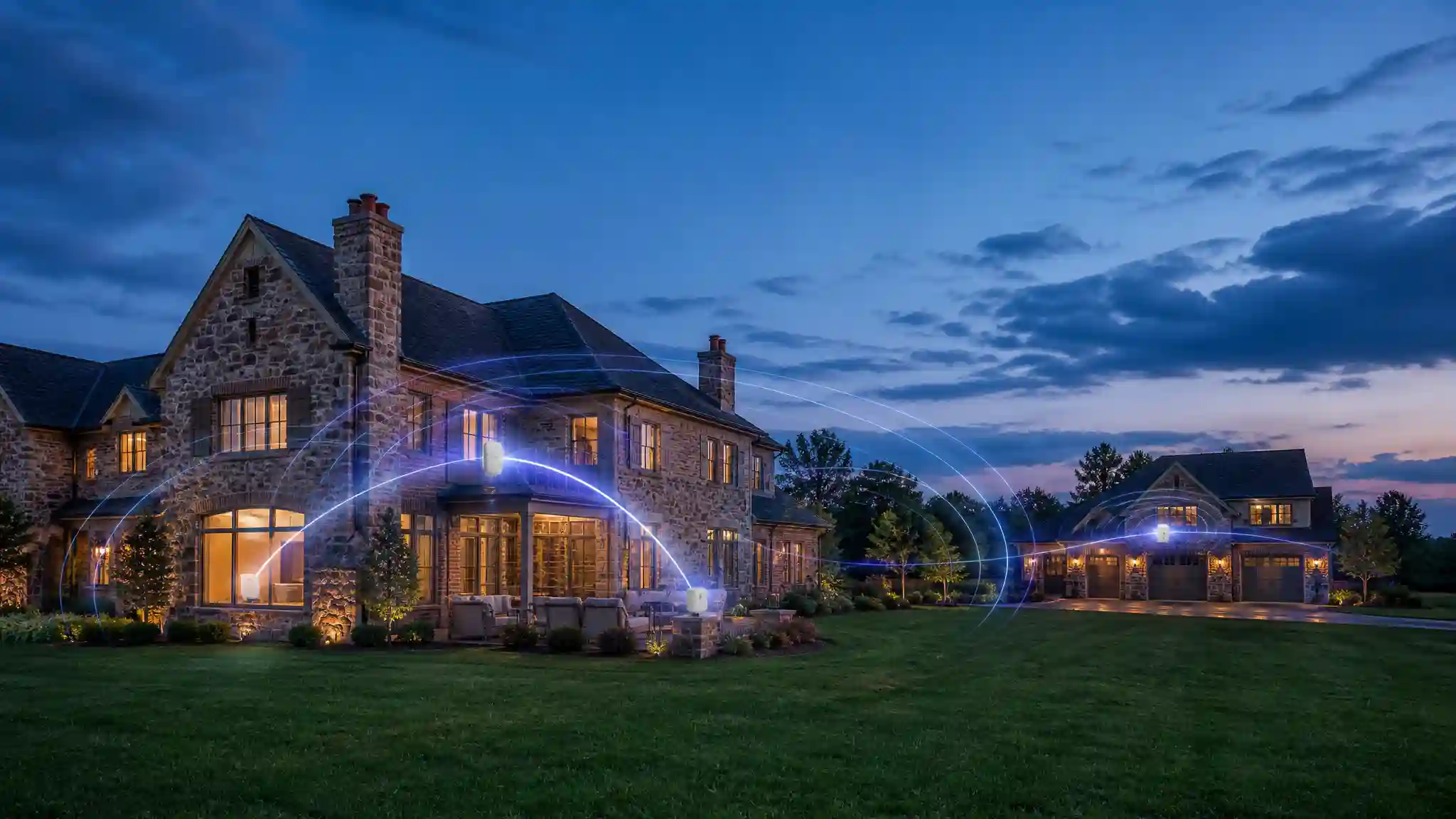

Pennsylvania features a diverse architectural landscape that ranges from historic colonial stone houses in Bucks County and Main Line estates to sprawling modern custom builds in the suburbs of Philadelphia and Pittsburgh. While these spacious residences offer rich architectural character and generous square footage, they present formidable hurdles for everyday residential wireless networking. Thick fieldstone masonry, multi-story layouts, expansive finished basements, and detached garages actively degrade traditional radio frequency transmissions. Deploying one of the best Wi-Fi mesh systems for large homes in Pennsylvania eliminates these chronic connectivity bottlenecks, delivering reliable whole home coverage across every square foot of your expansive property.
The Unique Networking Challenges of Pennsylvania Homes
Large houses across the Keystone State rarely conform to standard single-level open floor plans. Many Pennsylvania residences incorporate dense structural elements such as load-bearing stone walls, plaster lathe framing, brick chimneys, and reinforced concrete foundation slabs. These dense building materials absorb and deflect standard 2.4 GHz and 5 GHz wireless signals, creating severe signal degradation, packet loss, and persistent dead zones throughout the living spaces.
Furthermore, multi-story floor plans amplify vertical signal attenuation, meaning standard consumer routers positioned on the main floor fail to penetrate upper-floor master bedrooms or attic offices. Sprawling estate layouts often extend outdoors to patios, decks, pool houses, and detached barns where homeowners require seamless outdoor Wi-Fi coverage. A distributed mesh network solves these physical barriers by deploying interconnected wireless access points that blanket complex indoor and outdoor spaces with robust, reliable wireless coverage.



How Mesh Technology Eliminates Dead Zones in Large Properties
Traditional networking setups rely on a single central gateway paired with inexpensive signal boosters. These basic range extenders create separate network names, halve available bandwidth, and force your devices to drop connections during physical transit. In contrast, modern tri-band mesh systems utilize intelligent dynamic routing protocols to establish a unified local area network under a single network name across the entire property.
When you walk from a basement home theater to an upstairs office, advanced client steering protocols instantly transfer your smartphone, tablet, or laptop to the closest node without connection drops. Modern mesh hardware supports Wi-Fi 6E and Wi-Fi 7 networking standards, opening up the clean 6 GHz wireless band to bypass neighborhood radio frequency interference. Dedicated wireless backhaul channels maintain full multi-gigabit throughput across primary and satellite units, ensuring zero latency spikes during high-bandwidth video conferencing, competitive online gaming, and simultaneous multi-stream media playback.
Key Performance Factors for Expansive Pennsylvania Estates
Selecting the ideal mesh network hardware requires matching your specific home architecture with advanced technological capabilities. Homeowners should evaluate several critical hardware parameters to ensure their network effortlessly handles high device density, heavy bandwidth demands, and sprawling physical layouts.
Structural Penetration and Radio Signal Strength
Homes with dense plaster or exterior brick demand high-gain internal antennas and powerful radio frequency amplifiers. High-output mesh nodes push signals through challenging architectural barriers much more effectively than budget networking hardware. If your property includes an insulated detached workshop, garage apartment, or pool house, verify whether the hardware accommodates a wired Ethernet backhaul for direct, uninhibited data transmission between distant physical structures.
Tri-Band and Quad-Band Channel Capacity
A dual-band setup divides its wireless transmission capacity between handling device traffic and transmitting data back to the primary router. Large households with dozens of smart home devices, cloud security cameras, and 4K streaming platforms demand tri-band or quad-band architectures. These advanced configurations reserve an isolated high-speed wireless channel purely for node-to-node communication, preserving maximum speed and exceptionally low ping rates for active client devices.
Node Placement and Total Square Footage Coverage
Standard retail packaging claims often assume idealized open spaces without structural obstacles. For a 4,000 to 7,000 square foot Pennsylvania home with heavy stone or brick elements, calculate your node density conservatively. Plan for one primary router and two to three satellite access points to maintain high signal strength across all main living areas, finished basements, and outdoor entertainment zones.
Optimizing Your Mesh Network Deployment
Proper hardware placement dictates the ultimate stability and speed of your home internet service. Position the primary mesh router near your broadband fiber or cable modem in an elevated, central location. Avoid placing nodes inside closed metal media cabinets, behind heavy wooden furniture, or directly against thick stone fireplaces.
Distribute satellite nodes within clear intermediate zones where they receive a strong primary signal while extending coverage toward outer perimeters. If your residence includes pre-installed Cat6 network cabling, connect all satellite units via wired Ethernet backhaul. This hardwired backbone bypasses structural signal absorption entirely, dedicating all wireless radio channels strictly to mobile devices, workstations, and automated home systems. Investing in a robust mesh architecture guarantees lightning-fast data transfers, reliable smart home automation, and uninterrupted connectivity across every wing of your estate.
Recommended System on Amazon.com: Asus ZenWiFi Pro XT12
For homeowners across Pennsylvania seeking uncompromising throughput, exceptional wall penetration, and effortless coverage for large properties, the Asus ZenWiFi Pro XT12 stands out as an exceptional tri-band mesh solution. Available on Amazon.com, this high-performance two-pack system covers up to 6,000 square feet and features high-gain internal antennas alongside dual 2.5 Gbps Ethernet ports for ultra-fast wired backhauls. Its intelligent RangeBoost Plus technology actively punches through thick masonry and multi-story floor plans, delivering truly seamless whole-home connectivity, exceptional multi-gigabit speeds, and robust signal reliability for demanding, connected households across sprawling Pennsylvania residential properties.