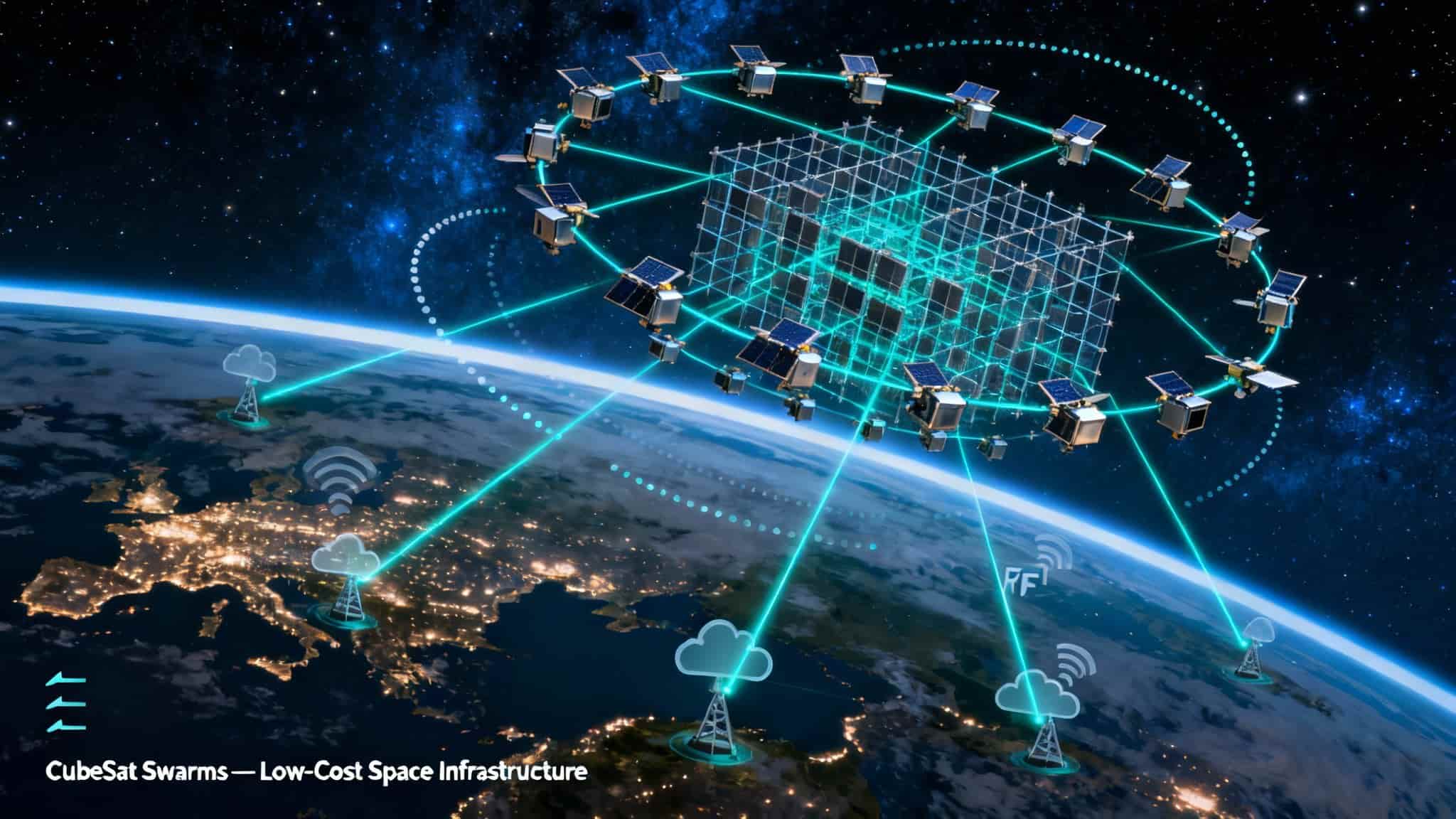

CubeSat swarms are transforming how humanity builds, launches, and operates space infrastructure. By coordinating dozens—or even hundreds—of miniature satellites to work as a cohesive system, organizations can achieve capabilities once reserved for billion-dollar programs. From Earth observation and communications to space weather monitoring and in-orbit servicing, CubeSat constellations and swarms are creating a flexible, scalable, and low-cost architecture for space. This article explains what CubeSat swarms are, how they work, their advantages and challenges, key applications, enabling technologies, business models, regulatory hurdles, and what the next decade might bring.
What is a CubeSat and what is a swarm?
A CubeSat is a standardized small satellite built around units called “U” (10 x 10 x 10 cm, typically weighing ~1–1.33 kg per unit). Common sizes include 1U, 3U, 6U, and 12U. Using commercial off-the-shelf components, rapid design cycles, and rideshare launches, CubeSats drastically reduce costs and development time.
A “swarm” refers to a distributed network of many satellites cooperating in a coordinated way. Unlike a simple constellation where each satellite operates independently, a swarm uses inter-satellite links, shared tasking, and autonomous decision-making to act as a single, adaptive instrument. Swarms can reconfigure dynamically, distribute workloads, and tolerate failures without mission loss.

Why CubeSat swarms matter
- Cost efficiency: Mass production, modular design, and shared launch services minimize capex and opex. A swarm can deliver system-level performance at a fraction of the cost of traditional monolithic satellites.
- Resilience: Redundancy through numbers. If one node fails, the network continues to function with graceful degradation.
- Scalability: Start small, add capacity as demand grows. Incremental deployment shortens feedback loops and improves tech maturity in orbit.
- Responsiveness: Swarms can be retasked quickly for new targets, event-driven observations, or emergency communications.
- Global coverage: Distributed nodes enable higher revisit rates and more uniform coverage, which is crucial for Earth observation, IoT backhaul, and situational awareness.
Key applications of CubeSat swarms
- Earth observation and environmental monitoring
Multi-spectral and SAR-equipped swarms provide high-revisit imagery for agriculture, forestry, urban planning, and climate science. Coordinated tasking enables rapid response to wildfires, floods, and oil spills. With formation flying, satellites can gather multi-angle observations for 3D reconstruction and improved atmospheric correction. - Communications and IoT connectivity
Low-data-rate IoT backhaul, asset tracking, and narrowband messaging benefit from distributed low-latency coverage. As inter-satellite links mature, swarms can route data through space, reducing reliance on ground gateways and improving latency for remote regions. - Space weather and near-Earth environment sensing
Distributed sensors measuring radiation, plasma, and magnetic fields build richer models of the ionosphere and magnetosphere. Swarms improve spatial-temporal resolution, aiding GNSS reliability, aviation safety, and power grid planning. - Disaster response and public safety
Rapid-tasking imaging and emergency communications can be delivered quickly after earthquakes, hurricanes, or infrastructure failures. Synchronized overpasses and data fusion enhance situational awareness for first responders. - In-orbit inspection and servicing (emerging)
Miniaturized proximity operations, relative navigation, and robotic capabilities are converging to enable inspection of large spacecraft, debris characterization, and eventually small-scale servicing or deorbit assistance. - Scientific missions and technology demonstration
Distributed science (e.g., heliophysics, exoplanet photometry from multiple vantage points) and fast-paced tech demos leverage the low-cost ride to orbit. Iterative upgrades become feasible on annual or even semi-annual cadences.
Enabling technologies
- Inter-satellite links (ISLs): Optical or RF crosslinks allow data routing, collaborative sensing, and consensus algorithms. Optical ISLs offer high bandwidth and low probability of intercept, while RF links provide robustness and simpler pointing.
- Autonomous operations: Onboard AI/ML enables target detection, onboard compression, anomaly detection, and autonomous retasking. This reduces downlink requirements and latency from event to insight.
- Formation flying and relative navigation: Miniaturized GNSS, star trackers, and sensors, coupled with control algorithms, maintain desired geometries. Electric propulsion (e.g., ion, Hall-effect, or iodine thrusters) supports precision orbit control and collision avoidance.
- Edge computing: Radiation-tolerant processors and FPGAs accelerate image processing, SAR focusing, and model inference in orbit, cutting data volumes and enabling real-time products.
- Standardized buses and payload modularity: Common electrical/mechanical interfaces shorten integration timelines and enable swap-in payload upgrades without full redesigns.
- Ground segment virtualization: Cloud-native mission control, software-defined radios, and ground-station-as-a-service streamline operations and scaling.
Mission architecture and operations
Designing a CubeSat swarm begins with defining coverage, latency, and data throughput requirements. Operators select orbital regimes—LEO sun-synchronous orbits for imaging, mid-inclination for IoT, or multi-plane architectures for global coverage. Nodes may be heterogeneous (imagers, relays, and processors) or homogeneous for simpler logistics.
Operations emphasize:
- Collaborative tasking: Satellites negotiate who observes, who relays, and who processes, balancing power, memory, and link budgets.
- Health and resilience: Continuous telemetry, onboard fault management, and automated safe modes ensure uptime at scale.
- Versioning and upgrades: Regular software updates and rolling hardware refreshes improve performance while the constellation remains online.
- Data lifecycle: Prioritize, compress, and route data in-orbit; then deliver to end users via APIs and streaming pipelines with clear SLAs.
Advantages over traditional architectures
- Speed to value: From concept to first data in months, not years.
- Continuous improvement: Iterative deployments reduce technical risk and align with agile product development.
- Democratization: Universities, startups, and developing nations can field impactful missions, widening global access to space-based services.
- Mission flexibility: Software-defined behaviors allow satellites to adopt new roles, sensors, or customers with minimal downtime.
Challenges and how the sector addresses them
- Space debris and traffic management: More objects in LEO raise collision risks. Best practices include propulsion for end-of-life deorbit, autonomous conjunction screening, compliance with debris mitigation standards, and participation in space traffic coordination frameworks.
- RF spectrum and licensing: Coordinated spectrum use, frequency coordination, and ITU filings are non-negotiable. Optical ISLs can alleviate RF congestion for inter-satellite traffic.
- Radiation and reliability: Rad-hard components, watchdogs, redundancy, and fault-tolerant software mitigate single-event upsets and cumulative dose effects.
- Power and thermal constraints: Careful duty cycling, deployable solar arrays, and heat management are required to support high-throughput payloads.
- Cybersecurity: End-to-end encryption, secure boot, key rotation, and zero-trust ground architectures protect command links and payload data.
- Data quality and calibration: Cross-satellite calibration routines, vicarious ground targets, and reference instruments ensure consistent, science-grade data across the swarm.
Business models and economics
- Data-as-a-service (DaaS): Sell imagery, analytics, or IoT connectivity via subscription or usage-based pricing with tiered SLAs.
- Platform-as-a-service (PaaS): Offer hosted payloads, in-orbit compute, or downlink services to third parties.
- Government partnerships: Public-private missions for climate, security, or critical infrastructure monitoring provide anchor tenancy and risk sharing.
- Vertical solutions: End-to-end products for agriculture, insurance, maritime, energy, and logistics leverage domain-specific analytics and integrations.
Unit economics hinge on launch costs, bus and payload BOM, ground segment fees, and customer acquisition. Swarms support staged capital deployment and revenue ramp, lowering financing risk compared to large single-satellite programs.
The road ahead
Over the next decade, expect tighter integration of optical ISLs, autonomous tasking, and in-orbit compute to create truly self-organizing networks. Hybrid constellations will mix smallsats with a few larger hub nodes acting as data centers and high-capacity crosslink routers. Advances in propulsion and debris remediation will support responsible growth in LEO, while cislunar swarms begin to scout, relay, and map the Earth–Moon environment. Ultimately, CubeSat swarms will underpin a resilient, programmable space fabric that anyone—from researchers to global enterprises—can tap into.
Practical steps to get started
- Define mission requirements: coverage, latency, data types, and regulatory constraints.
- Choose architecture: homogeneous vs. heterogeneous nodes; planes, inclinations, and altitude.
- Build the tech stack: standardized bus, payload, ISLs, autonomy software, and secure ground segment.
- Prototype fast: orbital tech demos to validate sensors, links, and operations before scaling.
- Plan for lifecycle: deorbit strategy, refresh cadence, and continuous calibration for data consistency.
Conclusion
CubeSat swarms are reshaping space through affordability, agility, and resilience. By distributing capability across many small spacecraft, operators gain global coverage, rapid iteration, and robust performance. As enabling technologies mature—from crosslinks and edge AI to formation flying—swarms will evolve into a programmable space layer that supports communications, sensing, science, and security for a truly global audience.