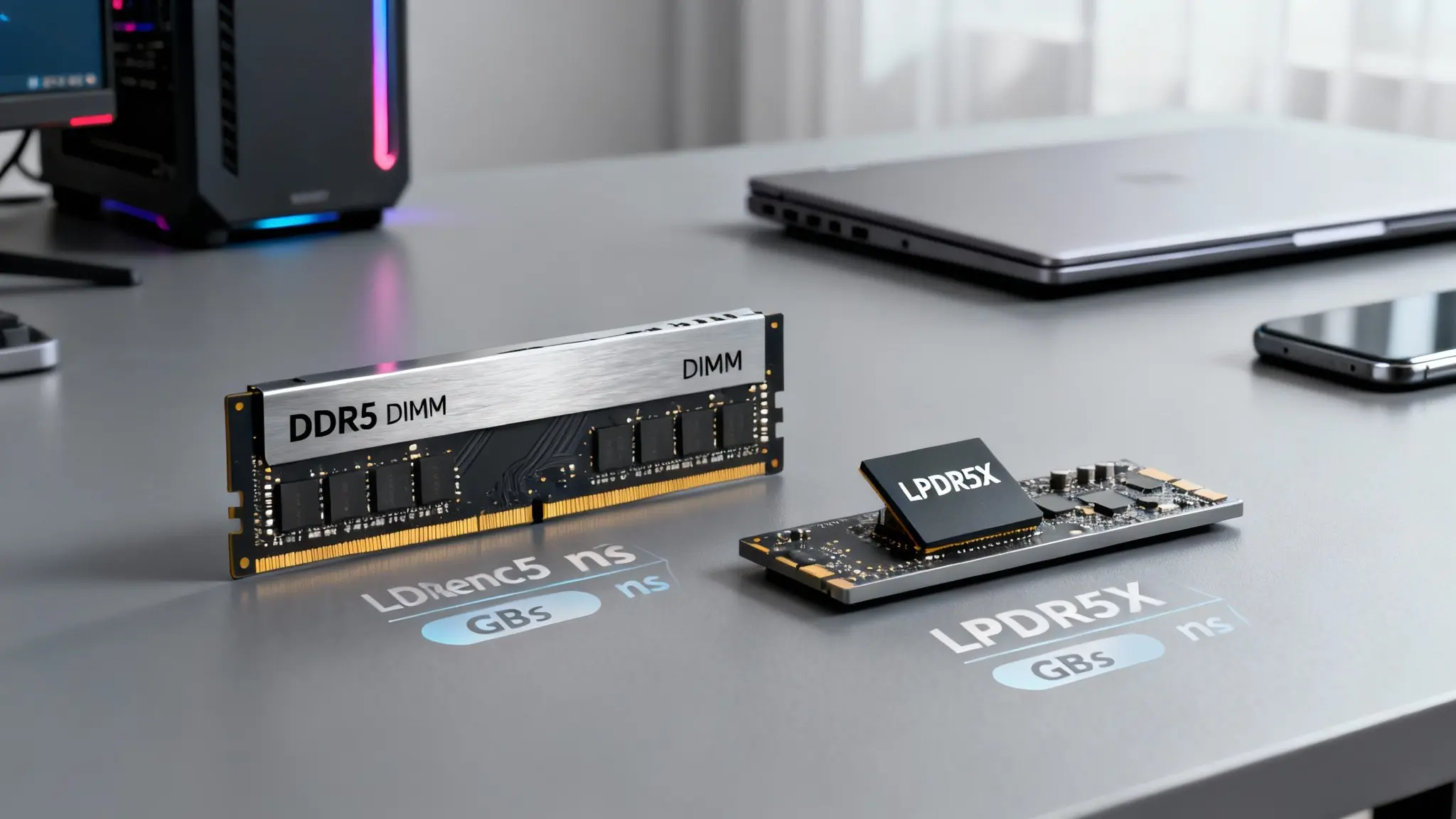

As computing devices diversify—from high-end desktop rigs and gaming laptops to ultrathin notebooks and flagship smartphones—the choice of memory technology has never been more critical. Two of today’s most discussed standards are DDR5 and LPDDR5X. While both belong to the fifth generation of double data rate memory, they are optimized for different use cases, architectures, and power envelopes. The most consequential differences boil down to latency, bandwidth, and power efficiency—and how these parameters influence real-world performance across workloads like gaming, content creation, AI inference, and mobile multitasking.
What Are DDR5 and LPDDR5X?
- DDR5 (Double Data Rate 5) is the mainstream memory for desktops, workstations, and many performance laptops. It targets sustained bandwidth, higher module capacities, and stability for CPUs and GPUs that rely on generous memory throughput.
- LPDDR5X (Low-Power DDR5X) is a mobile-first evolution of LPDDR5, designed for ultra-low power draw, tighter form factors, and on-package integration. It appears in smartphones, tablets, and increasingly in premium thin-and-light laptops where battery life and thermals are paramount.
Both standards boost peak bandwidth over predecessors via higher data rates, but they diverge in signaling, packaging, and power profiles, leading to different latency and efficiency characteristics.
Bandwidth: Peak Throughput vs Sustained Delivery
Bandwidth dictates how much data memory can transfer per second. DDR5 DIMMs commonly deliver very high aggregate bandwidth in multi-channel desktop configurations (e.g., dual-channel kits), especially at speeds like DDR5-5600 and beyond. LPDDR5X raises the ceiling over LPDDR5 by pushing data rates higher (e.g., 8533 MT/s and above), and when soldered in multi-channel, multi-rank configurations, it can rival or exceed the raw bandwidth of entry-level DDR5 laptop modules.

- Desktop advantage (DDR5): Wide memory buses, user-upgradable DIMMs, and robust cooling enable sustained high throughput. Workloads such as 3D rendering, scientific computing, large code compilation, and high-FPS gaming benefit from this sustained bandwidth.
- Mobile advantage (LPDDR5X): On-package integration (often with the CPU/SoC) reduces trace lengths and power losses, enabling impressive bandwidth density for a given power budget—ideal for mobile AI inference, camera pipelines, and high-resolution UI rendering.
In short, DDR5 tends to dominate in total sustained bandwidth for high-power systems, while LPDDR5X achieves excellent bandwidth-per-watt in compact devices.
Latency: The Hidden Lever of Responsiveness
Latency is the time it takes to access data after a request. It’s often measured in nanoseconds and influenced by timings (CAS, tRCD, tRP), frequency, and architectural overheads. A peculiarity of modern memory is that raising frequency may increase timing values (in cycles), yet real latency can still shrink if the clock rises enough. Conversely, platform firmware, memory controllers, and power states can add overhead.
- DDR5 latency profile: Desktop DDR5 can achieve competitive to low latencies with tuned timings (e.g., XMP/EXPO) and higher clocks, improving frame pacing in gaming and UI responsiveness. Enthusiasts can often fine-tune timings, command rate, and gear modes.
- LPDDR5X latency profile: While designed for low power, LPDDR5X’s on-package proximity can mitigate some overheads. Still, typical laptop implementations prioritize power savings, and absolute latency may be higher than well-tuned desktop DDR5. In practice, LPDDR5X latency is “good enough” for many mobile workloads but can trail desktop-grade DDR5 in latency-sensitive tasks.
Latency matters most in workloads with frequent small, random accesses—think high-FPS competitive gaming, certain financial simulations, compilers, and some database or analytics kernels. Bandwidth helps throughput; low latency helps snappiness and per-core efficiency.
Power Efficiency and Thermals: Why LPDDR5X Shines in Mobile
LPDDR5X operates at lower voltages with deep power-management states and is typically soldered close to the SoC, minimizing parasitic losses. This yields:
- Better battery life under mixed workloads.
- Lower heat output, enabling thinner designs and quieter fans (or fanless devices).
- Consistent performance in thermally constrained form factors.
Desktop DDR5, while improving power characteristics over DDR4, still assumes generous power and cooling. That’s perfect for performance desktops and gaming rigs, where absolute speed trumps energy efficiency.
Real-World Impacts by Use Case
- Gaming (Desktop): DDR5 with tuned timings can reduce 1% low frame drops and improve minimums, especially in CPU-bound esports titles. For GPU-bound AAA games at high resolutions, bandwidth and cache behavior dominate, making the difference smaller but still measurable on cutting-edge CPUs.
- Gaming (Ultrathin Laptops): LPDDR5X provides strong bandwidth for integrated graphics and mobile dGPUs within a tight power envelope. Latency is typically not as competitive as desktop DDR5, but overall experience is excellent for portable gaming—especially when paired with efficient modern GPUs and upscalers.
- Content Creation (Video, 3D, Photo): DDR5’s sustained bandwidth and upgradeability favor desktops and creator laptops with SO-DIMMs. Large asset pipelines and parallel workloads thrive on high bandwidth and capacity. LPDDR5X machines can perform well for on-the-go edits but may trail in heavy multitasking and big project renders.
- AI/ML Inference: Both can deliver high bandwidth; LPDDR5X is compelling for on-device AI where power and thermals are critical (e.g., neuron engines and NPUs in mobile). Desktop DDR5 benefits discrete GPUs and accelerators that ingest massive datasets and streams, where host memory throughput and capacity still matter.
- Software Development and Data Tasks: Compiling large codebases and manipulating big in-memory datasets often favor the lower latency and higher capacity configurations available with DDR5 desktops, though LPDDR5X laptops remain excellent for portable development with good battery life.
Capacity, Upgradability, and Form Factor
- DDR5 DIMMs allow higher total capacities and easy upgrades—a top priority for workstations, servers, and enthusiast rigs.
- LPDDR5X is typically soldered, trading upgrade flexibility for tighter integration, better power efficiency, and slimmer chassis designs. Choose carefully at purchase time since you usually cannot expand later.
Platform and Controller Considerations
Memory performance depends heavily on the memory controller, BIOS/firmware, and motherboard routing. Two systems with the same nominal DDR5 or LPDDR5X speeds can perform differently due to:
- Controller efficiency and prefetch strategies.
- Rank and channel configuration (dual-channel vs single-channel, dual-rank vs single-rank).
- Firmware-level power states and latency tradeoffs.
- Timing optimizations and stability margins.
For desktops, enabling XMP/EXPO and ensuring stable timings can notably improve latency and real throughput. For laptops, OEM firmware optimizations and thermal design have outsized impact.
Which Should You Choose?
- Pick DDR5 if you need maximum performance, upgradability, and the best latency potential for gaming, creation, data science, or high-end productivity on desktops and performance laptops.
- Pick LPDDR5X if you prioritize battery life, portability, silent thermals, and excellent bandwidth-per-watt, especially for mobile AI, productivity, and media consumption in ultrathin designs.
Ultimately, neither is “better” in a vacuum; DDR5 wins in raw, sustained performance and tweakability, while LPDDR5X wins in efficiency and form-factor advantages. Understanding your workloads—latency sensitivity versus bandwidth demand—will determine the optimal memory technology.
Actionable Tips
- Desktop builders: Choose reputable DDR5 kits with higher frequencies and proven low timings, and validate stability with memory tests. Aim for dual-channel, dual-rank when possible for improved real-world bandwidth.
- Laptop buyers: For longevity, opt for higher LPDDR5X capacities up front. Check reviews that measure sustained performance under load; thermals can make or break real-world speeds.