
DNA Data Storage: A Wild New Frontier for Innovation
As the world generates data at an unprecedented pace, traditional storage technologies are rapidly approaching their physical and economic limits. From high‑resolution video to complex scientific simulations and AI models, our digital footprint is expanding faster than hard drives, SSDs, and data centers can reasonably keep up. In this context, DNA data storage is emerging as a wild, fascinating, and potentially revolutionary new frontier.
This technology promises storage densities that dwarf anything we have today, along with durability measured not in decades but in thousands of years. While still largely experimental, DNA storage is quickly becoming one of the most talked‑about innovations in the future of data infrastructure.
Why We Need DNA Data Storage
Every day, humanity creates petabytes of new information. Cloud providers build massive data centers, consuming enormous amounts of energy and physical space. However, conventional storage devices have three major limitations:
- Finite capacity
Even as storage capacities grow, they cannot scale indefinitely in a cost‑effective way. Silicon‑based technologies are reaching physical limits in terms of miniaturization. - Limited lifespan
Hard drives might last 5–10 years, SSDs slightly longer, but not centuries. Tapes and optical discs degrade. Migrating legacy data to new media every few years is costly and error‑prone. - High energy consumption
Data centers require constant cooling, electricity, and maintenance. The environmental footprint of global data storage is becoming a serious concern.
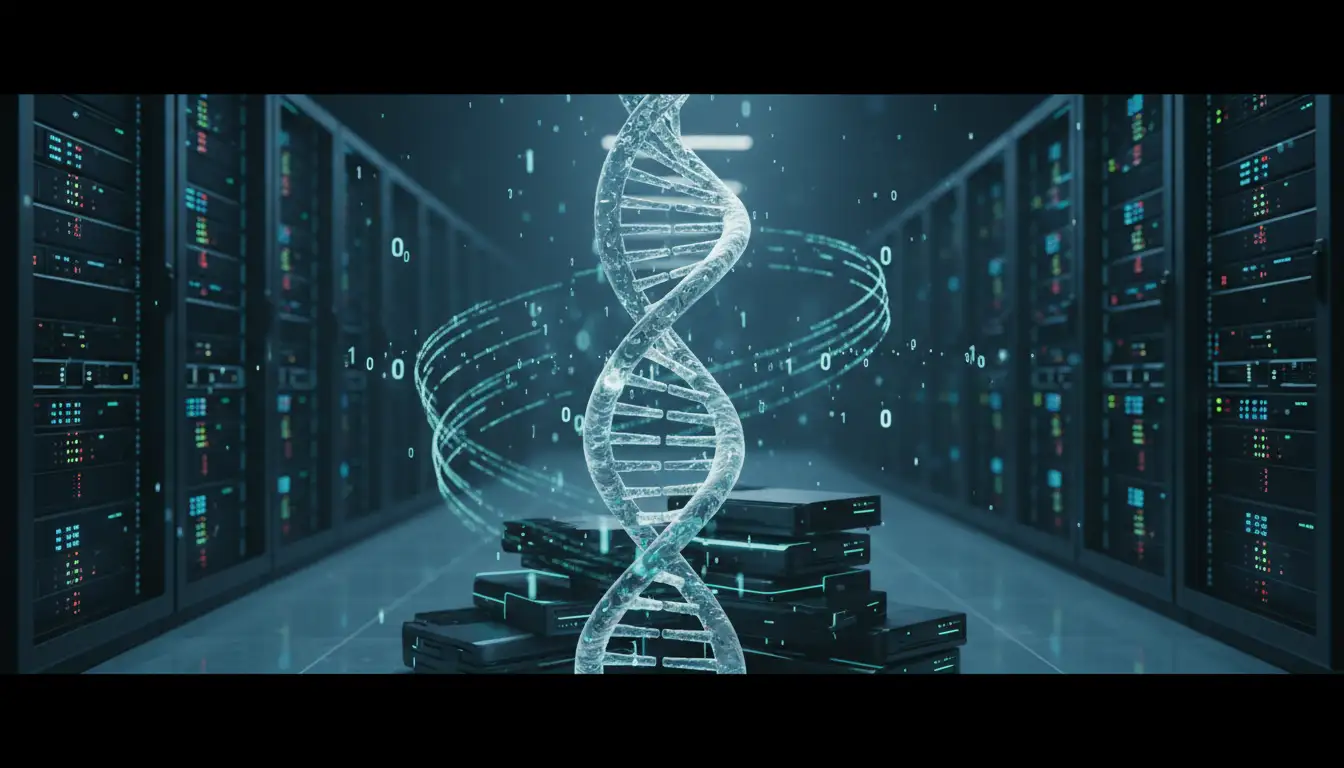
DNA offers a radically different paradigm. It is the original information storage system, perfected by nature over billions of years. Instead of relying on electrons in chips or magnetized particles on disks, DNA storage encodes data in the sequence of nucleotides—the familiar A, T, C, and G.
How DNA Data Storage Works
At its core, DNA storage is a process of encoding binary data into biological code.
From bits to bases
Digital data consists of bits—0s and 1s. To store that data in DNA, these bits are translated into sequences of the four bases:
- A (adenine)
- T (thymine)
- C (cytosine)
- G (guanine)
For example, a simple encoding scheme might map 00 → A, 01 → C, 10 → G, 11 → T. In practice, the encoding is more sophisticated, with algorithms designed to avoid problematic patterns, improve reliability, and integrate error correction codes.
Synthesizing the DNA
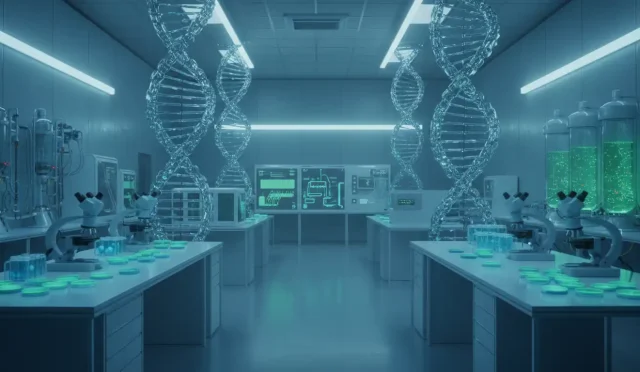
Once the data is encoded into DNA sequences, specialized machines synthesize short DNA strands that physically embody the information. These are not taken from living organisms; they are synthetic DNA, produced in controlled lab environments.
Each strand typically includes:
- A segment of payload data
- Indexing information, to reconstruct the full file
- Error‑correcting codes, to detect and fix mistakes during reading
Reading the data back
To retrieve the data, the DNA is sequenced using high‑throughput DNA sequencing technologies. The output of these machines is a set of DNA sequences, which are then decoded back into bits using the same mapping and error‑correction schemes used during encoding.
In simplified form, the pipeline is:
- Digital file → binary data
- Binary data → DNA sequences
- DNA synthesis → physical storage
- DNA sequencing → recovered sequences
- Sequences → binary data → original file
This process is still relatively slow and expensive today, but both DNA synthesis and sequencing costs have been dropping exponentially, similar to Moore’s Law in computing.
The Stunning Advantages of DNA Storage
1. Unmatched storage density
DNA’s information density is extraordinary. In theory, one gram of DNA could store up to several hundred petabytes of data. To put it in perspective, all of the world’s digital information could potentially fit into a room‑sized DNA archive.
This makes DNA storage especially compelling for:
- National archives
- Scientific datasets
- Long‑term backups for organizations and governments
2. Extreme longevity
Under the right conditions (cool, dark, and dry environments), DNA can remain stable for tens of thousands of years. We know this because scientists routinely sequence DNA from ancient bones and fossils.
By comparison:
- Hard drives and SSDs: years to a few decades
- Magnetic tapes: a few decades at best
- Optical discs: highly variable and often unreliable over long time spans
For institutions that need to preserve data across generations—libraries, museums, space agencies, and historical archives—DNA storage could be a game changer.
3. Minimal energy requirements
Unlike spinning disks or active servers, DNA does not need power to maintain its state. Once the DNA is created and stored, it sits passively, requiring only safe environmental conditions.
This translates into:
- Lower operational energy costs
- Reduced cooling requirements
- Smaller carbon footprint over the long term
As sustainability becomes a central design constraint for digital infrastructure, DNA offers a compelling green alternative for archival data.
Challenges and Limitations
Despite its potential, DNA data storage is not ready to replace your external hard drive or cloud subscription. Several key challenges remain.
High costs
DNA synthesis and sequencing are still expensive compared to writing data to magnetic or flash storage. Although prices are falling, large‑scale deployment would require orders‑of‑magnitude cost reductions.
Slow read/write speeds
Current DNA storage workflows are far too slow for real‑time access. Encoding and decoding DNA is measured in hours or days, not milliseconds. This means DNA is suited for cold storage—data that is written once and read very infrequently—rather than for active databases or transactional systems.
Error rates and data integrity
Biological processes are not perfectly precise. Mutations, incomplete synthesis, and sequencing errors can introduce noise into the data. To address this, researchers use robust error‑correction codes, redundancy, and sophisticated encoding schemes. These methods improve reliability but also add overhead and complexity.
Standardization and infrastructure
The ecosystem for DNA storage is still emerging. There are no universally adopted:
- File formats
- Encoding standards
- Hardware interfaces
Before DNA storage can enter mainstream IT infrastructure, hardware manufacturers, biotech companies, and cloud providers will need to agree on interoperable standards and develop automated, scalable systems.
Real‑World Applications and Use Cases
Given these constraints, where does DNA storage make sense today and in the near future?
Long‑term archival storage
The most obvious and immediate application is archiving:
- National libraries preserving cultural heritage
- Film studios storing master copies of movies and TV series
- Research institutions archiving experimental data
- Governments safeguarding legal, historical, and geospatial records
These organizations care more about durability and density than instant access, making DNA storage an ideal candidate.
Scientific and space missions
Space agencies and research centers dealing with massive datasets—astronomy, particle physics, climate models—often need to keep data for decades. DNA’s resilience to radiation (when properly encapsulated) also makes it interesting for space exploration, where conventional hardware may degrade faster.
Secure and tamper‑resistant storage
Because DNA is a physical medium that can be embedded in various materials, it opens possibilities for:
- Anti‑counterfeiting markers in luxury goods and pharmaceuticals
- Embedding encrypted data into physical artifacts
- Long‑lived cryptographic records and time capsules
While these use cases are still experimental, they highlight the versatility of DNA as an information carrier.
The Future of DNA Data Storage
As biotechnology continues to intersect with computing, DNA data storage is likely to become a cornerstone of next‑generation data infrastructure. Researchers and companies are actively working on:
- Automated DNA storage systems that integrate with cloud platforms
- New encoding algorithms that improve density and reduce error rates
- Hybrid systems that combine DNA with conventional storage for multi‑tiered architectures
- Faster and cheaper synthesis and sequencing technologies
In the long term, DNA storage may not replace all existing technologies, but it could become a critical layer in a hierarchical storage model:
- Hot data → SSDs and high‑speed memory
- Warm data → disks and object storage
- Cold archival data → DNA storage
What makes DNA data storage so exciting is not just its technical promise but its symbolic significance: we are beginning to use the same molecule that encodes life itself to preserve our digital civilization. For innovators, researchers, and forward‑thinking organizations, this is truly a wild new frontier.