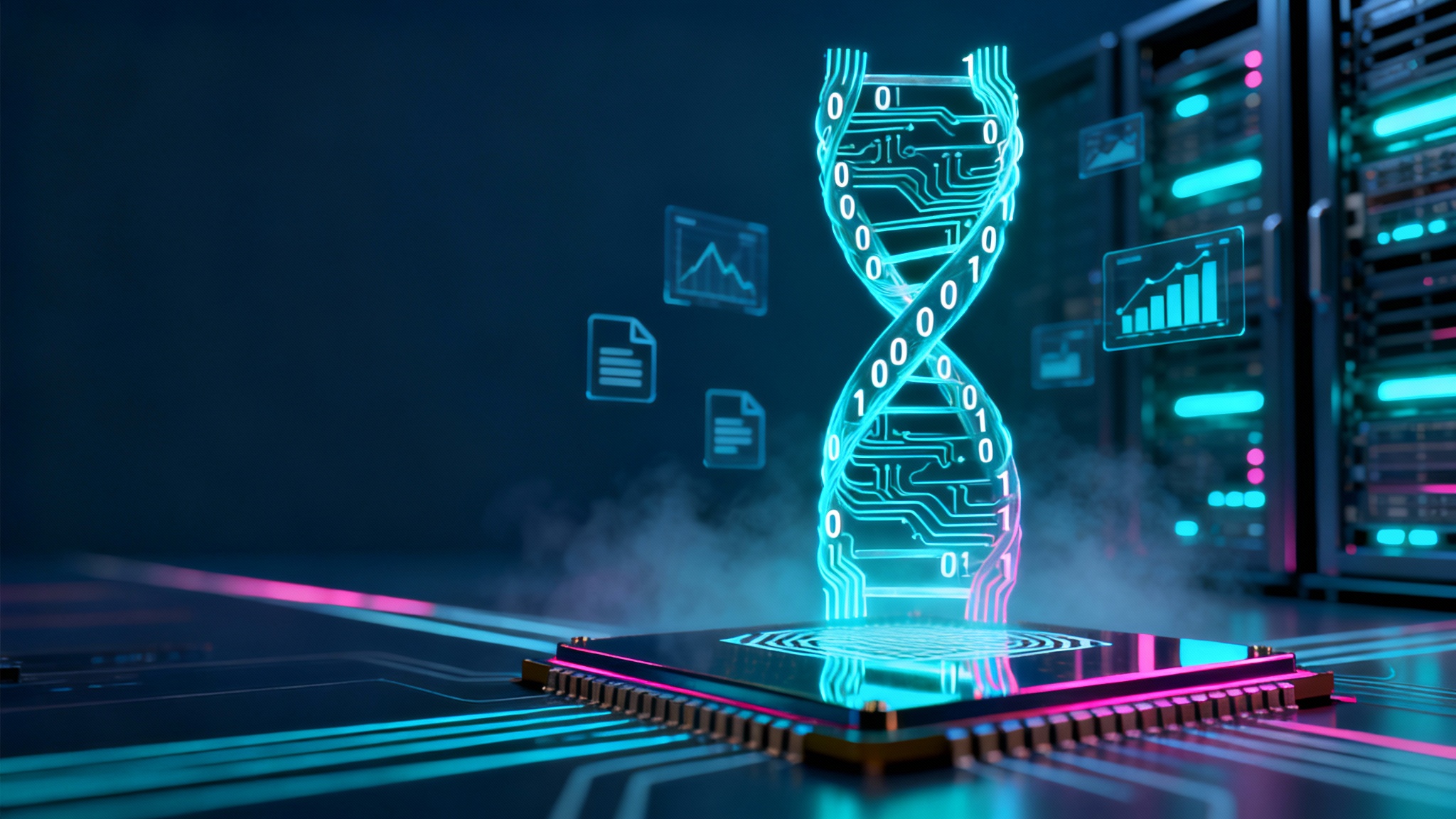

DNA data storage—encoding digital information into the genetic code—is emerging as one of the most promising frontiers in archival storage. As our world generates zettabytes of data, traditional media like magnetic tape and flash struggle to keep pace with density, durability, and long-term readability. DNA, nature’s original information substrate, offers a radically compact, ultra-long-lived, and format-stable alternative. This article explains how DNA storage works, why it matters, current challenges, cost and scalability outlook, regulatory considerations in the United States, and what to watch next.
What Is DNA Data Storage?
DNA data storage converts binary data (0s and 1s) into sequences of the four nucleotide bases—A, T, C, and G—then uses DNA synthesis to physically “write” those sequences into synthetic DNA molecules. Later, sequencing reads the DNA and computational decoding reconstructs the original file. Unlike biological DNA, storage DNA is non-living, chemically synthesized strands designed purely for information.
Key advantages:
- Extreme density: Up to petabytes per gram—orders of magnitude beyond HDDs or tapes.
- Longevity: Properly stored DNA can last centuries to millennia, outliving any current digital format.
- Format durability: DNA’s base-pair alphabet is universal; future readers only need sequencing technology and decoding specs.
How DNA Storage Works (Step-by-Step)
- File preparation
- Data (e.g., video, PDF) is compressed and chunked into fixed-size blocks.
- Error-correcting codes (Reed–Solomon, LDPC, fountain codes) are added to tolerate synthesis and sequencing noise.
- Encoding binary to bases
- A mapping converts bits to nucleotides while avoiding problematic patterns:
- Run-length limits to prevent long homopolymers (AAAA…).
- GC content balancing to reduce synthesis/seq bias.
- Constraint coding to minimize secondary structures.
- Each block receives index/locator tags for reassembly.
- A mapping converts bits to nucleotides while avoiding problematic patterns:
- DNA synthesis (writing)
- Oligonucleotides (oligos) representing data blocks are chemically synthesized via array-based or enzymatic methods.
- Pools may contain millions of unique strands, each ~100–300 nucleotides.
- Storage
- DNA is dried and stored in inert containers, often with desiccants, at room temperature or cooled.
- Encapsulation in silica or polymers enhances stability against humidity, heat, and UV.
- Retrieval and sequencing (reading)
- A subset or the entire pool is amplified (PCR) and sequenced (Illumina, nanopore, or emerging methods).
- Adaptor sequences and barcodes allow multiplexing and random access.
- Decoding and reconstruction
- Reads are aligned, consensus is formed, errors corrected, and indices reassemble the blocks.
- The original file is verified via checksums or cryptographic hashes.
Use Cases and Market Fit
- Cold archival storage: National archives, cultural heritage, film studios, scientific datasets, satellite imagery, and logs requiring retention for decades.
- Compliance archiving: Long-term, tamper-evident storage for regulated industries (finance, healthcare), when paired with cryptographic attestations.
- Space- and energy-constrained archives: DNA’s passive storage reduces long-term power needs compared with active data centers.
DNA storage is not for high-throughput hot data. Today’s write/read latencies and costs are unsuitable for real-time analytics or frequent access. The sweet spot is low-access, long-retention archives with extreme durability requirements.
Performance, Costs, and Scalability
- Density: Theoretically ~215 petabytes per gram; practical implementations are lower but still far beyond silicon.
- Durability: With proper encapsulation, modeled half-lives extend into centuries; accelerated aging studies support longevity under controlled conditions.
- Costs: The primary barrier. DNA synthesis is expensive per megabyte; sequencing costs are falling faster. Enzymatic synthesis and microarray scale promise step-change reductions.
- Access: Random access via PCR primers enables targeted retrieval without reading the entire pool, improving practicality as pools grow.
Industry efforts focus on:
- Lower-cost enzymatic synthesis (vs. phosphoramidite chemistry).
- Faster, cheaper nanopore and short-read sequencing.
- Better codec designs that maximize information density while minimizing errors.
- Automation: from liquid handling to end-to-end write–store–read systems.
Data Integrity and Security
- Error correction: Robust ECC and redundancy mitigate insertions, deletions, and substitutions introduced during synthesis/seq.
- Hashing and signatures: Cryptographic hashes verify file integrity; digital signatures support authenticity.
- Encryption: AES-256 or post-quantum schemes can be applied to the data prior to encoding.
- Steganography and watermarking: Optional techniques can hide or tag content within DNA pools.
Because DNA is a physical medium, chain-of-custody controls (tamper-evident capsules, monitored storage) complement cryptography for defense-in-depth.
Environmental and Sustainability Considerations
- Lower idle energy: DNA storage requires essentially no power when archived.
- Material footprint: Minuscule compared to data center racks and tapes, potentially reducing long-term environmental impact.
- Chemistry: Green synthesis methods and solvent reduction are active areas of R&D to improve sustainability.
Standards, Interoperability, and IP
- File formats and codecs: Community efforts aim to standardize metadata, addressing schemes, and encoding constraints to ensure future readability.
- Interoperability: Vendor-neutral indices and primer schemes can reduce lock-in.
- Intellectual property: Patents cover codec techniques, synthesis methods, random-access strategies, and encapsulation. Organizations should assess freedom-to-operate.
Regulatory Considerations in the United States
- Non-biological synthetic DNA used for data storage typically falls outside clinical diagnostic or therapeutic regulations.
- Facilities should follow chemical handling and biosafety best practices even for non-living materials.
- For regulated data (HIPAA, GLBA, SEC/FINRA retention), compliance hinges on the end-to-end system: encryption, access controls, retention policies, auditable retrieval, and integrity verification.
- Cross-border data transfer rules may apply based on where DNA is stored and processed.
Consult qualified counsel for sector-specific obligations.
Practical Challenges Today
- Write cost and throughput: Synthesis throughput and price per base are the gating factors.
- Error profiles: Homopolymer runs, sequence context biases, and indel rates require robust ECC.
- Latency: Turnaround for write–read cycles is measured in hours to days, not milliseconds.
- Tooling: Mature, user-friendly pipelines for enterprises are still developing.
Despite these challenges, trends are positive: sequencing costs keep dropping, enzymatic synthesis is improving, and automation is accelerating.
Roadmap: What to Watch
- Enzymatic synthesis at scale with lower error rates and cost.
- Integrated write–store–read appliances with standardized APIs.
- Random-access advances: primer libraries and primer-free approaches.
- In-silico–to–in-vitro compilers that optimize for target devices and costs.
- Long-term standards bodies endorsing archival formats and audits.
Getting Started: High-Level Steps
- Identify archival workloads: cold data, retention >10 years, low retrieval frequency.
- Run a pilot: encode a representative dataset with strong ECC and security.
- Evaluate TCO: include storage facility, encapsulation, sequencing, and operational processes.
- Plan for governance: retention schedules, key management, integrity attestations, and audit trails.
Conclusion
DNA data storage transforms the idea of an archive from racks of hardware into grams of material that may outlast institutions. While it’s not ready to replace active storage, the medium is compelling for ultra-dense, ultra-durable, compliance-friendly archives. With accelerating innovation in synthesis, sequencing, and codecs, the path from laboratory to enterprise deployment is becoming clearer—especially for U.S.-based organizations with stringent long-term retention and sustainability goals.