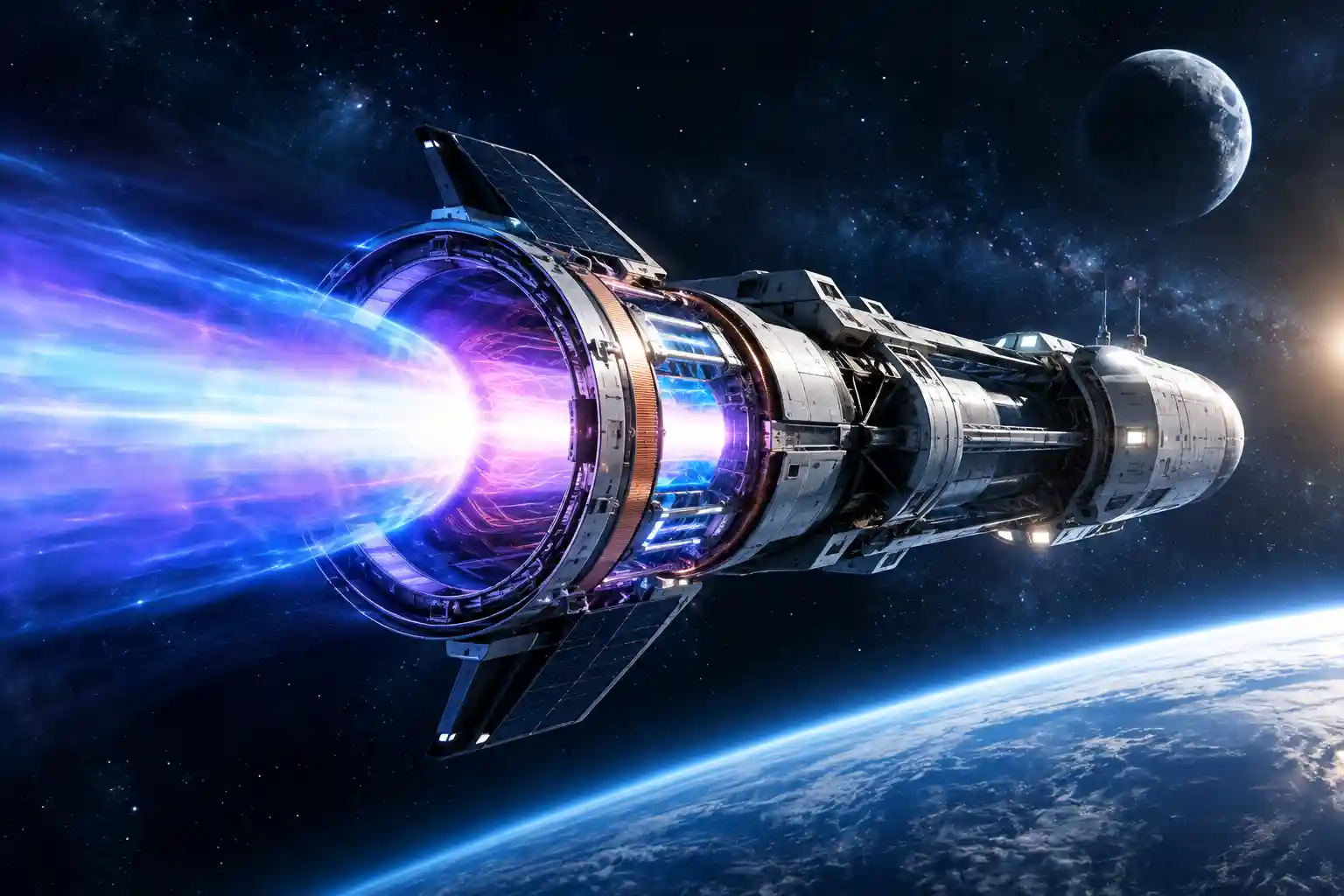

Fusion Propulsion Could Transform Space Travel Within a Decade
For generations, faster-than-light journeys and effortless trips between planets belonged to science fiction. That picture may be changing. New work on fusion propulsion suggests that spacecraft could one day cross the solar system far faster than conventional chemical rockets. The technology remains experimental, yet recent demonstrations have moved nuclear fusion engines from imaginative sketches toward measurable engineering goals.
What Makes Fusion Propulsion Different?
Nuclear fusion joins light atomic nuclei and releases energy, much like the process that powers the Sun. On Earth, researchers struggle to hold superheated plasma stable long enough to produce practical electricity. A spacecraft can use the same physics differently. Instead of converting every unit of fusion energy into grid power, a fusion engine could direct extremely hot plasma through a magnetic exhaust and create continuous thrust.
That approach matters because chemical rockets deliver strong thrust for a short period, while electric propulsion operates efficiently but produces very little thrust. A fusion rocket could combine useful acceleration with exceptional fuel efficiency. It might accelerate for months, gradually reaching speeds that current spacecraft cannot approach. Faster journeys could reduce exposure to radiation, simplify life-support demands and make ambitious robotic missions more realistic.
The New Fusion Engine Race
Several teams now pursue different versions of this idea. Pulsar Fusion, a U.K.-based company, reported a first-plasma demonstration in March. Its Sunbird test briefly converted krypton gas into plasma and used electromagnetic fields to hold that plasma in the desired region of the engine. The result did not prove a working fusion drive, but it addressed one important question: can the exhaust system control plasma without allowing it to damage the vehicle?
The next challenge is far more demanding. Pulsar plans to combine deuterium with helium-3, then use the resulting energy to heat helium-4 and expel it as propellant. The company has discussed an orbital demonstration in 2027. Its long-term concept could reach roughly 329,000 miles per hour, although acceleration and braking would take time rather than happen instantly.
Princeton researchers are developing a related Direct Fusion Drive through the Starfire project. Their prototype has produced plasma at about 18 million degrees Fahrenheit, but deuterium-helium-3 fusion requires temperatures near one billion degrees Celsius. That gap shows why researchers describe current results as promising beginnings rather than finished propulsion systems.
Helicity Space is taking another route. Its Helicity Drive would release pulsed plasma instead of relying on continuous fusion. The company targets a prototype launch in the 2030s and hopes to achieve net energy gain later. Together, these projects illustrate a growing commercial space industry that is testing multiple solutions instead of betting on a single engine design.
Potential Missions Across the Solar System
If engineers solve the remaining problems, fusion propulsion could reshape deep-space exploration. A mission to Mars might take months less than a traditional chemical flight. More efficient propulsion could also reduce the amount of propellant a spacecraft must carry, leaving room for scientific instruments, shielding or crew supplies.
The outer solar system offers an even stronger case. Faster spacecraft could visit Saturn’s moons, explore the distant asteroid Psyche or reach remote objects that currently require decades of planning. Researchers have even studied a fusion-powered mission to Sedna, a distant dwarf planet that will approach the Sun in 2075. A shorter travel time could make that rare opportunity scientifically achievable.
Interstellar travel remains a much larger ambition. Even a very fast fusion spacecraft would face enormous distances, energy requirements and navigation challenges. Fusion does not automatically deliver faster-than-light travel. It could, however, become an important stepping stone toward missions that move beyond the solar system and test technologies needed for future starflight.
Why the Breakthrough Is Not Guaranteed
The headlines should not hide the engineering obstacles. A fusion engine must become compact enough to launch, while powerful magnets must confine plasma that is hotter than any ordinary material can withstand. Designers also need durable reactor walls, reliable cooling, a practical propellant supply and a way to manage radiation. Producing meaningful thrust requires an immense number of reactions every second.
Fuel creates another complication. Deuterium exists naturally in water, but helium-3 is scarce on Earth. Some proposals point to lunar resources, yet mining, processing and transporting material from the Moon would introduce a separate industrial challenge. Engineers must also demonstrate that a system produces more usable energy than it consumes, not merely that it creates a brief pulse of plasma.
Fission propulsion may arrive sooner. NASA’s SR-1 Freedom concept uses nuclear fission to generate power for a planned Mars mission, and fission technology does not require the billion-degree temperatures needed for fusion. However, fission engines cannot promise the same ultimate exhaust speeds. Fusion therefore remains attractive for the most distant destinations, even if fission becomes the first practical nuclear option.
Why This Matters for Everyday Space Science
The importance of fusion research extends beyond distant planets. A high-efficiency engine could support longer satellite servicing missions, improve cargo transport and strengthen scientific observatories far from Earth. Its development would also advance superconducting magnets, plasma physics, robotics and autonomous navigation. Those technologies could benefit energy research and other industries on Earth. For readers, the key point is simple: fusion propulsion is not an operational rocket yet, but it is becoming an engineering field with testable milestones and measurable progress.
A Realistic Outlook
The next decade may reveal whether fusion propulsion has crossed the line from bold concept to useful space technology. Orbital demonstrations would provide critical evidence, but a successful plasma test alone would not guarantee a flight-ready engine. Researchers must prove stable operation, efficient thrust, long-duration performance and safe integration with a spacecraft.
The most credible conclusion is neither hype nor dismissal. Fusion propulsion could shorten journeys and expand humanity’s reach, but it still depends on difficult scientific discoveries and major investment. If current teams meet their milestones, the future of space travel may change dramatically—not through a single spectacular launch, but through steady progress in plasma control, magnetic confinement and spacecraft engineering.
Amazon Product Recommendation
For readers interested in space and astronomy, the Celestron Travel Scope 70mm Beginner Portable Telescope could be a good starting option. On Amazon, this product is listed with a portable design, a 70 mm aperture, suitability for viewing the Moon and planets, and an included carrying bag. Check the Amazon.com telescopes page for the latest price and stock availability.