
Hubble Space Telescope Reveals Why Some Stars Refuse to Grow Old
For decades, astronomers have puzzled over stars that appear far younger than their surroundings. These unusual objects, called blue straggler stars, shine with a hotter, bluer light inside some of the Milky Way’s oldest globular clusters. A new Hubble Space Telescope study offers a compelling explanation: many of these stellar outliers do not survive through spectacular collisions. Instead, long-lasting binary star systems help them regain the fuel and brightness associated with youth.
A Cosmic Mystery in Ancient Star Clusters
Globular clusters contain densely packed populations of ancient stars. Because most stars in these systems formed billions of years ago, researchers expect them to show similar stages of stellar evolution. Blue stragglers break that pattern. They look more massive, hotter, and brighter than neighboring stars, almost as if they joined the cluster long after its formation. Their apparent youth created a long-running debate about whether stellar collisions or binary interactions produced them.
The new research examines this mystery on an unusually broad scale. An international team used ultraviolet observations from NASA’s and ESA’s Hubble observatory to study 48 globular clusters across the Milky Way. The survey included more than 3,000 blue stragglers. That large sample allowed scientists to compare stellar populations in environments with very different densities, rather than drawing conclusions from only a few unusual clusters.
Binary Stars Provide a Stellar Reset
The study’s central result points toward stable companionship. In relatively low-density clusters, stars have more space around them and binary pairs can remain intact for long periods. A binary system contains two stars bound by gravity, with one orbiting the other. As the pair evolves, one star can transfer material to its companion. The receiving star gains fresh hydrogen and additional mass, then burns hotter and appears younger than its true age.
This process explains the blue straggler phenomenon without requiring a dramatic collision. The rejuvenated star does not literally reverse time. Instead, it receives new fuel that changes its mass, temperature, color, and luminosity. Astronomers therefore describe the result as a stellar reset. The star becomes a bright blue object that stands out against the older, redder population surrounding it.
Why Crowded Clusters Suppress Blue Stragglers
Dense clusters tell a different story. In a crowded stellar core, frequent gravitational encounters disturb the orbits of binary pairs. Passing stars can pull companions away, alter their trajectories, or break the systems apart before mass transfer can begin. These disruptions reduce the number of stable binaries and, consequently, limit the production of blue straggler stars.
That finding challenges the simple idea that more stellar encounters should create more unusual stars. Collisions may occur more often in dense environments, but the same gravitational activity can destroy the partnerships that sustain long-term stellar rejuvenation. The research suggests that a calm environment can be more productive than a chaotic one when binary evolution drives the outcome.
Ultraviolet Light Helps Hubble See the Evidence
Hubble’s ultraviolet sensitivity played an important role in the investigation. Ancient globular clusters can look visually confusing because thousands of stars overlap in a small region. Ultraviolet observations help separate hot, luminous stars from the cooler majority. Blue stragglers emit a distinctive ultraviolet glow, so astronomers can identify and count them even when visible-light images appear crowded.
By combining ultraviolet data with information about cluster density and binary populations, the team could connect stellar appearance with local conditions. The pattern was consistent: blue stragglers appeared in greater numbers where binaries survived more easily. This statistical relationship provides stronger support for mass transfer in binary systems than an explanation based only on occasional stellar collisions.
A Broader Lesson About Stellar Evolution
The result changes how scientists view the evolution of star clusters. Researchers once treated binary systems as secondary details within a larger population. The Hubble findings instead place them near the center of the story. Binary pairs can influence how stars gain mass, how they appear, and how long certain evolutionary stages remain visible.
The study also shows that stellar evolution depends on surroundings. A star’s internal physics remains essential, but its neighbors can determine whether a companion survives, whether mass transfer occurs, and whether a blue straggler emerges. In that sense, a globular cluster behaves like an ecosystem. The environment does not merely host stars; it actively shapes their possible life histories over billions of years.
What the Discovery Means for Astronomy
The research does not eliminate every role for collisions or other interactions. Different clusters may support different formation pathways, and astronomers will continue testing how metallicity, density, binary frequency, and cluster age affect blue straggler populations. However, the size and range of the Hubble survey make the binary explanation especially persuasive for the systems examined.
Future observations could refine this picture by tracking more binary candidates and comparing globular clusters with other stellar environments. New instruments may also reveal how transferred material settles onto a companion and how quickly the rejuvenated star changes. These questions matter because blue stragglers serve as natural laboratories for studying mass exchange, gravitational dynamics, and stellar aging.
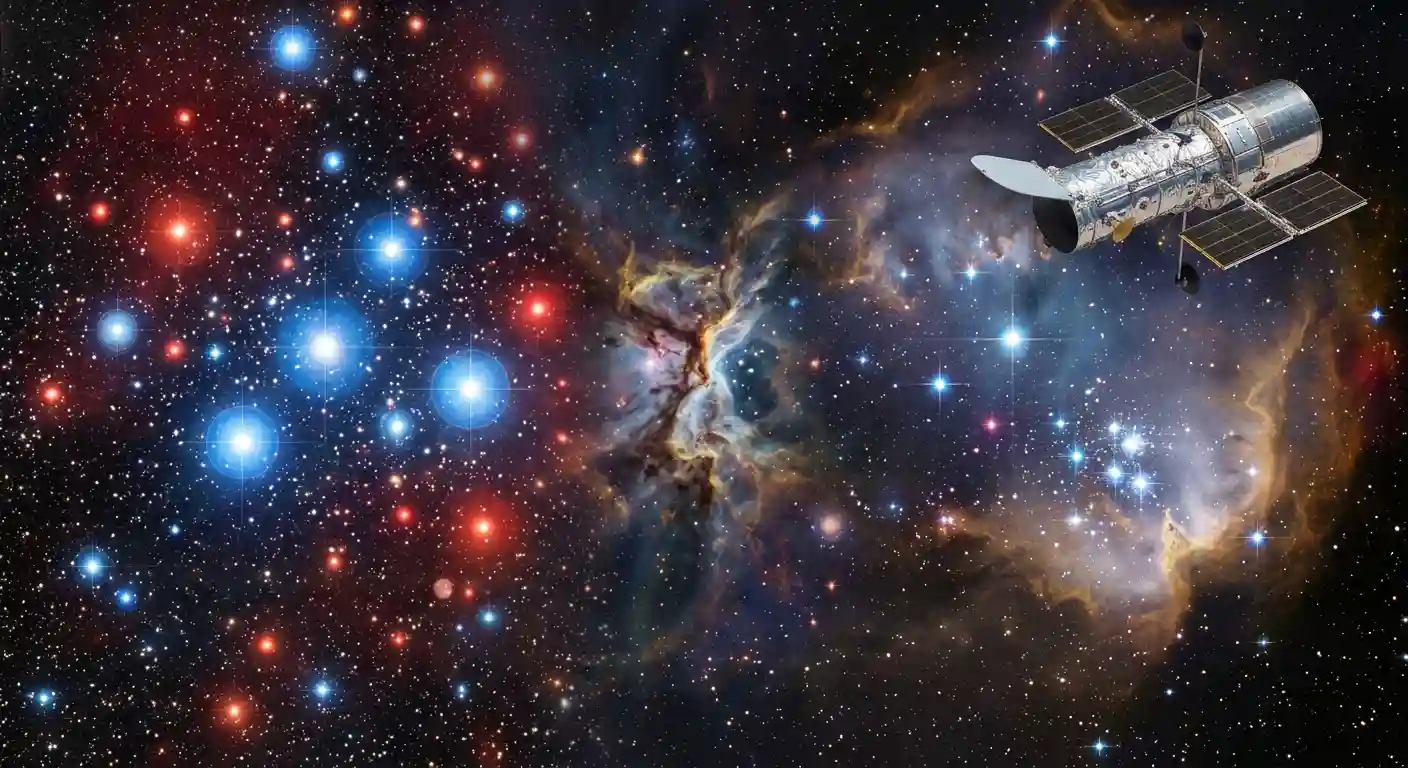
It also offers a visual introduction to the observatory’s mission, helping general readers connect landmark Hubble imagery with the deeper science of stellar evolution and cosmic history.
The Hubble Space Telescope’s latest contribution therefore reaches beyond a single strange category of stars. It demonstrates that cosmic aging is not always a solitary process. A star can appear young because a companion shared its material, while the surrounding cluster determines whether that partnership survives. Blue stragglers are not simply stars that defy time; they are evidence that companionship, space, and gravity can rewrite a star’s visible history.
Amazon Product Recommendation
Readers who want to explore Hubble’s history and imagery may consider Hubble Space Telescope: New Views of the Universe by Mark Voit, available through Amazon.com. The illustrated book presents Hubble observations alongside explanations of the telescope’s discoveries, making it a useful companion for anyone interested in ultraviolet astronomy, star clusters, and the science behind iconic space images.