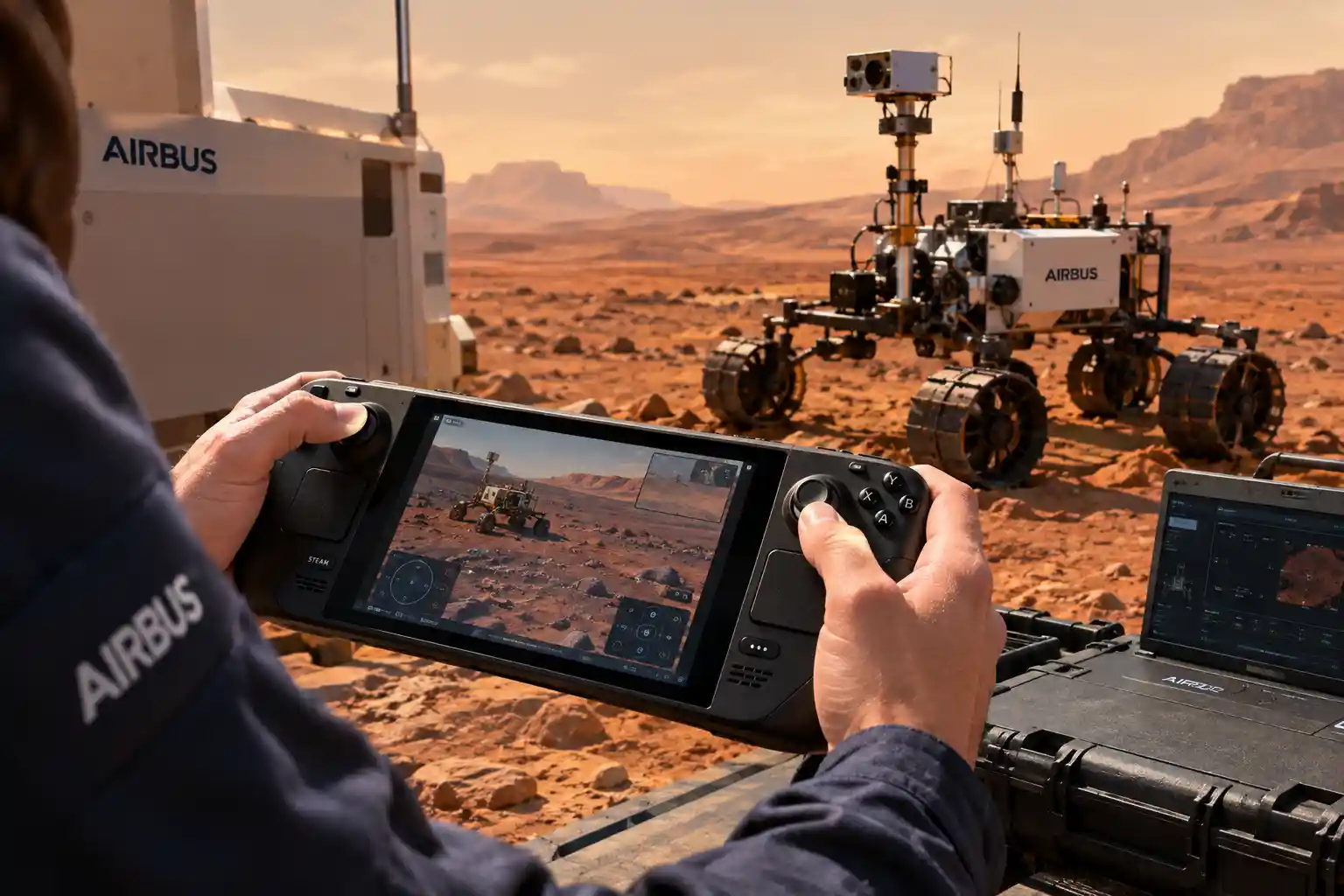

Airbus Uses Steam Deck to Drive a Mars Rover Prototype
The idea of using a gaming handheld to operate a Mars rover may sound unusual, but Airbus has shown how practical consumer technology can support advanced space engineering. During testing for the ExoMars rover, Airbus engineers used a Steam Deck to control a rover prototype inside a Mars-like environment.
The experiment demonstrates that the Valve handheld is more than a portable gaming device. Because it works like a compact Linux PC and includes physical controls, the Steam Deck can provide a convenient interface for robotics testing, remote vehicle control and autonomous navigation development.
The project also highlights an important stage in the development of future planetary exploration vehicles. Engineers must control and test rover prototypes on Earth before the final system can operate independently on Mars.
Why Airbus Chose a Steam Deck
According to the TechSpot report, the Steam Deck appeared in a video by YouTuber Tom Scott, who visited Airbus facilities in the United Kingdom. The demonstration showed a senior engineer controlling one prototype with a laptop before Scott operated another vehicle with a Steam Deck.
The handheld’s analog sticks, buttons and triggers gave the operator immediate control over the rover’s movement. This arrangement can feel more natural than using a keyboard, especially when an engineer needs to make quick steering adjustments across uneven terrain.
The Steam Deck also offers portability. A laptop and external controller may require more space, cables and equipment. By contrast, the handheld combines a display, computer hardware and control inputs in one compact device. That combination makes it useful during field tests, laboratory demonstrations and mobile robotics experiments.
The Difference Between Testing and Mars Operations
The Steam Deck will not replace the ExoMars rover’s autonomous systems. Airbus uses the handheld during development, when engineers need to move prototypes, test mechanical responses and inspect how the vehicle handles simulated Martian terrain.
The final rover must operate in a far more independent way. Mars sits millions of miles from Earth, and radio signals require significant time to travel between the two planets. Engineers cannot steer the rover continuously from a control room on Earth.
Instead, the vehicle must analyze its surroundings and select safe routes by itself. Onboard 3D cameras will help the rover identify terrain, obstacles and possible paths. Specialized software will then support autonomous navigation, allowing the vehicle to make decisions without waiting for a command from Earth.
This distinction explains why the Steam Deck serves as a development tool rather than the rover’s main intelligence. It helps engineers test the machine, while onboard systems will eventually manage navigation on the Martian surface.
A Linux PC in a Handheld Design
The Steam Deck works well in this role because it is essentially a small Linux computer with built-in controls. Valve designed the device for gaming, but its operating system and hardware allow users to install applications outside the standard Steam ecosystem.
That flexibility gives developers more opportunities to experiment. Engineers can use compatible software, create custom control interfaces or connect the device to external hardware. The Steam Deck does not need to act as the rover’s central computer. It can simply function as a human-machine interface that sends commands to another system.
This approach shows why open consumer hardware can attract attention from robotics developers. A company may not need to design a custom controller for every prototype. Instead, engineers can adapt an existing device that already includes reliable buttons, joysticks, wireless connectivity and a screen.
Valve Hardware Beyond Gaming
Airbus is not the only organization using Steam Deck hardware for an unusual purpose. Disney operators have also reportedly used Steam Decks to control BDX droids at Galaxy’s Edge. In that situation, the handheld acts as a flexible control interface for a physical robot.
These examples reveal a broader trend in technology. Hardware developed for entertainment can also support education, research, industrial testing and interactive robotics. A capable computer remains useful even when users move it outside its original market.
Valve’s relatively open approach encourages this experimentation. Steam Deck owners can install additional software and operating systems, which makes the device more adaptable than a closed game console. The same philosophy may also influence future Valve products, including other PC-based devices.
What This Means for Robotics Development
Using a Steam Deck does not mean that space agencies will replace specialized equipment with gaming consoles. Planetary missions require carefully engineered systems that can survive radiation, extreme temperatures, dust and long communication delays.
However, the experiment shows how consumer technology can accelerate early development. Engineers can use familiar controls to evaluate prototypes quickly. They can identify steering problems, test movement patterns and observe how the rover reacts before they finalize expensive autonomous systems.
This method can also lower the barrier to experimentation. Students, hobbyists and smaller research teams may find it easier to explore robotics with accessible PC hardware instead of costly industrial controllers. The same principle applies to remote vehicles, educational robots and autonomous machines.
Conclusion
Airbus’s use of a Steam Deck to control an ExoMars rover prototype offers an interesting look at modern engineering. The handheld does not perform the rover’s final autonomous decision-making, but it gives engineers a practical way to test movement and control systems.
The project also demonstrates the value of flexible Linux hardware. A device created for gaming can become a robotics controller, development computer or research tool when users apply it creatively. As space exploration becomes more autonomous, experiments like this may help engineers build safer and more capable planetary vehicles.
Recommended Product
For readers interested in the hardware behind this experiment, the Valve Steam Deck OLED 1TB Handheld Gaming Console is a relevant product to consider. It combines a portable Linux-based computer with built-in controls and a high-quality OLED display.
The device is designed for gaming rather than Mars exploration, but its compact design and flexible software environment explain why engineers can adapt it for robotics experiments. Availability, seller information and pricing may change, so buyers should check the current details on Amazon.com before purchasing.