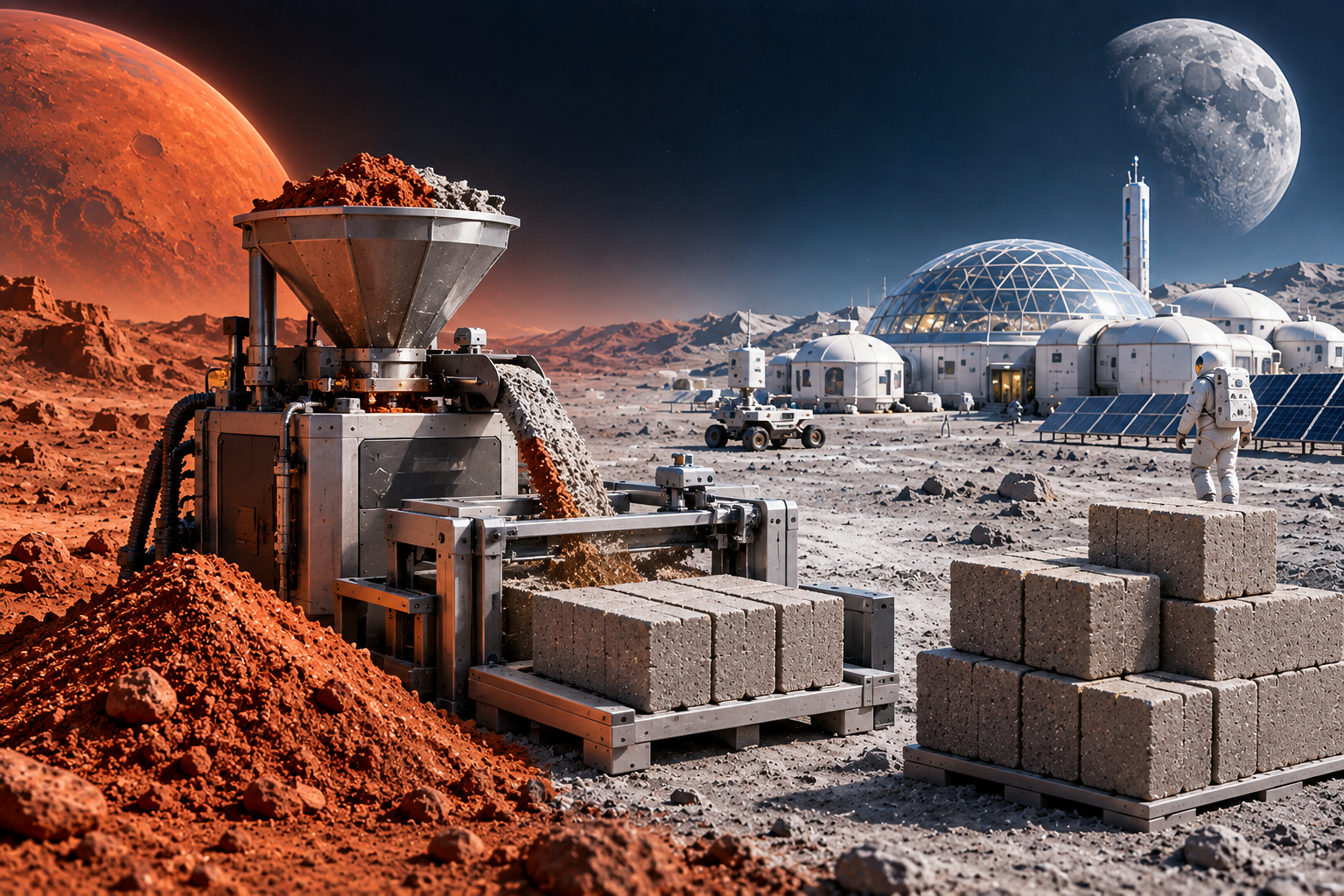

Turning Martian and Lunar Sand into Building Blocks for Space Settlements
A New Direction for Off-World Construction
Building a permanent settlement on the Moon or Mars requires more than rockets, habitats, and life-support systems. Crews will also need walls, roads, landing areas, storage spaces, and protective shelters. Transporting every kilogram of construction material from Earth would consume enormous energy and create serious logistical challenges. Researchers are therefore exploring a practical alternative: using the loose surface material already available on other worlds.
A study highlighted by TechSpot reports that scientists at Trinity College Dublin developed a method for transforming Martian and lunar regolith into strong bricks. Regolith describes the layer of loose rock, dust, and sand that covers the surfaces of the Moon and Mars. Instead of treating this material as waste, engineers could use it as a local construction resource for future space habitats.
How Regolith Bricks Could Work
The research team used carbon nanotubes to bind regolith particles together. The process works at relatively low temperatures and requires limited energy compared with many conventional manufacturing techniques. That advantage matters in space, where power, equipment, and fuel remain scarce.
The resulting blocks combine low density with impressive mechanical performance. According to the reported findings, the strongest samples reached a compressive strength of about 100 MPa, approaching or exceeding the strength of some terrestrial concrete products. The material could therefore support structural components while reducing the mass that missions must launch from Earth.
Smart Bricks for Future Space Habitats
The bricks offer another important property: electrical conductivity. Engineers could use that feature to create building elements that monitor their own condition. Embedded conductive paths might detect cracks, deformation, or changes in pressure before a structural problem becomes dangerous.
This concept could turn ordinary habitat walls into active safety systems. A settlement on Mars or the Moon would operate far from immediate repair teams, so early warnings could help crews isolate a damaged section, reinforce a weak area, or protect a pressurized interior. Structural health monitoring could become as important as insulation and radiation shielding.
Regolith-based construction could also help designers create thicker protective barriers. Layers of local soil may reduce exposure to cosmic radiation and solar particles, while solid blocks could protect equipment from micrometeoroids. Engineers could combine these functions with airtight liners and internal frames to build safer living spaces.
Why Local Materials Matter
Space construction depends heavily on in-situ resource utilization, often called ISRU. This strategy uses materials found at the destination instead of transporting all supplies from Earth. Every locally produced brick can reduce launch mass, cargo requirements, and dependence on resupply missions.
The idea has already influenced other experiments. Earlier work explored lunar regolith bricks made with saltwater and additive manufacturing. Binder jet technology can deposit a liquid binding agent onto a powder bed, creating complex shapes layer by layer. NASA also studies regolith-polymer systems that could support automated construction with robotic arms.
These methods point toward a flexible future. A lunar base might print landing pads, radiation shields, roads, and equipment housings. A Martian settlement could use autonomous machines to prepare foundations before astronauts arrive. Local production would not eliminate the need for imported electronics, seals, metals, or specialized tools, but it could reduce the amount of bulk material launched from Earth.
Benefits for Construction on Earth
The research may also influence sustainable construction on our planet. The scientists suggested that graphene, a related nanomaterial, could strengthen concrete by as much as 40 percent when used appropriately. Stronger concrete could allow builders to use less material while maintaining structural performance.
That possibility matters because cement and concrete manufacturing creates substantial carbon emissions. If stronger mixtures reduce material demand, construction companies could lower waste, transport needs, and the environmental impact of large projects. However, researchers must evaluate cost, scalability, worker safety, recycling, and long-term durability before the technology can compete with established building methods.
The Remaining Engineering Challenges
Several obstacles remain before extraterrestrial bricks become a practical building system. Machines must operate reliably in abrasive dust and harsh thermal cycles. Robotic equipment must handle, mix, shape, and inspect the regolith with minimal human intervention. Future missions must also supply or produce the binders, nanotubes, water, and energy required by each process.
They must compare carbon-nanotube bricks with sintered regolith, geopolymer concrete, polymer composites, and 3D-printed structures. Mission planners will then decide which method provides the best balance of strength, energy use, repairability, and available resources.
A Practical Step Toward Space Settlements
Turning lunar and Martian sand into building blocks represents more than an intriguing laboratory experiment. It demonstrates how future explorers could replace imported construction materials with local resources. Strong, conductive regolith bricks could support habitats, protect crews, and provide valuable structural data.
The technology still requires extensive testing, but it offers a principle: build with what the destination provides. Combined with autonomous robotics, 3D printing, ISRU, and smart sensors, that principle could help transform the Moon and Mars from temporary mission sites into more sustainable human outposts.
Source context: TechSpot report. Additional background on regolith-polymer printing appears in NASA’s technology overview. Product information for basalt-based printing material is available from The Virtual Foundry.