
America Wants to Win the AI War Against China, but Wall Street Still Sees Opportunity
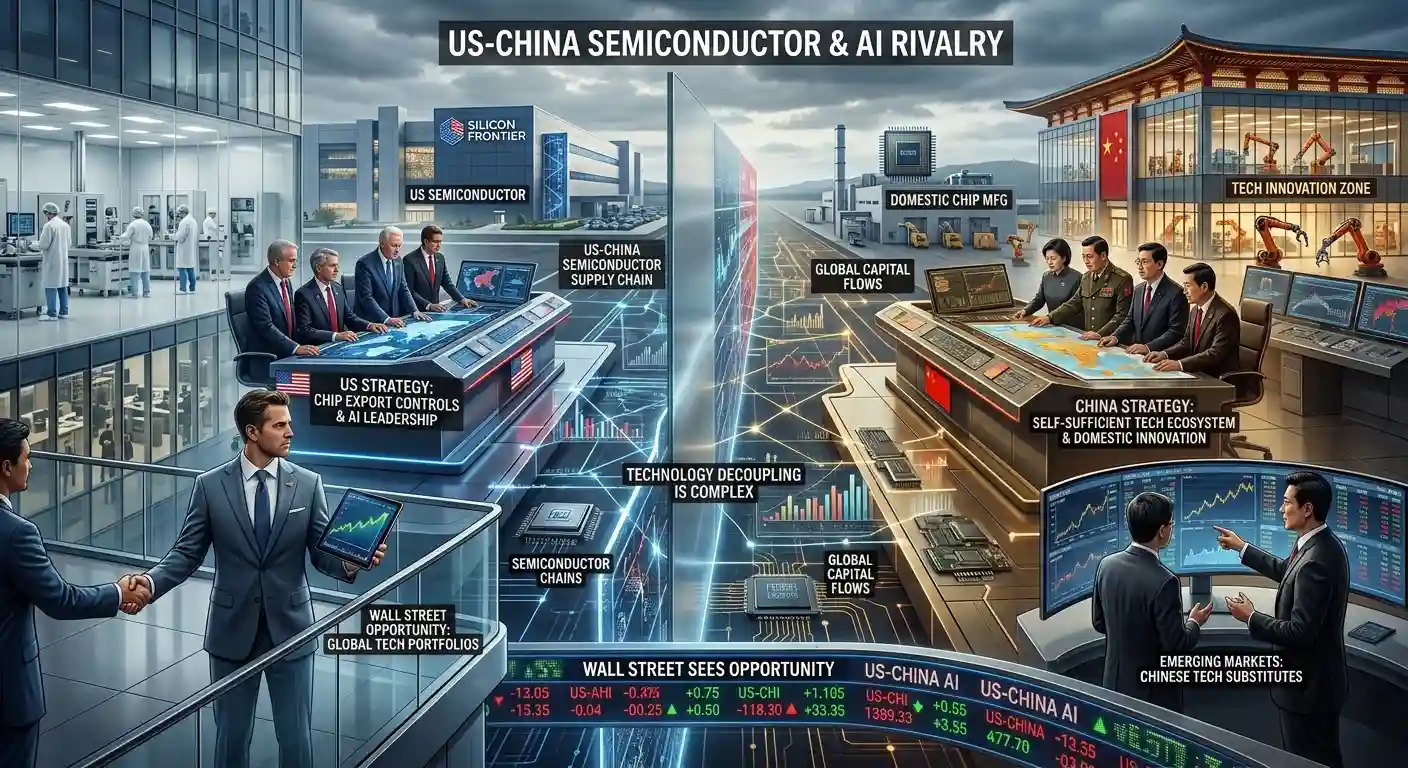
The United States and China are competing for leadership in artificial intelligence, semiconductors, cloud computing, and advanced technology. Washington wants to protect its strategic advantage, while Beijing aims to build a self-sufficient technology ecosystem. However, the financial relationship between the two countries remains more complicated than political speeches often suggest.
The central issue is simple: governments may want technological separation, but investors still look for profitable opportunities on both sides of the rivalry. This tension defines the modern US-China AI rivalry and creates difficult questions for policymakers, companies, and global investors.
The Financial Side of the Artificial Intelligence Race
The artificial intelligence race requires enormous amounts of capital. Companies need money to design advanced processors, build data centers, train large language models, and expand cloud infrastructure. These projects often require billions of dollars before they generate consistent profits.
Investment banks and asset managers focus on this financial opportunity. Their primary goal is usually to arrange transactions, manage portfolios, and earn returns. They do not necessarily need to support one country’s geopolitical ambitions. If a transaction remains legal and promises attractive returns, financial institutions may participate.
This approach creates a clear difference between national strategy and portfolio strategy. The United States may want to reduce China’s access to advanced technology, while American banks may continue working on permitted Chinese transactions. These actions can appear contradictory, but they follow different incentives.
A government measures success through national security, industrial capacity, and technological independence. An investor measures success through risk, valuation, liquidity, and potential returns. When these priorities collide, financial markets can weaken the impact of geopolitical restrictions.
How AI Chip Export Controls Change the Market
The United States has used AI chip export controls to limit China’s access to advanced computing hardware. These restrictions target technologies that can support artificial intelligence development, high-performance computing, and sensitive military applications.
Export controls can slow a country’s progress by limiting access to the most advanced processors. They can also increase production costs and create delays for companies that depend on foreign suppliers. However, restrictions may produce an unexpected result: they can encourage domestic competition.
When a Chinese company loses access to an American component, it must search for an alternative. A local supplier may receive more orders, government support, and customer attention. The replacement technology may not equal the performance of the original product, but policy pressure can create a protected market for domestic manufacturers.
This situation does not prove that export controls fail. Restrictions may still slow the overall development of China’s technology sector. Yet they can improve the relative position of specific Chinese tech companies that specialize in chips, cloud services, robotics, or machine learning infrastructure.
For investors, this creates a complex investment thesis. A policy designed to restrict China’s capabilities may simultaneously create new opportunities for companies developing local substitutes.
Technology Decoupling Is Not a Complete Separation
The idea of complete technology decoupling sounds straightforward, but the global technology industry depends on long and interconnected supply chains. A single AI product may rely on American software, Taiwanese manufacturing, European equipment, South Korean memory chips, and Chinese assembly or component production.
Removing one link from this system can create significant costs. Companies may need to redesign products, find new suppliers, and build duplicate infrastructure. These changes can reduce efficiency and increase prices for customers around the world.
The semiconductor supply chain demonstrates this challenge clearly. Advanced chip production requires specialized machinery, intellectual property, engineering talent, raw materials, and global logistics. No country controls every part of the process.
As a result, the United States may restrict certain technologies without ending every commercial connection with China. Financial relationships, cloud services, consumer markets, and ordinary business transactions can continue even while sensitive technologies face stronger controls.
Why Cross-Border Capital Flows Matter
Cross-border capital flows reveal how financial markets can operate differently from national security policy. Money often moves toward growth, innovation, and perceived opportunity. If investors believe that a Chinese technology company can benefit from domestic demand or government support, they may continue to study that company even when geopolitical risks rise.
The linked newsletter highlights this contradiction by discussing American financial participation in Chinese high-tech equity deals and Chinese holdings of US equities. These figures do not necessarily mean that governments directly financed each other’s strategic programs. They show, however, that investors and institutions remain connected despite political pressure.
This connection creates several risks. Governments may introduce new sanctions, restrict listings, or limit access to financial markets. A company that appears attractive today could face sudden regulatory pressure tomorrow. Investors must therefore consider not only business performance but also legal, diplomatic, and national security developments.
The Investment Risks Behind the AI Competition
The national security investment environment differs from ordinary technology investing. Investors must examine export rules, ownership restrictions, supply-chain exposure, data regulations, and government policy.
A company may have strong revenue growth but still face serious risks if it depends on restricted chips or foreign cloud infrastructure. Another company may have weaker technology but benefit from state support and a protected domestic market.
Investors should also avoid treating the semiconductor supply chain as a simple winner-takes-all contest. The United States may lead in certain software and chip-design areas, while China may develop strengths in manufacturing, deployment, and domestic applications. Both countries can make progress without completely replacing the other.
The outcome may depend less on one dramatic breakthrough and more on access to capital, engineering talent, energy, data centers, and reliable suppliers.
What the Future May Bring
The next phase of the US-China AI rivalry will likely combine regulation, investment, diplomacy, and industrial policy. Washington may expand restrictions on advanced technology, while Beijing may increase support for domestic alternatives. Wall Street will continue evaluating whether the potential returns justify rising political risk.
This creates an important lesson for readers and investors: technology policy does not operate in isolation. Export controls affect company valuations. Financial restrictions affect innovation. Diplomatic decisions influence supply chains. A policy designed in Washington can change the business prospects of a company in Shanghai, Taipei, or Silicon Valley.
The United States may want to win the AI competition against China, but global finance does not always follow national borders. Investors search for opportunity wherever they find it. Until governments fully restrict that movement, the financial system will continue connecting two technology ecosystems that political leaders increasingly want to separate.
Amazon Product Recommendation
For readers who want a deeper academic introduction to China’s artificial intelligence sector, consider Artificial Intelligence in China: Proceedings of the 3rd International Conference on Artificial Intelligence in China. The book examines developments in artificial intelligence and may help readers understand the technical and research environment behind the broader geopolitical competition. You can find it on Amazon.com.