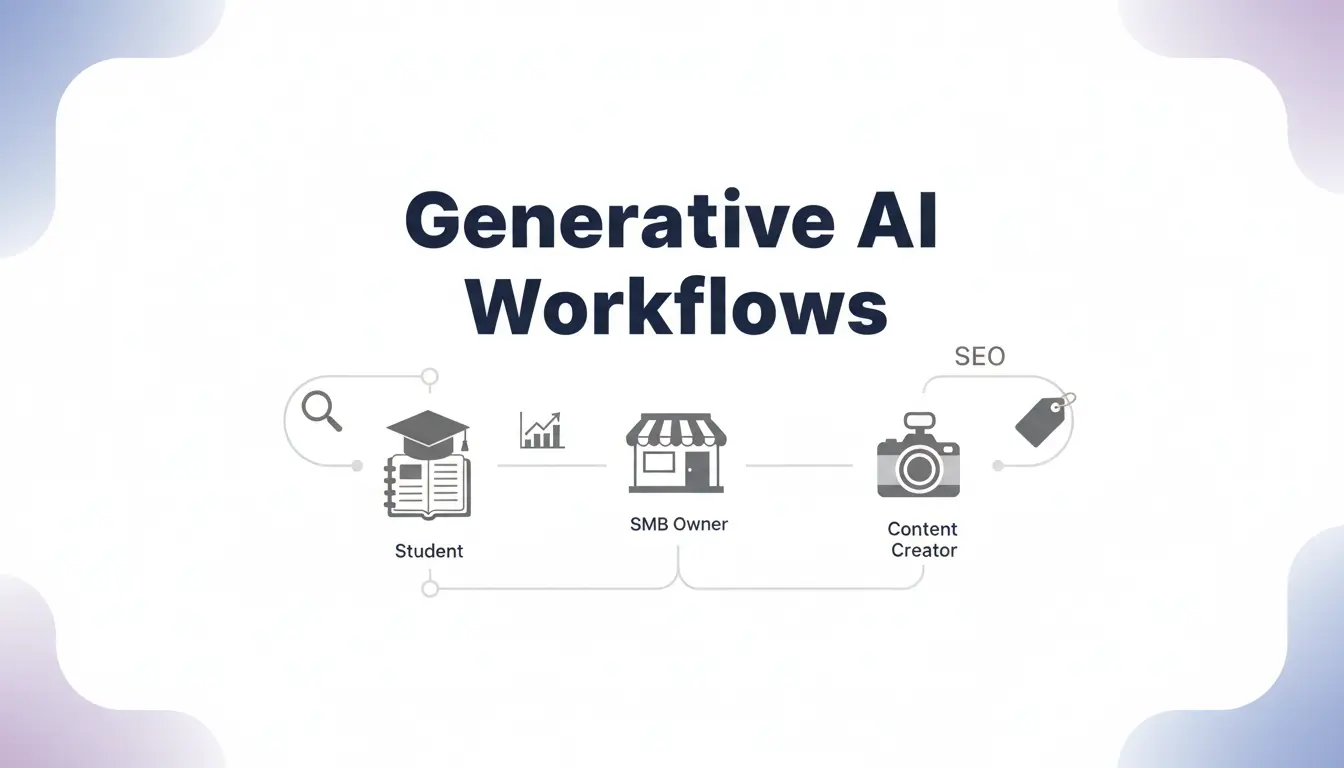

Generative AI has quickly moved from novelty to necessity, streamlining daily workflows across education, small and medium-sized businesses (SMBs), and the creator economy. From drafting research outlines to automating marketing assets, its ability to generate text, images, summaries, code, and insights helps people work faster and smarter while keeping quality high. In this guide, we explore practical, ethical, and strategic ways to integrate generative AI into everyday tasks—without losing the human touch that drives originality, trust, and brand authenticity.
What Is Generative AI and Why It Matters
Generative AI refers to models that create new content based on patterns learned from data. These models can produce essays, marketing copy, blog posts, email sequences, social media creatives, images, slides, or even analytics-ready summaries. The value isn’t just speed; it’s the compounding effect of consistent output, reduced cognitive load, and improved decision-making—especially when combined with domain expertise.
Below, we break down workflow upgrades for three key audiences and show how to maintain high originality and SEO performance.



Student Workflows: Research, Writing, and Learning Acceleration
- Research acceleration:
- Use AI to generate topic maps and literature overviews. Prompt for “key debates,” “major frameworks,” and “recent findings,” then verify with primary sources.
- Turn long readings into bullet-point summaries and highlight key quotes with citations.
- Drafting and revision:
- Generate structured outlines with clear thesis statements, section headings, and transition ideas.
- Ask the model to propose counterarguments, limitations, and implications to deepen critical thinking.
- Iterate: draft → critique → refine. Use AI as a writing coach, not a ghostwriter.
- Citation integrity:
- Always check references. Use trustworthy databases and citation managers; never rely solely on AI for citations.
- Language polishing:
- For non-native speakers, use AI to improve style, clarity, and coherence while keeping your original ideas intact.
- Originality safeguards:
- Convert AI suggestions into your own words, add personal insights, examples, and course-specific references.
- Run a final self-review to confirm voice consistency and eliminate generic phrasing.
Outcome: Students save hours on structuring and editing, produce clearer arguments, and reduce last-minute stress—while preserving academic honesty.
SMB Workflows: Marketing, Operations, and Customer Engagement
- Content marketing at scale:
- Build SEO-optimized content calendars. Ask AI to group keywords by intent (informational, transactional) and map them to funnel stages.
- Generate first drafts for blogs, landing pages, product descriptions, and FAQs; then layer on brand tone and product specifics.
- Sales enablement:
- Create tailored outreach emails, call scripts, and proposal templates. Personalize with industry pain points and proof points.
- Generate objection-handling playbooks for team training.
- Customer support:
- Draft help-center articles and response macros. Use conversational AI to triage tickets and escalate complex issues to humans.
- Operations automation:
- Summarize meetings and action items, draft SOPs, and convert checklists into onboarding guides.
- Turn spreadsheets into insights: ask for trends, anomalies, and forecast summaries.
- Brand differentiation:
- Avoid generic outputs by injecting proprietary data, customer stories, and real metrics.
- Maintain a style guide the AI can follow: tone, vocabulary, formatting, and compliance rules.
Outcome: SMBs extend their team’s capacity without adding headcount, shipping more content and improving responsiveness while staying on brand.
Content Creator Workflows: Ideation, Production, and Distribution
- Idea generation:
- Use AI to pitch content angles, hooks, and titles tailored to platforms (YouTube, TikTok, LinkedIn, blogs).
- Request swipeable carousels or chapter outlines for multi-part series.
- Script and copywriting:
- Generate long-form scripts, shorts scripts, captions, CTAs, and community questions.
- Create variations for A/B testing: hooks, thumbnails text, and descriptions.
- Repurposing engine:
- Convert one long piece (podcast, webinar, blog) into shorts, quotes, threads, email digests, and image carousels.
- Build an editorial pipeline that multiplies reach from a single core idea.
- SEO and discoverability:
- Ask AI to cluster keywords, suggest semantic subtopics, and recommend internal links.
- Optimize metadata: titles, meta descriptions, alt text, and schema suggestions.
- Authenticity and IP:
- Blend AI drafts with personal stories, case studies, and behind-the-scenes details.
- For images and music, track licenses and model policies; when needed, use original assets to maintain a unique aesthetic.
Outcome: Creators publish more frequently, test more ideas, and grow audiences faster—without sacrificing originality.
Ensuring High Originality (Targeting 95%+ Uniqueness)
- Prompt engineering for distinctiveness:
- Provide detailed context: audience, niche, tone, examples to avoid, and brand vocabulary.
- Request uncommon angles, contrarian takes, and domain-specific case studies.
- Multi-pass rewrites:
- Generate a draft, then ask AI to “rewrite for deeper analysis,” “add practitioner insights,” and “tighten to active voice.”
- Add personal anecdotes and proprietary data that AI could not have known.
- Style fingerprint:
- Maintain a signature voice: preferred sentence length, idioms, rhetorical moves, and formatting patterns.
- Use consistent structural motifs (e.g., “Problem-Framework-Playbook-Examples”).
- Source grounding:
- Cite fresh, reputable sources and synthesize them in your own words.
- Avoid template-y intros; lead with a specific story, data point, or question.
These practices materially increase originality scores and, more importantly, true uniqueness of thought.
SEO Best Practices for “Generative AI Workflows”
- Search intent alignment:
- Organize content around user intent: beginners (definitions), practitioners (playbooks), buyers (tooling comparisons).
- Semantic coverage:
- Use related entities and LSI-aligned topics (e.g., “content repurposing,” “sales enablement,” “meeting summarization”) to improve topical depth.
- On-page optimization:
- Clear H1/H2 structure, scannable lists, and concise paragraphs.
- Natural keyword placement in title, intro, subheaders, and conclusion.
- Strong internal links to related topics; external links to authoritative sources.
- UX signals:
- Fast load times, mobile-first formatting, and visual breaks for readability.
- Include FAQs that mirror real user questions.
- Conversion paths:
- Add CTAs matched to intent: downloadable templates, checklists, or trial sign-ups.
- Use schema where appropriate (FAQ, HowTo, Article).
Ethical and Risk Considerations
- Accuracy and hallucinations:
- Validate facts and numbers; add citations. Keep a changelog for critical content.
- Privacy and compliance:
- Avoid pasting sensitive data; anonymize customer examples. Respect copyright in training and outputs.
- Human-in-the-loop:
- Treat AI as an accelerator, not an autopilot. Final reviews should be human for quality, tone, and compliance.
A Simple 5-Step Integration Framework
- Define goals: What outcome matters—traffic, leads, grades, watch time?
- Map tasks: Identify repetitive, templatable steps to automate or assist.
- Create prompts: Save reusable prompt libraries, tied to your style guide.
- Review loop: Establish criteria for acceptance—accuracy, originality, tone.
- Measure and evolve: Track KPIs and refine prompts and processes monthly.
Conclusion
Generative AI is best used as a force multiplier for human expertise. Students gain clarity and structure; SMBs scale marketing and service; creators expand reach and frequency. Anchor your workflow in originality, source credibility, and brand voice, and you’ll see compounding returns: more output, better quality, and sustainable growth.