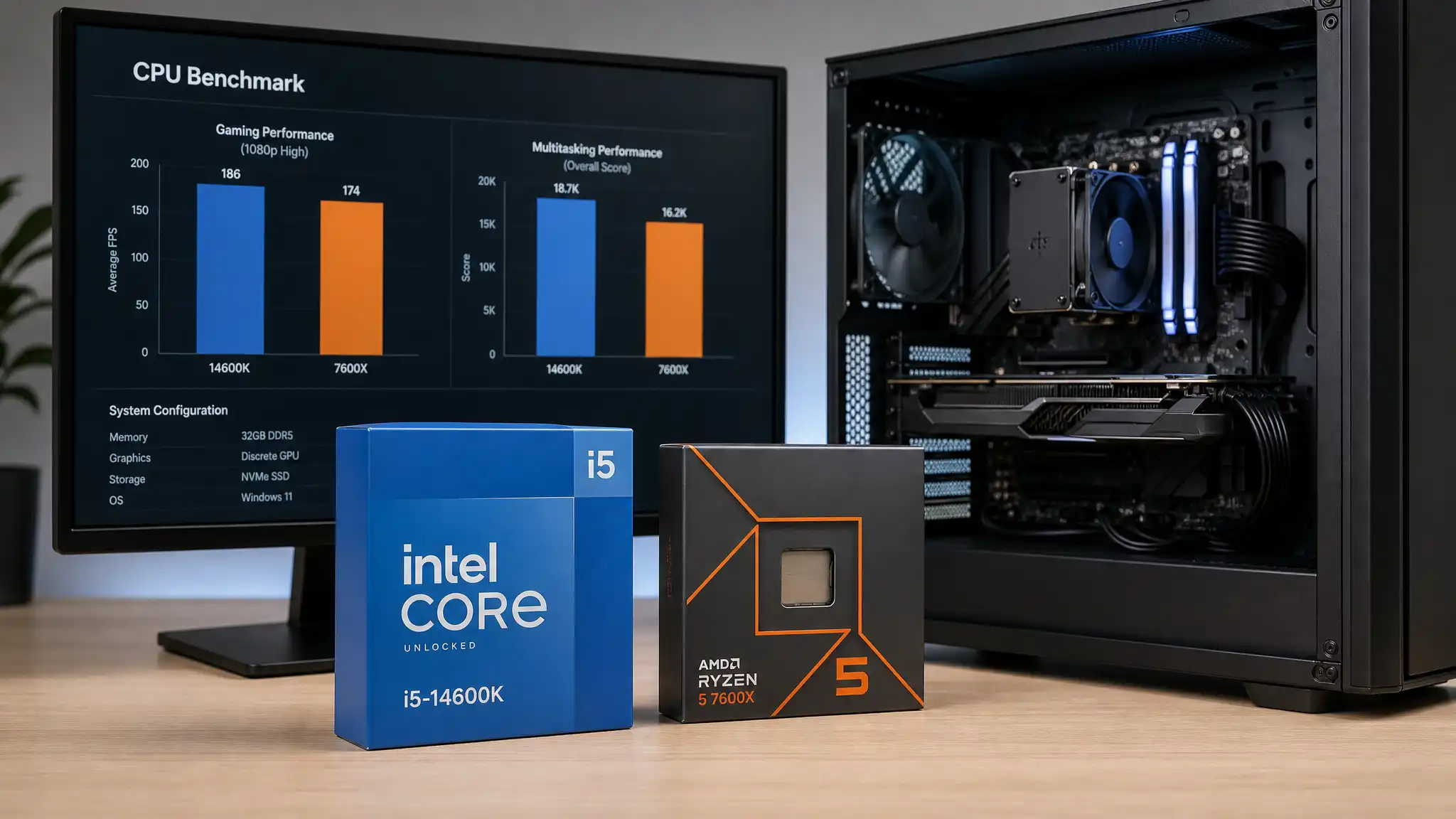

Intel Core i5-14600K vs. AMD Ryzen 5 7600X: Which Is the Best Mid-Range CPU in 2026?
Choosing the right processor can make a significant difference in gaming performance, content creation speed, and overall system responsiveness. Among the most popular options in the mid-range CPU market, the Intel Core i5-14600K and AMD Ryzen 5 7600X continue to attract attention from gamers, streamers, and PC builders looking for strong value without entering the premium enthusiast segment.
Both processors deliver excellent performance, support modern platforms, and offer impressive efficiency for their respective price ranges. However, they approach computing power differently. In this detailed comparison, we examine specifications, gaming benchmarks, productivity capabilities, power consumption, upgrade potential, and overall value to determine which CPU deserves a place in your next build.
Overview of Intel Core i5-14600K
The Intel Core i5-14600K belongs to Intel’s 14th Generation desktop processor lineup. It uses a hybrid architecture that combines Performance Cores (P-Cores) and Efficient Cores (E-Cores), allowing the processor to handle demanding workloads while maintaining efficiency during lighter tasks.

Key specifications include:
- 14 cores (6 P-Cores + 8 E-Cores)
- 20 threads
- Up to 5.3 GHz boost clock
- Intel UHD Graphics 770
- Support for DDR4 and DDR5 memory
- Unlocked multiplier for overclocking
The flexibility of supporting both DDR4 and DDR5 memory gives builders more options when balancing budget and performance.
Overview of AMD Ryzen 5 7600X
The AMD Ryzen 5 7600X is based on the Zen 4 architecture and targets users seeking strong gaming performance and future platform longevity. Despite having fewer cores than the Intel competitor, AMD focuses heavily on per-core performance and efficiency.
Key specifications include:
- 6 cores
- 12 threads
- Up to 5.3 GHz boost clock
- Integrated Radeon Graphics
- DDR5 memory support
- AM5 platform compatibility
- Unlocked for overclocking
The Ryzen 5 7600X remains one of the most popular gaming CPUs because of its excellent single-core performance and efficient architecture.
Architecture and Technology Comparison
One of the biggest differences between these processors lies in their design philosophy.
Intel employs a hybrid architecture. The Performance Cores tackle demanding applications such as gaming, video editing, and rendering, while Efficient Cores handle background tasks and multitasking workloads.
AMD follows a more traditional design with six high-performance Zen 4 cores. Each core delivers strong instructions-per-clock (IPC), resulting in excellent gaming and application performance.
For users who frequently run multiple applications simultaneously, Intel’s additional cores can provide a noticeable advantage. Those focused primarily on gaming may appreciate AMD’s streamlined architecture and efficiency.
Gaming Performance
Gaming remains one of the most important considerations when selecting a mid-range CPU.
In modern titles such as Cyberpunk 2077, Call of Duty: Warzone, Starfield, Baldur’s Gate 3, and Fortnite, both processors perform exceptionally well. When paired with a high-end graphics card, the differences often remain within a few percentage points.
Intel Core i5-14600K Gaming Results
The i5-14600K typically excels in:
- Competitive esports titles
- High-refresh-rate gaming
- CPU-intensive strategy games
- Streaming while gaming
The additional threads help maintain stable frame rates when background applications run simultaneously.
AMD Ryzen 5 7600X Gaming Results
The Ryzen 5 7600X often delivers:
- Excellent 1080p gaming performance
- Low latency in competitive titles
- Strong frame consistency
- Efficient thermal behavior
In many gaming benchmarks, AMD and Intel trade wins depending on the game engine and optimization.
Gaming Winner
For pure gaming, the Ryzen 5 7600X remains highly competitive and sometimes matches or slightly exceeds Intel’s performance. However, the difference is generally small enough that GPU choice affects overall gaming experience far more than the CPU selection.
Productivity and Content Creation
Gaming is only part of the equation. Many users also edit videos, stream content, code software, and work with creative applications.
Intel Core i5-14600K Productivity Performance
Intel’s higher core and thread count creates a substantial advantage in:
- Video editing
- 3D rendering
- Multitasking
- Live streaming
- Software compilation
- Productivity workloads
Applications such as Adobe Premiere Pro, Blender, and DaVinci Resolve often benefit from the extra processing resources.
AMD Ryzen 5 7600X Productivity Performance
The Ryzen 5 7600X still performs very well in content creation tasks but cannot consistently match Intel’s multicore capabilities.
Users who occasionally edit videos or create content will find the AMD processor more than adequate, but heavy creators may prefer Intel’s stronger productivity output.
Productivity Winner
The Intel Core i5-14600K clearly takes the lead for productivity-focused users.
Power Consumption and Thermals
Power efficiency influences cooling requirements, electricity usage, and overall system noise.
Intel Core i5-14600K
While powerful, the i5-14600K can consume significantly more power under heavy workloads. During rendering and stress testing, temperatures may rise quickly without a capable CPU cooler.
Recommended cooling solutions include:
- 240mm AIO liquid cooler
- 280mm AIO cooler
- High-end air cooler
AMD Ryzen 5 7600X
The Ryzen 5 7600X generally demonstrates better efficiency. Although it can run warm under load, overall power consumption remains lower compared to Intel’s offering.
This efficiency often results in:
- Lower temperatures
- Reduced system noise
- Smaller cooling requirements
- Better long-term energy efficiency
Efficiency Winner
AMD Ryzen 5 7600X wins in efficiency and thermal management.
Motherboard and Platform Value
Platform costs can significantly impact the total price of a PC build.
Intel Platform Advantages
Intel supports:
- DDR4 memory
- DDR5 memory
- Wide motherboard selection
- Budget-friendly upgrade paths
Users upgrading from older Intel systems may save money by reusing existing DDR4 memory.
AMD Platform Advantages
AMD’s AM5 platform offers:
- Long-term upgrade support
- Exclusive DDR5 support
- Future CPU compatibility
- Strong ecosystem growth
AMD has committed to supporting the AM5 socket for several future processor generations, making upgrades easier.
Platform Winner
AMD offers superior long-term upgrade potential, while Intel delivers more immediate budget flexibility.
Overclocking Potential
Both processors feature unlocked multipliers and support manual tuning.
Intel Core i5-14600K Overclocking
Intel enthusiasts can extract additional performance through:
- Core frequency tuning
- Memory overclocking
- Voltage optimization
However, overclocking increases power draw substantially.
AMD Ryzen 5 7600X Overclocking
AMD users benefit from:
- Precision Boost Overdrive (PBO)
- Curve Optimizer
- Automatic performance enhancements
AMD’s tuning tools make optimization relatively straightforward for beginners.
Integrated Graphics Comparison
Both CPUs include integrated graphics solutions.
Intel UHD Graphics 770
The Intel integrated GPU offers:
- Basic gaming capability
- Media acceleration
- Troubleshooting without a discrete GPU
AMD Radeon Integrated Graphics
The Ryzen 5 7600X includes integrated Radeon graphics suitable for:
- Display output
- Light graphics workloads
- Emergency system use
Neither processor targets serious gaming without a dedicated graphics card.
Price-to-Performance Ratio
The value equation depends largely on current market pricing.
The Intel Core i5-14600K typically provides:
- Better productivity performance
- Strong multitasking capabilities
- Excellent gaming performance
The AMD Ryzen 5 7600X typically provides:
- Excellent gaming value
- Better efficiency
- Longer platform lifespan
For gamers building a dedicated gaming PC, AMD often delivers exceptional value. For users mixing gaming with content creation and streaming, Intel frequently provides a more balanced experience.
Who Should Buy the Intel Core i5-14600K?
The Intel Core i5-14600K is an excellent choice if you:
- Stream and game simultaneously
- Edit videos regularly
- Run demanding productivity software
- Need strong multicore performance
- Want DDR4 compatibility
Its additional cores create a versatile system capable of handling virtually any mainstream workload.
Who Should Buy the AMD Ryzen 5 7600X?
The Ryzen 5 7600X is ideal if you:
- Primarily focus on gaming
- Value energy efficiency
- Want an upgrade-friendly platform
- Plan to keep your motherboard for years
- Prefer a simpler, cooler-running system
Its gaming performance remains impressive and competitive in modern titles.
Final Verdict
The battle between the Intel Core i5-14600K and AMD Ryzen 5 7600X demonstrates how competitive the mid-range processor market has become. Intel offers superior multitasking and productivity thanks to its hybrid architecture and higher core count. AMD counters with excellent gaming performance, lower power consumption, and a future-ready AM5 platform.
If your workload includes content creation, streaming, and heavy multitasking, the Intel Core i5-14600K is the stronger all-around performer. If gaming is your primary focus and you want a platform with long-term upgrade potential, the AMD Ryzen 5 7600X remains one of the smartest CPU choices available.
For most mixed-use users, the Intel Core i5-14600K narrowly earns the title of best mid-range CPU due to its versatility and impressive multicore performance.