
Philips Hue vs. Govee: Which Smart Lighting System Wins?
Choosing between Philips Hue and Govee feels simple at first: Hue has the premium reputation, and Govee has the aggressive pricing. But the “winner” depends on what kind of smart home you want to build—an ecosystem that scales reliably for years, or a flexible, budget-friendly setup that looks amazing fast.
In this guide, I’ll compare both systems in a practical, real-life way: setup, light quality, features, integrations, and long-term value. I’ll also help you decide which brand fits your home, your rooms, and your expectations.
Quick Verdict (If You Want the Summary First)
- Philips Hue wins if you prioritize stability, high-quality lighting, deep smart home integrations, and a system that scales room-by-room with minimal headaches.
- Govee wins if you want maximum visual impact per dollar, strong effects, easy expansion, and you’re fine living mostly inside the brand’s own app ecosystem.
1) Ecosystem Philosophy: “Infrastructure” vs “Effects”
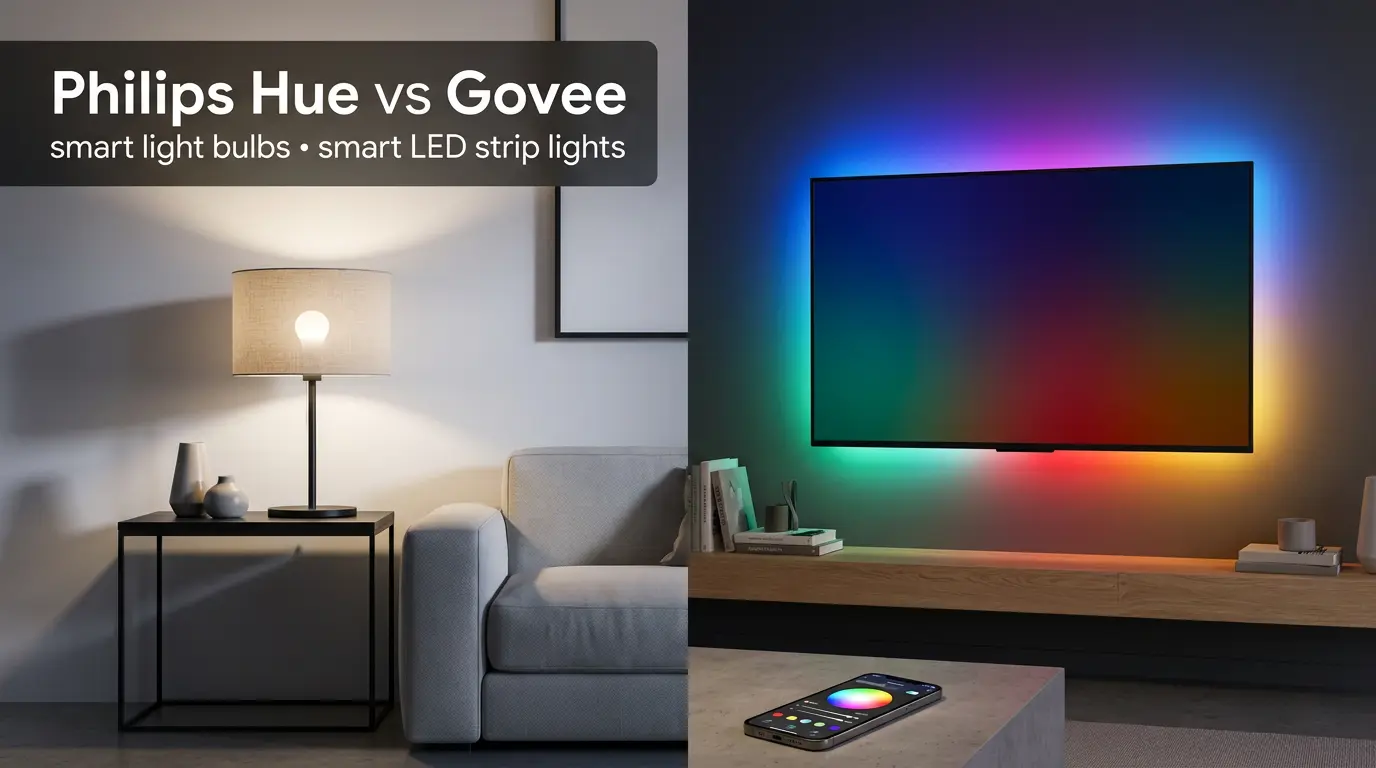
Philips Hue is built like lighting infrastructure. It focuses on consistency, reliability, and a broad catalog of smart light bulbs and fixtures that behave predictably across your whole home. Hue’s approach is less about “wow, look at these effects” and more about “this will still work flawlessly two years from now.”
Govee’s strength is creative lighting and value. If you love dramatic colors, gradients, and immersive setups, Govee’s smart LED strip lights and decorative products give you a lot of style quickly—often without requiring extra hardware.
If your plan is “whole-home lighting that replaces normal bulbs,” Hue naturally fits.
2) Setup & Hardware: Bridge, Wi‑Fi, and Real-World Convenience
Hue commonly uses a hub model, especially if you want the smoothest experience. The Philips Hue Bridge connects your lights and keeps commands fast and consistent. This hub approach also helps when you scale to many lights—your Wi‑Fi router doesn’t get overwhelmed by dozens of devices.
That said, people sometimes hesitate because they see the hub as “one more thing.” In practice, the bridge becomes “set it and forget it.” For many users, the stability is worth it.
Govee tends to lean into Wi‑Fi smart lights, which often means quick setup: connect the light to your Wi‑Fi, open the app, and go. This is convenient for apartments, dorms, and casual setups. The tradeoff: when your smart lighting count grows, Wi‑Fi device management can feel heavier, and consistency can depend more on your router quality.
Bottom line: Hue feels more “professional-grade” as you scale. Govee feels more “instant gratification.”
3) Light Quality: Brightness, Whites, and Color Accuracy
This is where Hue often justifies its price. Hue typically delivers excellent white tones (warm-to-cool), strong color accuracy, and a “real lamp” feel. If you care about natural-looking light for daily living—cooking, reading, winding down—Hue has a clear advantage.
Govee has improved massively, and many of its products look great—especially for colorful moods. But depending on the model, whites can sometimes look a bit less refined compared to Hue, and the overall “color accuracy” may vary across product lines.
If your goal is a living room that feels like a premium hotel suite, Hue tends to win. If your goal is vibrant ambiance in a bedroom or entertainment area, Govee can be more than enough.
4) Effects & Gradients: Where Govee Shines
Govee’s big advantage is visual creativity—especially with RGBIC lighting. RGBIC allows multiple colors on the same strip at once, which creates gradients, flowing patterns, and high-energy effects that look incredible behind desks, shelves, and TVs.
Hue has gradient products too, but they’re typically more expensive, and the entry cost for immersive setups can rise quickly.
If you love animated effects, colorful transitions, and bold scenes, Govee often feels like the more playful and dramatic system.
5) App Experience: Control, Scenes, and Daily Use
Hue’s app is designed for dependable daily control. It’s easy to build rooms, zones, routines, and scene presets that feel natural—like “Morning,” “Relax,” or “Movie Night.” It’s also very good at the boring but important stuff: stable pairing, reliable controls, and consistent behavior.
Govee’s strength is variety. The Govee Home app is packed with effects, community-inspired ideas, and features tailored for visual lighting. It can feel a bit busier, but if you enjoy experimenting, it’s a Playground.
If you want simple and clean: Hue.
If you want a lot of fun options: Govee.
6) Smart Home Integrations: Alexa, Google, HomeKit, Matter
Integrations are a major deciding factor, especially if you care about automation beyond “turn on/off.”
- Hue generally excels with hub-based reliability and broad compatibility, including Apple HomeKit (especially important for iPhone users).
- Govee supports major assistants well, and many products are Alexa compatible. It also works nicely for everyday voice commands and scenes.
The future-facing question is standards. If you’re building a modern setup and want broader interoperability, look at Matter support on the specific products you’re considering (for either brand). Matter can reduce “brand lock-in” over time, but real-world support still varies by device model.
Also consider whether you want a Zigbee hub style setup (Hue’s traditional strength) versus an all-Wi‑Fi approach.
Rule of thumb: If HomeKit and long-term system stability matter most, Hue usually wins. If you want a fast, assistant-friendly setup without extra hardware, Govee often wins.
7) Entertainment Features: Music Sync and TV/PC Ambience
Both brands offer fun entertainment features, but the value proposition differs.
Govee commonly offers very affordable options for music sync, which can react to sound and add energy to parties or gaming sessions. Many users love this because it feels “alive” without a high cost.
Hue is famous for immersive experiences too, especially for home theater vibes. Many people build setups around ambient bias lighting behind TVs and monitors. Hue’s results can look extremely polished—again, typically at a premium.
If you’re building an entertainment wall on a budget, Govee is hard to beat. If you want premium polish and deep ecosystem cohesion, Hue often feels like the “investment” choice.
8) Reliability, Latency, and Scaling to Many Lights
This is where Hue’s infrastructure mindset pays off. With the bridge, commands remain responsive even as you add more devices. Scenes fire consistently. Routines feel dependable. For a whole-home system, those details matter more than people expect.
Govee can absolutely run a larger setup, but scaling a Wi‑Fi-heavy environment can depend on your network quality and how many devices your router handles comfortably.
If you plan to expand beyond a couple of rooms, Hue’s system design tends to feel calmer and more stable.
9) Pricing & Value: What You Actually Pay Over Time
Hue costs more per bulb and per fixture—there’s no way around it. But you’re paying for refined light quality, strong integrations, and a mature ecosystem.
Govee usually offers better cost-per-meter for strips and better cost-per-effect for “wow factor.” For many homes, that’s exactly the right trade.
A practical strategy many users follow:
- Use Hue for main lighting (ceiling fixtures, lamps, daily routines)
- Use Govee for decorative and entertainment zones (desk, shelves, behind TV)
This hybrid approach often gives the best mix of reliability and visual fun.
10) Which One Wins for You? (Simple Decision Guide)
Choose Philips Hue if you want:
- Whole-home lighting that feels premium and consistent
- Strong integration with Apple ecosystems and advanced automation
- A system that scales cleanly and stays stable long-term
- A more “lighting-first” experience rather than “effects-first”
Choose Govee if you want:
- Big visual impact for less money
- Gradient-heavy strips and animated effects
- Quick installs and easy upgrades
- A fun, creative approach to DIY smart lighting
Amazon.com Product Recommendation (1 Item)
If you want a safe “starting point” that demonstrates why Hue is considered the premium baseline, look for the Philips Hue White and Color Ambiance Starter Kit (with Hue Bridge) on Amazon.com. It’s a strong foundation for room-based automation, consistent whites, and future expansion.