
Why computing with light is the future
As data volumes explode and AI models scale to trillions of parameters, traditional electronic processors are hitting thermal and bandwidth limits. Photonic processors—chips that compute with light instead of electrons—offer a paradigm shift. By leveraging photons traveling at the speed of light with minimal heat dissipation, photonic computing enables ultra-low latency, massive parallelism, and orders-of-magnitude energy efficiency gains for AI inference, high-throughput analytics, and edge computing. If your roadmap demands real-time intelligence, greener data centers, or differentiated AI products, photonics may be your fastest path to competitive advantage.
What makes photonic processors different
- Speed at scale: Light propagates faster and without the RC delays inherent in electron-based interconnects. Photonic matrix multiplications can be performed in analog optical domains at near-light speed, reducing end-to-end latency.
- Energy efficiency: Optical interference and wavelength-division multiplexing (WDM) perform many operations simultaneously with lower switching energy. This translates into fewer watts per TOPS and lower TCO.
- Parallelism by physics: Multiple wavelengths carry independent data channels through the same waveguide. This unlocks extraordinary throughput without proportionally increasing footprint or heat.
- Reduced interconnect bottlenecks: Optical I/O alleviates bandwidth constraints between chips, memory, and accelerators. High-bandwidth photonic links cut serialization overheads and enable disaggregated architectures.
Business outcomes you can measure
- Accelerate AI inference: Deploy LLMs, recommendation engines, and computer vision with sub-millisecond latency even under heavy load.
- Lower operating costs: Reduce cooling and power draw across training and inference clusters; achieve sustainability targets without sacrificing performance.
- Unlock edge intelligence: Run complex models at the edge—industrial inspection, 5G RAN, autonomous systems—where latency and power budgets are unforgiving.
- Shorten time-to-insight: Real-time stream analytics and search over large vector databases become practical and cost-effective.
How photonic computing works (without the jargon)
At the heart of a photonic processor are optical components like waveguides, modulators, and interferometers that manipulate light to execute linear algebra operations, especially matrix-vector multiplications central to neural networks. Input signals modulate laser light; optical interference performs multiply-accumulate (MAC) operations in parallel; detectors convert results back to electrical domains for non-linear activation and control. Hybrid electro-optic designs give you the best of both worlds: optics for high-throughput linear layers and electronics for precision, programmability, and memory.
Key building blocks:
- Silicon photonics: Mature CMOS-compatible processes integrate photonics with conventional logic, improving yield and cost.
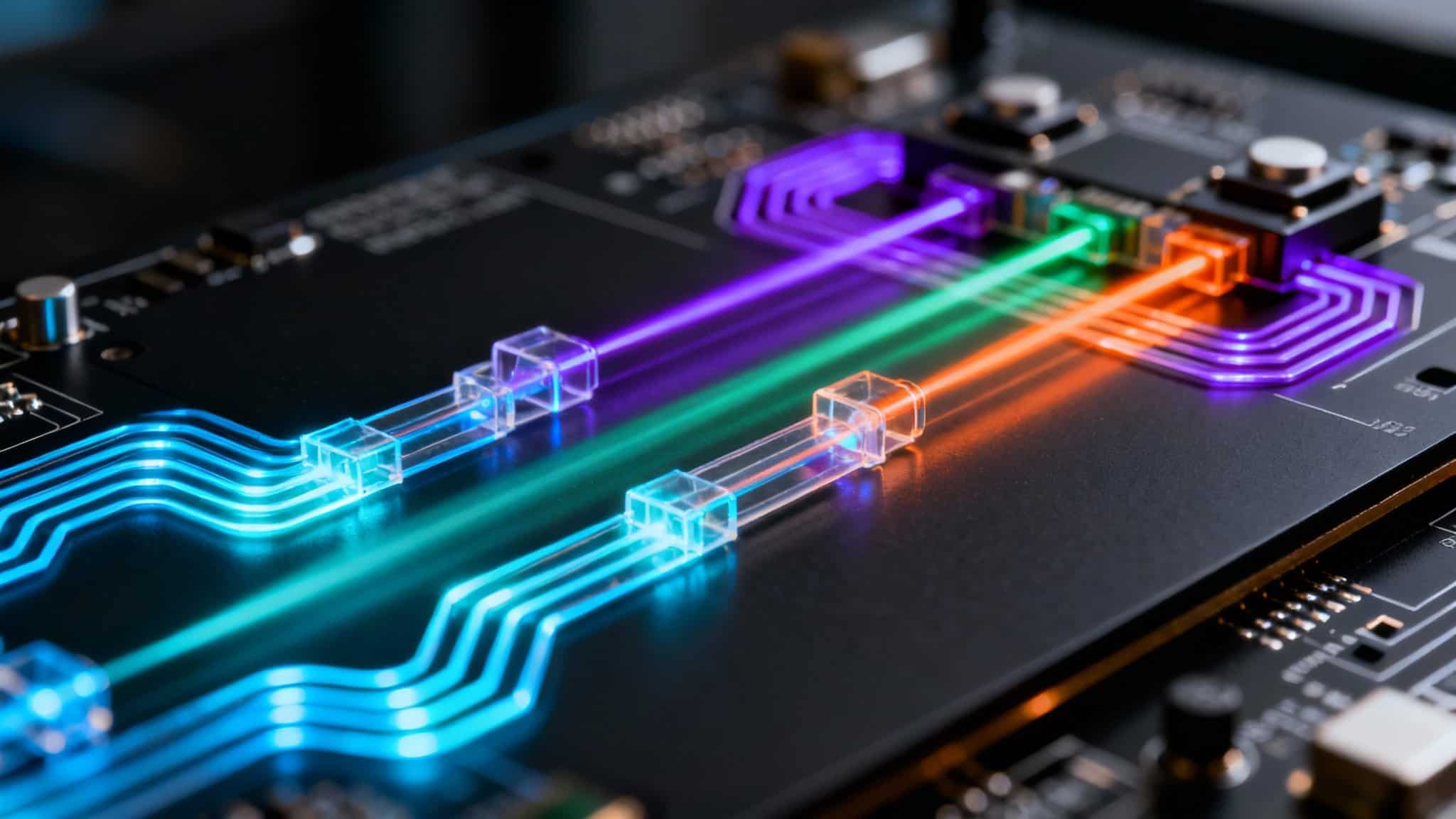
- WDM channels: Multiple colors (wavelengths) of light act as independent lanes—think multi-lane optical highways on a single waveguide.
- Optical matrix engines: Programmable mesh networks of interferometers execute dense linear operations natively in light.
Where photonics fits in your stack
- As an AI inference accelerator: Drop-in cards or appliances slot into existing racks via PCIe or CXL, targeting transformer layers that dominate inference cost.
- For vector search and retrieval: Accelerate high-dimensional similarity search for RAG, recommendation, and anomaly detection with ultra-fast dot products.
- In disaggregated data centers: Optical interconnects and photonic compute nodes reduce east-west traffic bottlenecks and enhance cluster elasticity.
- At the intelligent edge: Compact, low-power photonic modules drive real-time perception and decision-making in manufacturing, logistics, and mobility.
Addressing common concerns
- Precision and accuracy: Modern photonic systems combine analog optical compute with digital calibration and error correction. Mixed-precision flows (e.g., 8-bit/4-bit quantization) preserve model accuracy while delivering large speedups.
- Software integration: Standards-based APIs and frameworks (ONNX, PyTorch runtime plugins) hide hardware complexity. Model conversion tools map transformer layers to photonic kernels automatically.
- Ecosystem and support: A growing vendor ecosystem provides development kits, compilers, and reference models, reducing risk and accelerating proof-of-value.
- Reliability and manufacturability: Silicon photonics leverages established fabs. Thermal stability is actively managed via control loops and packaging innovations.
Adoption roadmap: from pilot to production
- Identify latency- and cost-sensitive workloads:
- LLM serving (RAG, chat, code assist)
- Vision inference (inspection, surveillance, robotics)
- Recommendation systems and ranking
- Vector similarity search at scale
- Run a structured proof of concept:
- Baseline today’s performance and TCO
- Quantize and calibrate models for photonic kernels
- Validate accuracy parity and latency targets
- Plan integration:
- Decide on accelerator cards vs appliances
- Connect to your orchestration (Kubernetes) and MLOps stack
- Integrate monitoring and autoscaling policies
- Scale and optimize:
- Offload the heaviest linear layers
- Tune batch sizes and sequence lengths
- Expand to multi-tenant inference with QoS guarantees
Expected impact benchmarks you can target:
- 10–100x lower latency for key layers
- 5–20x better energy efficiency per inference
- 2–5x throughput gains at fixed power/cooling envelopes
Why act now
The inflection point is here: AI demand is outpacing the power and cooling budgets of modern data centers. Early adopters of photonic computing are locking in structural advantages—serving more queries per watt, opening new low-latency product experiences, and meeting sustainability commitments. Waiting risks technical debt and rising costs as models grow.
Our value proposition
We help you harness photonic processors to achieve measurable performance and efficiency gains without disrupting your current AI pipeline.
What you get:
- Architecture assessment: Identify candidates for optical acceleration and expected ROI
- Pilot acceleration: Convert and calibrate your top models with photonic kernels
- Seamless integration: Runtime adapters for PyTorch/ONNX, observability, and autoscaling
- Reliability engineering: Thermal tuning, drift management, and accuracy assurance
- Deployment playbooks: From single-node pilots to fleet-scale rollouts
Outcomes:
- Faster AI experiences that delight users
- Lower compute spend and carbon footprint
- Future-proof infrastructure ready for the next generation of models
Use cases that win with photonics
- Real-time RAG assistants: Sub-100ms responses for enterprise search and support
- Industrial inspection: Micron-level detection at line speed with low-power edge nodes
- Financial analytics: Stream processing for risk, fraud, and market microstructure
- Logistics and retail: Instant recommendations and demand sensing at the edge
- Telecom: 5G RAN and backhaul analytics with tight latency SLAs
Getting started
- Book a discovery session to evaluate workload fit
- Share representative models and traffic patterns
- Launch a targeted pilot and quantify ROI within weeks
- Scale incrementally—on-prem or cloud-adjacent—based on results
Computing with light isn’t just a faster chip. It’s a smarter way to align physics with your AI ambitions—achieving speed, efficiency, and scale that electrons can’t match. If your business depends on real-time intelligence at sustainable cost, photonic processors are the advantage you can deploy today.