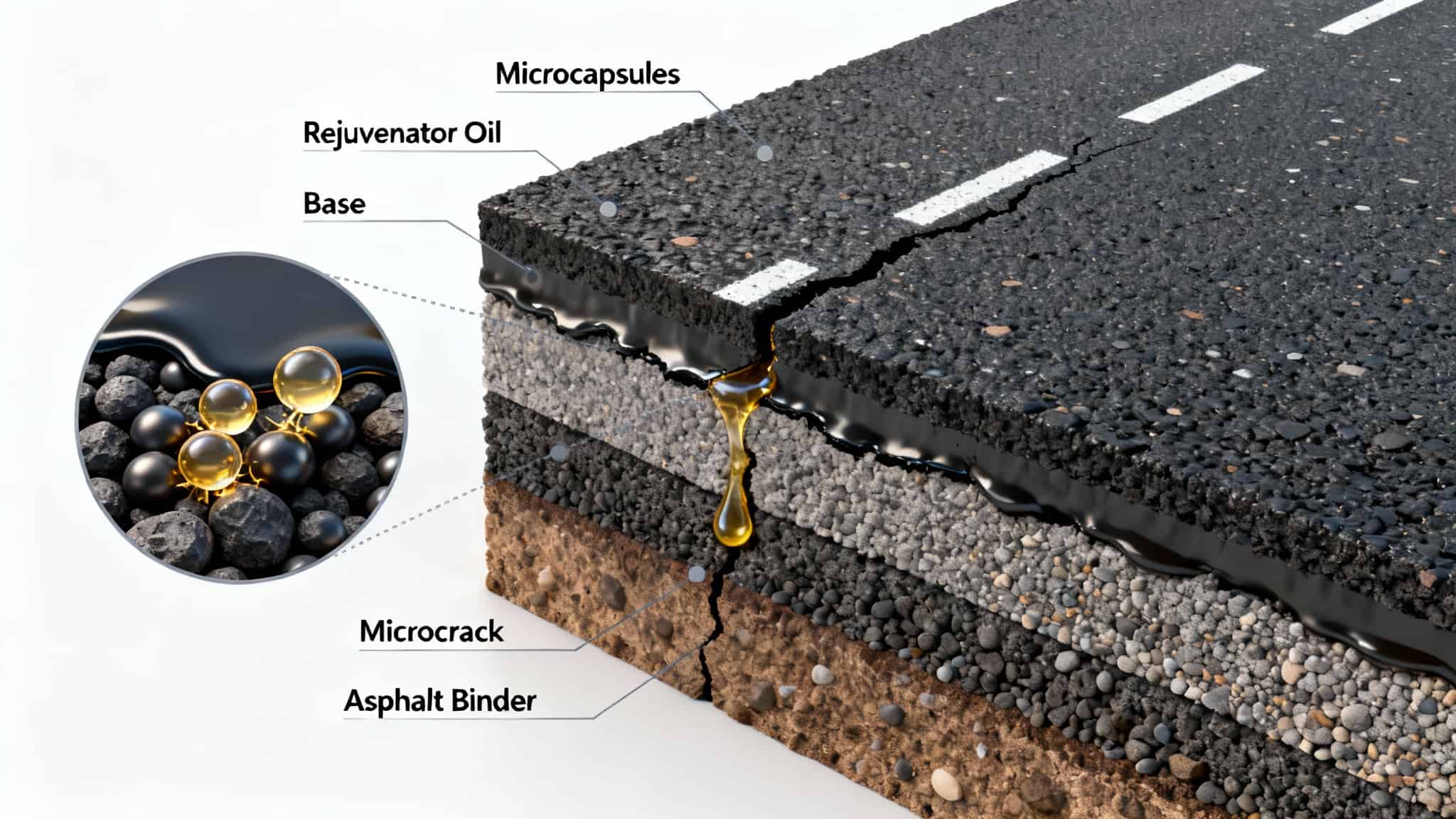

Road pavements face relentless mechanical stress, temperature swings, water infiltration, and oxidation. Over time, microcracks form in asphalt binders and propagate into larger cracks, potholes, and raveling. Conventional maintenance is reactive, costly, and disruptive. Self-healing asphalt using microcapsule technology offers a proactive, materials-level solution: embed tiny capsules filled with rejuvenating agents into the asphalt so that, when cracks appear, the capsules rupture and release healing compounds that restore the binder’s ductility and cohesion. This approach can extend pavement life, reduce lifecycle costs, and cut carbon emissions associated with frequent resurfacing.
How Microcapsule Self-Healing Works
Microcapsule-based self-healing asphalt borrows from bio-inspired and polymer engineering concepts. The core idea is simple:
- Microcracks create localized stress concentrations in the asphalt binder matrix.
- Under load or thermal cycling, nearby microcapsules rupture.
- The released healing agent (often a rejuvenator oil, bitumen-compatible polymer, or solvent) migrates into the crack by capillarity.
- Chemical and physical interactions soften oxidized binder, improve molecular mobility, and re-establish a continuous matrix.
Healing mechanisms vary:
- Physical rejuvenation: Lightweight oils diffuse into aged binder, reducing viscosity and increasing maltene-to-asphaltene balance.
- Polymer film formation: Reactive agents crosslink or form films that bridge cracks.
- Thermal activation: Some capsules are engineered to soften or rupture at specific temperatures (e.g., under summer heat or controlled warm-up), enhancing release kinetics.
Key parameters include capsule size, shell material, core chemistry, loading rate (wt% relative to binder), and spatial distribution. Optimal design ensures capsules survive mixing and compaction but reliably rupture under crack-induced stress.
Microcapsule Materials and Design
- Shell materials: Urea-formaldehyde, melamine-formaldehyde, polyurethane, and silica shells are common. The shell must be chemically compatible with asphalt, mechanically robust during mixing, and sufficiently brittle against crack-tip stress.
- Core agents: Waste cooking oil (WCO) derivatives, bio-based rejuvenators (tall oil, lignin oils), aromatic oils, diluents, and polymer-modified rejuvenators. Selection depends on target penetration grade, climate, and aging profile.
- Capsule size: Typically 50–500 μm. Larger capsules store more healing agent but can affect mix workability and mechanical uniformity; smaller capsules yield more uniform dispersion and multiple healing events.
- Encapsulation methods: In situ polymerization, interfacial polymerization, and sol-gel processes are used to produce high-yield, uniformly sized capsules with controlled shell thickness.
Mixing, Compaction, and Compatibility
Microcapsules are introduced during asphalt mixing at the plant. Practical considerations include:
- Mixing temperature: Excessive temperatures can weaken shells; thus, warm mix asphalt (WMA) techniques and temperature-optimized shells are advantageous.
- Compaction and shear: Capsules must withstand mixing shear yet remain rupture-ready at crack tips. Pilot trials often calibrate drum speeds and dwell times.
- Dosage: Typical loadings range from 3–10% by weight of binder, though optimal levels depend on capsule efficiency and desired healing intervals.
Compatibility is crucial. Capsules should not bleed out, agglomerate, or react prematurely with the binder. Surface treatments and dispersants can help maintain stable distributions.
Performance Metrics and Testing
Evaluating self-healing asphalt involves both mechanical and chemical testing:
- Healing index (HI): Ratio of recovered strength/stiffness after a controlled damage-heal cycle to the original value. Tests include fatigue healing (four-point bending), indirect tensile strength recovery, and semicircular bend (SCB) with rest periods.
- Crack closure and diffusion: Microscopy (optical, SEM), CT scanning, and fluorescence tagging of oils to quantify penetration depth and healing kinetics.
- Rheology: DSR (Dynamic Shear Rheometer) to assess binder complex modulus, phase angle, and recovery after aging (RTFO/PAV) with and without capsules.
- Durability cycles: Repeated damage-heal cycles to evaluate multi-heal capability and long-term performance, especially under moisture conditioning (AASHTO T283) and freeze-thaw.
Studies often report improved fatigue life, higher fracture energy recovery, and reduced crack propagation rates. Field demonstrations have shown extended intervals between maintenance overlays in suitable climates.
Advantages and Sustainability Impacts
- Extended service life: Self-healing delays crack coalescence and pothole formation, reducing frequency of patching and overlays.
- Lower total cost of ownership: While initial material costs may be higher, lifecycle cost analyses frequently show net savings through reduced maintenance and traffic management expenses.
- CO2 reduction: Fewer maintenance cycles mean lower material production, transport, and paving emissions. Using bio-based or recycled oils as core agents further improves sustainability.
- Network-level resilience: More durable pavements enhance reliability for logistics and public transportation, especially in regions with thermal extremes.
Limitations and Engineering Trade-Offs
- Initial cost premium: Capsules and process control add costs; economic justification relies on lifecycle modeling and local maintenance histories.
- Thermal sensitivity: Healing is temperature- and time-dependent. In cold climates, healing may be slow; supplemental strategies (e.g., induction heating or warm periods scheduling) can help.
- Mechanical trade-offs: Excessive capsule loading might slightly reduce initial stiffness or rutting resistance if not properly balanced with aggregates and modifiers.
- Quality control: Ensuring uniform capsule dispersal and preventing damage during production requires tight QA/QC protocols.
Integration with Other Smart Pavement Technologies
Microcapsules can be combined with:
- Induction-heated steel fibers to thermally activate healing on demand.
- Polymer-modified asphalt binders for balanced rutting-fatigue performance.
- Fiber reinforcement (cellulose, basalt) to control crack initiation while capsules address propagation.
- Sensing: Embedded strain or temperature sensors to trigger maintenance only when needed, leveraging predictive models of healing cycles.
This systems approach aligns with performance-based specifications and asset management philosophies, enabling data-driven maintenance scheduling.
Implementation Roadmap for Agencies and Contractors
- Lab screening: Select capsule and rejuvenator types based on local binder grades and climate. Calibrate dosage for target healing index and minimal rutting impact.
- Pilot mix designs: Compare control, capsule-enhanced, and alternative modifiers using SCB-JC, IDEAL-CT, DSR healing protocols, and Hamburg wheel tracking.
- Plant trial: Validate capsule survivability at production scale. Adjust mixing temperatures and times to protect shell integrity.
- Field section: Install test sections with instrumentation (strain gauges, temperature probes). Monitor crack density, IRI, and skid resistance over time.
- Lifecycle assessment: Model cost, downtime, emissions, and service life extension to inform network-wide adoption.
Future Directions
- Bio-derived shells and cores: Fully bio-based, low-toxicity shells and renewable oils to enhance ESG profiles.
- Multi-trigger capsules: Shells responsive to moisture, pH, or electromagnetic fields to tailor release in different environments.
- Multi-heal architectures: Core-shell-shell and microvascular hybrids for repeated healing events.
- Standardized specs: Development of harmonized testing protocols and performance thresholds to accelerate procurement and adoption.
Conclusion
Self-healing asphalt via microcapsule technology brings materials science into the heart of pavement maintenance. By embedding restorative capacity directly into the asphalt, roads can autonomously recover from micro-damage, prolonging service life, reducing costs, and shrinking environmental footprints. While not a universal cure-all, when thoughtfully designed and rigorously validated, microcapsule systems are a practical, scalable step toward smarter, more sustainable infrastructure.