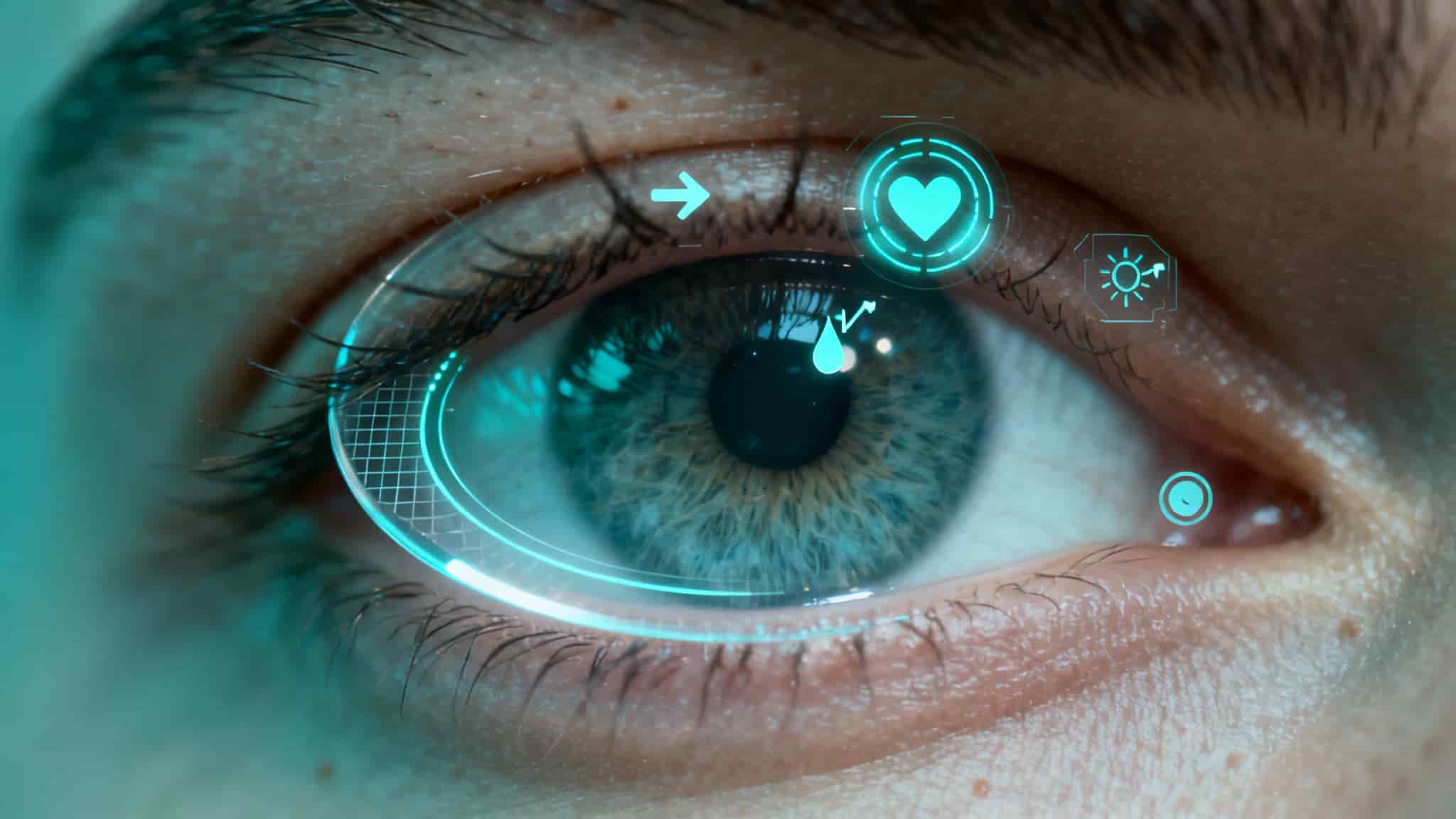

Smart contact lenses are transforming how we see and understand the world—literally. By embedding ultra-thin displays, biosensors, micro-batteries, and wireless communication modules into a soft lens, these devices promise hands-free augmented reality (AR) overlays and continuous health monitoring directly from the surface of the eye. Unlike bulky headsets or smart glasses, smart lenses offer a discreet, always-available interface that could redefine human-computer interaction, medical diagnostics, and personal wellness. This article explains how smart contact lenses work, what they enable for AR and health measurement, current limitations, safety, regulatory considerations, and what to expect next.
How Smart Contact Lenses Work
A smart contact lens integrates several core subsystems into a flexible, biocompatible polymer:
- Microdisplay or projection optics: Projects visual information onto the retina by using miniature LEDs, micro-LED arrays, or waveguides. The goal is to render crisp, high-contrast images that remain visible in various lighting conditions.
- Biosensors: Electrochemical or optical sensors measure biomarkers such as glucose, lactate, electrolytes, or tear film osmolarity using tear fluid as a non-invasive sample.
- Power management: Energy comes from micro-batteries, inductive coupling, or energy harvesting (for example, RF). Efficient power regulation and ultra-low-power chips keep heat and consumption low.
- Wireless connectivity: Low-energy communication (Bluetooth Low Energy, NFC, or custom RF) transmits data to a smartphone or wearable hub and receives AR content or firmware updates.
- On-lens processing: Edge AI or low-power microcontrollers perform signal conditioning, basic inference, and data compression to reduce bandwidth and latency.
- Biocompatible encapsulation: Multilayer barriers protect electronics from moisture and protect the eye from any leachable materials.
The contact lens sits in the tear film, so it must remain oxygen-permeable, comfortable, and stable during blinking. Advanced materials and curved flexible PCBs help match the corneal contour. A smart lens must also maintain optical clarity so it does not degrade natural vision when AR isn’t active.
AR From the Eye: What Becomes Possible
Smart contact lenses can place contextually relevant information directly in your line of sight while keeping your hands free:
- Heads-up navigation: Turn-by-turn directions, distance-to-destination, and route changes in your peripheral view without looking down at a phone.
- Real-time translation and captions: Subtitles for conversations or signage detected via on-device OCR and language models.
- Performance metrics for sports: Heart rate zones, lap times, cadence, running power, or cycling watts visible without disrupting form.
- Micro-notifications: Minimalist alerts for calls, messages, or calendar reminders that you can glance at and dismiss.
- Industrial and medical workflows: Overlays for assembly steps, torque specs, or surgical guidance that reduce errors and improve efficiency.
- Eye-tracked interfaces: Natural gaze-based selection and micro-gestures could replace taps or voice commands in noisy environments.
To be truly useful, AR overlays must be legible in daylight and not block or distract from hazards. Adaptive brightness, context-aware UI, and fixation-aware rendering help maintain safety.
Health Monitoring Through Tear Fluid
Tears provide a rich bio-sampling medium that correlates with various systemic and ocular health markers. Smart contact lenses can measure:
- Glucose trends: Continuous tear glucose monitoring may support diabetes management by indicating rising or falling trends, although absolute equivalence to blood glucose requires calibration and clinical validation.
- Inflammation markers: Proteins and cytokines could inform dry eye disease status or post-operative recovery.
- Intraocular pressure (IOP) proxies: Strain gauges or curvature sensors infer IOP fluctuations relevant to glaucoma risk monitoring.
- Environmental exposure: Sensors for UV exposure or allergens can trigger protective prompts.
Because tear composition differs from blood, algorithms must translate sensor outputs into clinically meaningful insights. Longitudinal baselining, on-device artifact rejection (blink events, tear turnover), and cloud-assisted models can improve accuracy and reliability.
Safety, Comfort, and UX Considerations
- Ocular safety: Materials must meet biocompatibility standards, remain stable in saline environments, and allow adequate oxygen permeability (Dk/t) to prevent corneal hypoxia.
- Thermal limits: Electronics should stay near physiological temperature, with duty-cycled power and efficient displays preventing heat buildup.
- Visual comfort: AR should respect depth cues and vergence-accommodation to minimize eye strain. Designs often target peripheral overlays or focal planes that reduce conflict.
- Hygiene: Single-use or frequent-replacement modalities reduce biofouling. Smart charging cases can disinfect with UV-C and manage firmware updates.
- Fail-safe modes: If power or connectivity fails, the lens should revert to optically neutral, ensuring no obstruction to vision.
Data Privacy and Security
Smart lenses collect sensitive biometrics and potentially capture contextual information from gaze patterns. Best practices include:
- On-device processing first: Minimize raw data leaving the lens or the companion device.
- End-to-end encryption: Protect data in transit and at rest with standards like TLS 1.3 and hardware-backed key storage.
- User control and consent: Clear opt-in for health metrics, data sharing, and AR recording features. Granular permissions and transparent retention policies are essential.
- Regulatory alignment: Compliance with HIPAA, GDPR, or regional equivalents depending on use cases and data types.
Regulatory Landscape and Clinical Validation
Depending on feature set, smart contact lenses may be regulated as medical devices. For example, continuous IOP estimation or glucose monitoring would likely require clinical trials and regulatory clearance demonstrating safety, performance, and benefit-risk profile. Non-medical AR-only variants may fall under consumer electronics, but still need to meet optical safety, RF exposure, and materials standards. Post-market surveillance, software lifecycle documentation, and cybersecurity evidence are increasingly important for approval.
Technical Challenges Still to Solve
- Power density and longevity: Extending wear time without bulk is a key constraint; hybrid power (micro-batteries plus wireless top-ups) is promising.
- Display brightness versus efficiency: Achieving outdoor visibility while preserving battery life demands microdisplay advances and adaptive rendering.
- Sensing specificity and drift: Biofouling, pH changes, and temperature can affect sensor accuracy; smart calibration and self-check routines are needed.
- Alignment and stability: Micromotion can blur displays or disturb sensor readings; better mechanical anchoring and dynamic compensation help.
- Manufacturing yield: Embedding chips and sensors into flexible, curved substrates at scale requires new assembly processes and rigorous QA.
Real-World Applications
- Diabetes and metabolic wellness: Trend alerts, behavioral nudges, and integration with nutrition and insulin delivery ecosystems.
- Ophthalmology: Continuous IOP trend analysis between clinic visits; monitoring dry eye treatment adherence.
- Sports and tactical performance: Live metrics without breaking flow; situational awareness overlays in mission-critical settings.
- Field service and logistics: Step-by-step AR procedures, inventory scanning, and remote expert guidance.
Interoperability and Ecosystem
The value of smart lenses compounds when they integrate smoothly with:
- Smartphones and wearables: Health data fusion with smartwatches, heart rate straps, and phones for richer context.
- Cloud analytics and EHRs: Securely sharing clinician-approved metrics into electronic health records or telehealth platforms.
- Spatial computing platforms: SDKs for AR developers to design glanceable, low-distraction interfaces optimized for microdisplays.
- Smart cases and chargers: Automated cleaning, charging status, and firmware updates while lenses rest in the case.
Open standards for data formats, APIs, and privacy controls will accelerate adoption and third-party innovation.
What to Expect Next
In the near term, expect hybrid products that prioritize one domain—either health sensing or lightweight AR—before fully converged solutions become mainstream. Early consumer models may focus on notifications, fitness cues, and UV exposure alerts, while medical-grade variants pursue specific, validated biomarkers with clinician dashboards. As micro-LED efficiency improves, on-lens AI matures, and manufacturing scales, smart contact lenses will shift from early adopters to broader markets.
Buyer and Patient Guidance
- Identify your use case: Do you need clinically validated health metrics, or primarily productivity and navigation overlays?
- Verify safety and compliance: Look for regulatory clearances for medical features and certifications for materials and RF safety.
- Evaluate comfort and wear schedule: Daily disposables vs. extended wear; check oxygen permeability and cleaning protocols.
- Privacy first: Ensure you can control data sharing and delete records; understand how gaze or health data is used.
- Ecosystem fit: Confirm compatibility with your phone, smartwatch, and health apps you rely on.
Conclusion
Smart contact lenses bring AR experiences and health insights as close as possible to where we see and sense the world: the eye. By merging microdisplays with sensitive biosensors in a safe, comfortable format, they promise a future of effortless information access and proactive wellness. While challenges around power, accuracy, safety, and regulation remain, rapid progress suggests that practical, trustworthy smart lenses are on the horizon. The winners will be those who blend human-centered design, medical rigor, and privacy by default.