
The landscape of personal mobility is undergoing a monumental shift. For decades, individuals living with severe mobility impairments relied heavily on conventional wheelchairs or rigid mechanical braces. While these devices offer vital support, they often limit upright independence and prevent natural upper-body freedom. Enter the Wandercraft Eve exoskeleton—a groundbreaking innovation engineered to restore hands-free, upright walking for wheelchair users. By replacing cumbersome crutches with intelligent dynamic balance, this medical device establishes a new standard for assistive technology and personal robotics.
The Evolution of Personal Exoskeletons
Traditional personal exoskeletons require users to maintain balance using forearm crutches or walking frames. This requirement limits upper-body movement and drains physical strength during daily activities. Wandercraft recognized these limitations and completely redesigned wearable robotics from the ground up.
Engineers developed the Eve personal exoskeleton to deliver autonomous dynamic equilibrium. Unlike legacy systems that merely motorize leg joints, Eve continuously calculates body mechanics to adjust posture in real time. Consequently, individuals with spinal cord injury regain the ability to stand, turn, and walk naturally without holding onto external stabilization tools.
How Advanced Self-Balancing Technology Works
At the heart of Eve lies a sophisticated physical AI engine integrated with high-precision sensors and actuation systems. Twelve high-torque electric motors drive the hip, knee, and ankle joints, replicating natural human gait dynamics.
Deep-learning algorithms process spatial orientation and user motion intent dozens of times per second. By analyzing shifts in center-of-gravity, the onboard computer executes instantaneous micro-adjustments. This real-time processing keeps the user stable on smooth indoor flooring, uneven outdoor pavements, and tight residential doorways.
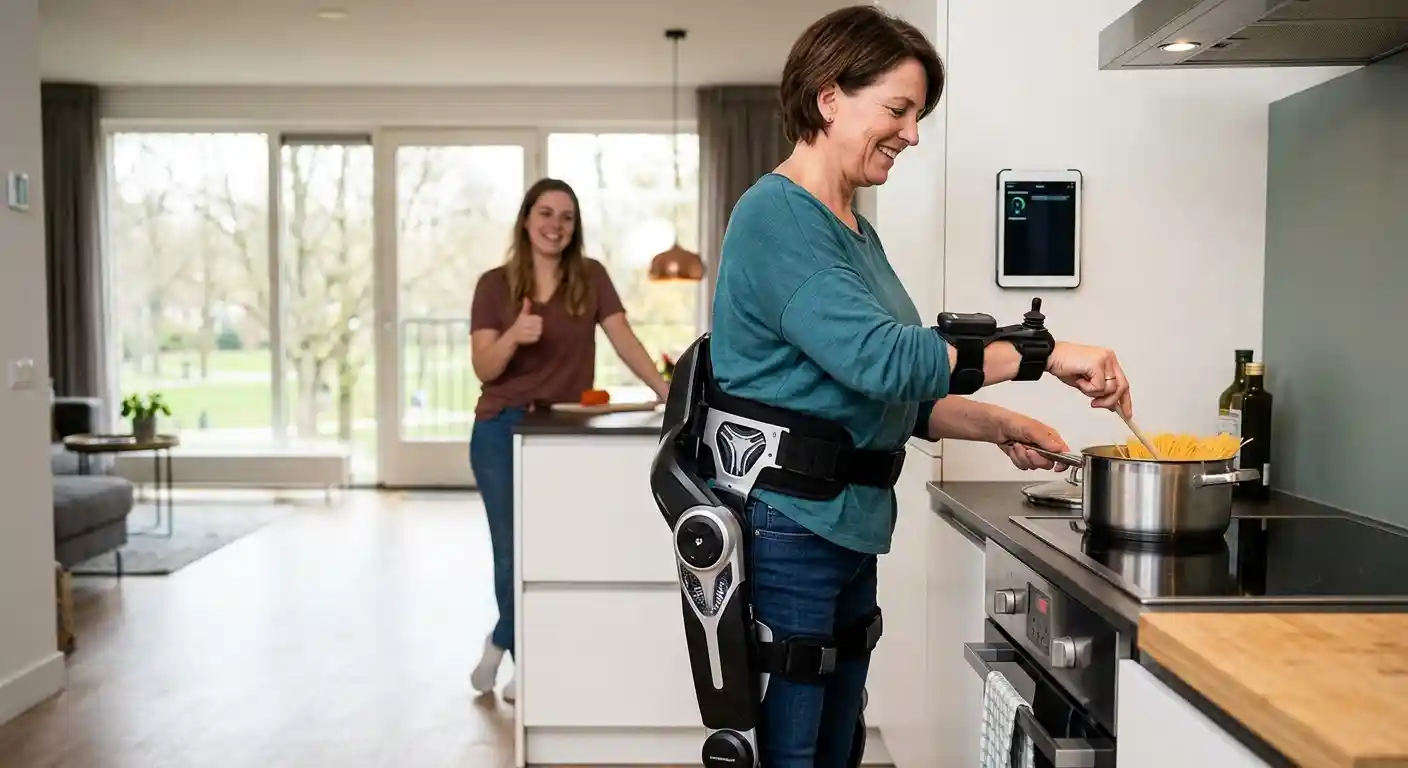
Because the system manages balance autonomously, users keep their hands completely free. You can cook at a kitchen counter, hold a coffee cup, or embrace a loved one at eye level—simple everyday interactions that traditional mobility aids prevent.
FDA Clearance and Expanding Patient Eligibility
Safety remains the single most critical factor for home-use medical robotics. The United States Food and Drug Administration granted clearance for the Wandercraft Eve exoskeleton, marking a historic milestone in personal mobility.
Crucially, Eve stands out as the first personal exoskeleton cleared without restrictive limits regarding the neurological level of spinal cord injury. Eligible adults operating the intuitive handheld controller can utilize the device regardless of thoracic or lumbar injury classification.
Before taking the device home, prospective candidates complete a specialized evaluation alongside a certified companion. This comprehensive training program ensures safe operation, seamless transfer techniques, and maximum confidence during daily tasks.
Reimagining Daily Life and Health Benefits
Regaining an upright posture offers profound physiological and psychological benefits extending far beyond simple locomotion. Prolonged wheelchair usage often leads to secondary health challenges, including reduced bone density, compromised cardiovascular circulation, severe muscle atrophy, and digestive issues.
Regular upright walking inside the Eve exoskeleton delivers vital physical therapy advantages:
- Improved Circulation: Vertical alignment enhances blood flow and reduces fluid retention in lower extremities.
- Enhanced Bone Density: Weight-bearing activity promotes skeletal strength and slows bone mineral loss.
- Functional Autonomy: Hands-free operation allows users to complete household chores, office duties, and social activities smoothly.
- Psychological Empowerment: Re-engaging with surroundings at eye level fosters emotional well-being and social connection.
By transforming clinical rehabilitation concepts into home mobility solutions, Wandercraft bridges the gap between specialized therapy centers and everyday living spaces.
Custom Fitting and Accessibility Pathways
Every human body features unique anatomical proportions and movement biomechanics. To ensure maximum safety and ergonomic alignment, technicians custom-fit each Eve exoskeleton to the individual user’s measurements, weight parameters, and mobility profiles.
Wandercraft collaborates closely with specialized rehabilitation networks, Assistive Technology Professionals (ATPs), and insurance providers to build viable reimbursement pathways. Qualified users can access coverage through Medicare, Veterans Affairs programs, workers’ compensation, and private healthcare insurance, making high-tech mobility hardware increasingly accessible.
The Future of Wearable Physical AI
The launch of Eve signals a transformative era in personal assistive robotics. As physical AI technology continues to evolve, future updates will offer refined terrain adaptation, smarter obstacle avoidance, and even lighter structural materials. Wandercraft’s dedicated focus on hands-free mobility transforms science fiction concepts into daily reality, offering millions of individuals newfound physical freedom and autonomy.