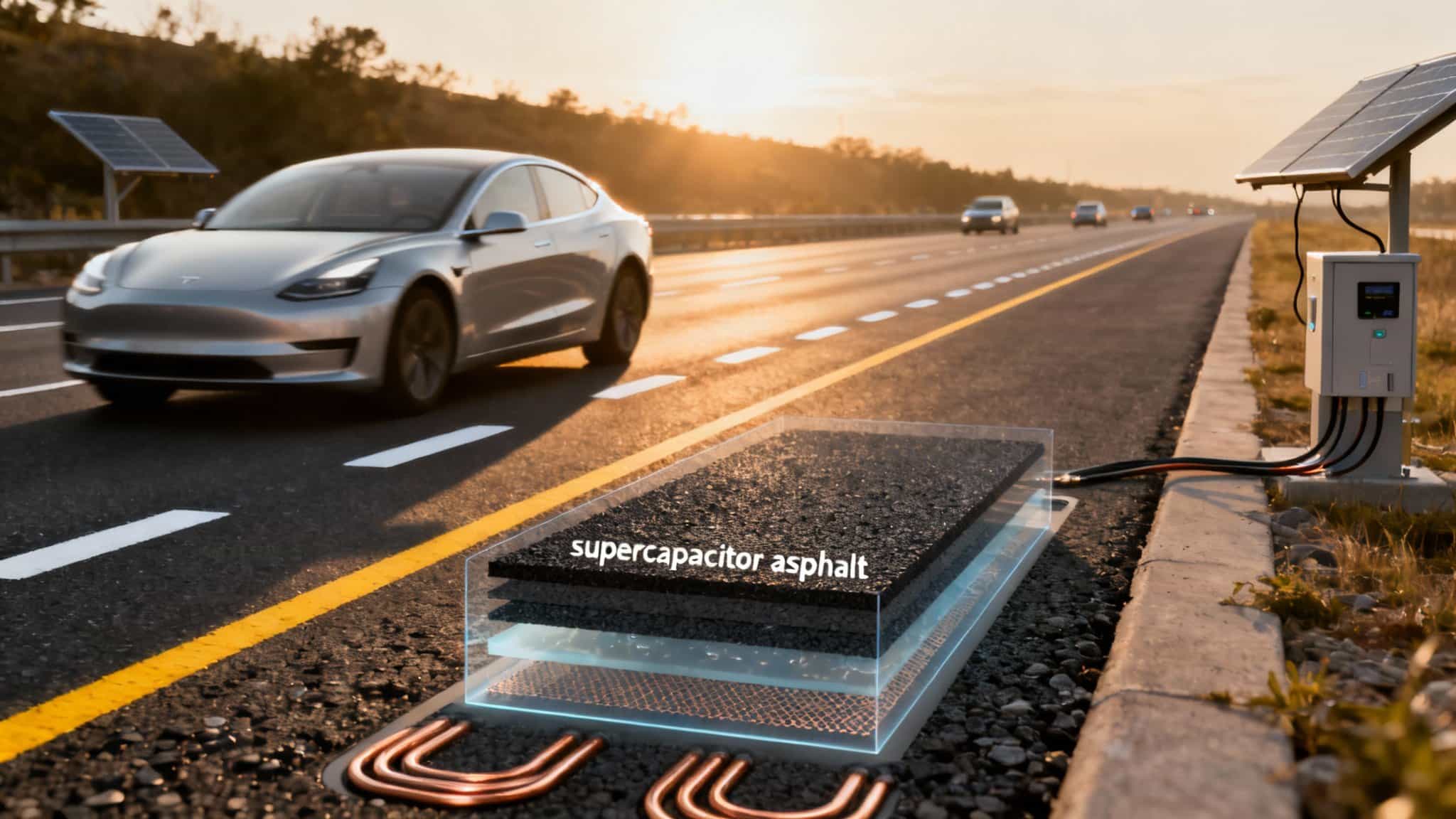

Imagine if every mile of roadway could double as a giant battery, charging electric vehicles, powering streetlights, and stabilizing the grid. This is the vision behind supercapacitor asphalt—an emerging materials innovation that blends asphalt pavements with energy-storing composites to create intelligent, load-bearing, grid-interactive surfaces. For the United States, where more than 4 million miles of roads form the backbone of the economy, converting pavement into distributed energy storage could be transformative. It could reduce peak demand, support renewable integration, enable wireless EV charging, and upgrade urban infrastructure without consuming new land. This article explains how supercapacitor asphalt works, the materials that make it possible, the engineering challenges, and the near-term applications that could make “energy-storing roads” a reality.
What Is Supercapacitor Asphalt?
Supercapacitor asphalt embeds electrochemical double-layer capacitors (EDLCs) or hybrid supercapacitors directly into pavement structures. A conventional supercapacitor stores energy through charge separation at the interface between an electrode and an electrolyte. In a road, the “device” is engineered as a layered system: conductive and dielectric layers, current collectors, and encapsulated electrolytes are integrated into asphalt mixtures or modular pavement segments. The result: a surface that provides mechanical performance for traffic while delivering fast charge–discharge cycles, high power density, and long cycle life—core hallmarks of supercapacitors.
Unlike batteries, supercapacitors don’t rely on slow chemical reactions. They charge quickly, deliver bursts of power, and can survive hundreds of thousands to millions of cycles with minimal degradation. While their energy density is lower than lithium-ion batteries, their power density, cycle life, and safety profile make them ideal for applications such as regenerative braking capture, roadway-powered smart lighting, and smoothing intermittent solar output from roadside photovoltaics.


How It Works: Materials and Design
- Conductive asphalt composites:
- Carbon-based fillers such as graphene, reduced graphene oxide, carbon nanotubes (CNTs), carbon black, or biochar are dispersed within asphalt binder or mastic to form percolated networks that conduct electrons.
- The challenge is achieving percolation without sacrificing rheological properties. Too much filler can embrittle the mix or reduce fatigue resistance; too little won’t conduct.
- Electrode architecture:
- Porous carbon electrodes maximize surface area for charge storage. In pavement, these can be realized as conductive layers or inserts with hierarchical porosity.
- Hybrid designs may use pseudocapacitive materials (e.g., MnO₂, Ti₃C₂ MXenes, or conductive polymers) to boost energy density while keeping high power.
- Electrolytes and encapsulation:
- Solid-state or gel polymer electrolytes (e.g., PVA/H₃PO₄ gels, ionic gels) are favored to avoid leakage and to withstand thermal cycling.
- Encapsulation and moisture barriers are critical to cope with freeze–thaw cycles, de-icing salts, and water ingress.
- Current collectors and interconnects:
- Corrosion-resistant, flexible collectors (stainless steel meshes, aluminum foils, conductive fabrics) are embedded to interface with roadside power electronics.
- Modular pavement panels can include plug-and-play interconnects for maintenance.
- Structural integration:
- Energy-storing layers are placed below the wearing course to protect them from rutting and direct tire abrasion while staying close enough for inductive coupling.
- Finite element modeling ensures that mechanical stresses from heavy vehicles do not fracture electrodes or delaminate layers.
Why the U.S. Market Cares
- Grid resilience and peak shaving: Supercapacitor roads can store off-peak energy and discharge during spikes, lowering demand charges for municipalities and DOTs.
- EV infrastructure acceleration: Coupled with wireless inductive charging coils, energy-storing pavements can buffer power to deliver high bursts to EVs without oversizing the grid connection.
- Renewable integration: Roads adjacent to solar canopies or median-mounted PV arrays can buffer intermittency and support microgrids at rest areas, truck stops, and park-and-ride lots.
- Smart cities: Power roadside IoT, sensors, and adaptive LED lighting locally, minimizing trenching and cabling.
- Climate and sustainability: Use recycled carbon (e.g., pyrolyzed tire char) and industrial byproducts to enhance conductivity and sustainability metrics.
Performance Metrics That Matter
When evaluating supercapacitor asphalt for U.S. deployments, stakeholders should look at:
- Areal and volumetric capacitance: How much charge per unit area/volume. Typical targets may range from tens to hundreds of mF/cm² depending on architecture.
- ESR (equivalent series resistance): Lower ESR enables higher power output and faster charging—critical for inductive road segments.
- Cycle life: Aim for >500,000 cycles to match long-term pavement maintenance schedules.
- Mechanical integrity: Rutting resistance (Hamburg), fatigue life (four-point bending), moisture susceptibility (TSR), and thermal cracking (SCB) must remain within DOT specs.
- Thermal stability: Asphalt can reach >60°C in summer; electrolytes and polymers must maintain performance across -30°C to 80°C ranges in many U.S. climates.
- Safety and fire behavior: Solid/gel electrolytes and non-flammable materials improve safety over battery-embedded pavements.
Engineering and Construction Considerations
- Mix design optimization:
- Balance conductive filler dosage with polymer-modified binders to maintain workability and durability.
- Use anti-stripping agents and compatibilizers to keep conductive networks intact.
- Layered assembly:
- Construct a sandwich of conductive layers separated by dielectric/gel electrolytes, then capped with a wear course for skid resistance.
- Alternatively, deploy precast, energy-storing modules set within the roadway, enabling factory QA/QC.
- Power electronics and controls:
- Bidirectional inverters, DC/DC converters, and smart controllers manage charge–discharge cycles, grid sync, and inductive load management.
- Cybersecurity and metering support utility programs and monetization.
- Maintenance and life-cycle:
- Design for modular replacement: damaged panels can be swapped without milling entire lanes.
- Monitor state-of-health via embedded sensors that measure capacitance drift and ESR changes over time.
Use Cases Rolling Out First
- Smart corridors and bus lanes: Capture regenerative braking from electric buses via conductive pads and discharge to assist acceleration.
- Truck stop electrification: Store off-peak energy to power anti-idling systems, refrigeration, and overnight EV charging.
- Airport pavements: Supply peak loads to ground support equipment or runway lighting during storms.
- University and corporate campuses: Demonstration microgrids linking rooftop PV, supercapacitor pathways, and EV shuttles.
- Urban lighting: Power adaptive LEDs, pedestrian crossings, and signage, reducing cabling and trenching costs.
Economics and Policy Levers in the U.S.
- Cost drivers: Advanced carbons (graphene/CNTs) are expensive; using recycled carbon fillers and scalable manufacturing (slurry casting, spray deposition) reduces costs.
- Value stacking: Combine demand charge reduction, capacity payments, frequency regulation, and avoided infrastructure upgrades to build a bankable business case.
- Federal and state programs: Infrastructure grants, grid modernization funds, and clean transportation incentives can support pilots. DOT public–private partnerships (P3s) can accelerate deployment along high-visibility corridors.
- Standards and certification: Collaboration with AASHTO, FHWA, and utilities will be vital to define test methods and interconnection standards for energy-storing pavements.
Sustainability and Circularity
- Reclaimed asphalt pavement (RAP) can be combined with conductive fillers to reduce embodied carbon.
- Tire-derived carbon and biochar add conductivity while sequestering carbon.
- End-of-life recyclability: Designing electrodes and electrolytes for separability will enable future recycling streams and lower TCO.
Challenges to Overcome
- Durability under heavy loads and harsh climates must be proven over multi-year trials.
- Moisture and salt ingress can degrade electrochemical performance—robust encapsulation is essential.
- Balancing conductivity with mechanical performance remains a core materials science challenge.
- Standardized safety, testing, and utility interconnection protocols are still emerging.
- Public acceptance and permitting for inductive charging lanes require clear evidence of safety and EMF compliance.
Roadmap: From Pilots to Scale
- Lab-scale optimization: Tune filler content, binder modifiers, and gel electrolytes for U.S. climate bands.
- Full-depth test slabs: Validate structural performance under accelerated loading and environmental chambers.
- Microgrid pilots: Pair with PV canopies at rest areas for real-world charge–discharge cycling.
- Inductive segments: Short wireless charging stretches on bus routes or logistics hubs, with robust metering and billing.
- Scale-out toolkits: Publish design guides, specs, and LCCA models for DOTs and EPCs to bid with confidence.
Bottom Line
Supercapacitor asphalt won’t replace large grid batteries, but it can complement them by delivering safe, fast, localized power where the loads actually are: on the road. For U.S. cities, campuses, airports, and logistics corridors, energy-storing pavements offer a practical path to smarter infrastructure—without carving out new land or building bulky enclosures. With the right materials, encapsulation strategies, and standards, America’s roads can evolve from passive pathways into active, resilient energy assets.