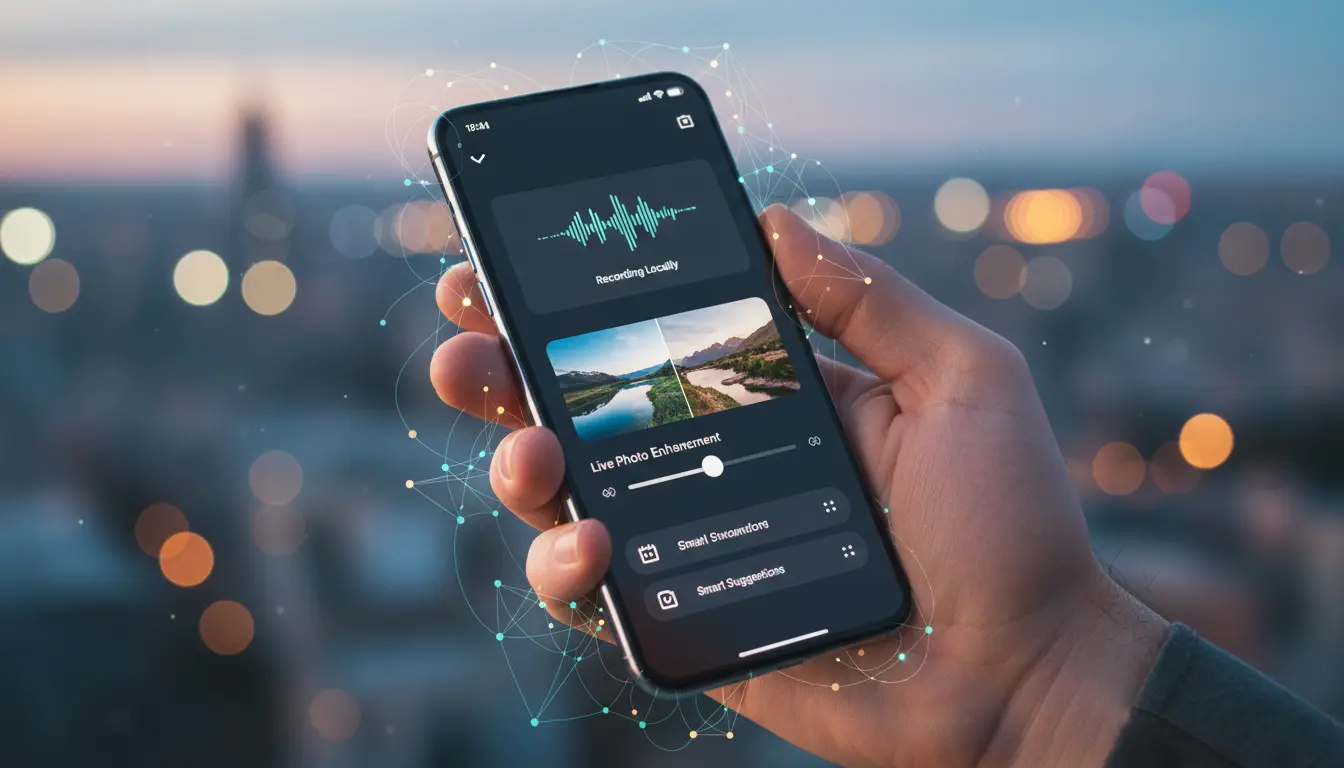

The Benefits of On-Device AI: Why Mobile AI Is Moving From the Cloud to Your Phone
As smartphones evolve into powerful personal computing hubs, artificial intelligence is shifting closer to where data is created: the device itself. On-device (or “edge”) AI runs models locally on a phone, tablet, or wearable rather than sending data to the cloud. This shift is unlocking faster experiences, greater privacy, lower costs, and new capabilities that weren’t feasible with a network connection in the loop. In this article, we’ll explore how on-device AI works, why it matters for performance and privacy, what it enables for battery and cost efficiency, and how developers and businesses can leverage it today for better user experiences and organic growth.
What is On-Device AI?
On-device AI refers to machine learning models—like large language models (LLMs), speech recognition, image segmentation, and recommendation engines—executed directly on a user’s hardware. Thanks to specialized neural processing units (NPUs), GPU acceleration, optimized runtimes, and quantization techniques, today’s mobile chipsets can run sophisticated models at low latency. Rather than uploading audio, images, or text to remote servers, the device processes them locally, often in milliseconds.
Typical on-device AI workloads include:



- Real-time text generation and summarization
- Voice assistants with offline command handling
- Live image and video processing (e.g., object detection, background blur)
- Predictive typing and personalized recommendations
- Health and fitness signal analysis from wearables
- Privacy-preserving analytics and context inference
Key Benefits of On-Device Models
- Speed and Responsiveness
Latency is the enemy of user experience. Cloud round-trips add unpredictable delay and jitter, especially on congested networks or in low-signal environments. On-device inference eliminates the network hop, enabling instantaneous feedback for typing suggestions, camera enhancements, and voice interactions. Faster responses translate directly to higher engagement, more frequent feature use, and better app store ratings. - Privacy and Data Sovereignty
When data never leaves the device, the privacy risk surface shrinks. On-device AI minimizes exposure of personal photos, voice samples, biometrics, and location traces. This not only builds user trust but also reduces compliance overhead with regulations like GDPR or CCPA. For sensitive domains—health, finance, education—keeping data local can be a decisive competitive advantage. - Reliability and Offline Use
On-device models keep working when the network doesn’t. Whether users are on a plane, underground, or traveling internationally, the core AI experience remains available. Offline resilience improves retention and differentiates apps that otherwise depend on back-end availability or bandwidth.
other
- Cost Efficiency and Scalability
Cloud inference can be expensive at scale. Running AI locally shifts the compute to the user’s device, reducing server costs and dependency on GPU capacity. For startups and established publishers alike, hybrid or on-device-first strategies can dramatically lower unit economics, especially for high-frequency tasks like keyboard suggestions or real-time vision processing. - Personalization Without Centralization
On-device models can continuously learn from user interactions while keeping training signals local. Techniques like federated learning and on-device fine-tuning allow personalization to happen at the edge. Users get experiences tailored to their behavior, dialect, schedule, and preferences—without uploading raw data to central servers. This improves relevance while reinforcing privacy. - Energy Awareness and Battery Life
Modern mobile NPUs and software stacks are optimized for efficient inference. Quantization (e.g., int8, int4), operator fusion, sparsity, and adaptive scheduling reduce power draw. For always-on experiences like wake-word detection or proactive suggestions, on-device inference can be more energy-friendly than constant networking and radio wake-ups. - Regulatory and Ethical Alignment
By design, on-device AI reduces cross-border data transfer and limits third-party access to user data. This architectural choice simplifies compliance and aligns with the growing ethical expectations around data minimization, purpose limitation, and user control.
How On-Device AI Works Under the Hood
- Model Compression: Distillation, pruning, and quantization shrink models to fit memory and run efficiently, often with minimal accuracy loss.
- Hardware Acceleration: NPUs and GPUs accelerate matrix multiplications and convolution operations.
- Runtime Optimizations: Frameworks and compilers (e.g., NNAPI, Core ML, Metal, Vulkan, ONNX Runtime Mobile) map models to hardware for optimal throughput and latency.
- Incremental Updates: Delta packages update models without re-downloading full binaries, saving bandwidth.
- Hybrid Orchestration: Systems dynamically decide whether to run locally or in the cloud based on battery level, thermals, network quality, and user settings.
Use Cases That Shine on Device
- Camera and AR: Real-time HDR, scene detection, de-noising, portrait mode, and AR object tracking benefit from ultra-low latency.
- Voice Assistants: Wake-word spotting, command parsing, and offline dictation reduce delay and improve reliability.
- Messaging and Productivity: Autocomplete, grammar checks, translation, and summarization become instantaneous, improving flow.
- Accessibility: On-device captioning, object recognition for low-vision users, and gesture detection are more responsive and private.
- Health and Wellness: Signal processing for heart rate variability, respiratory patterns, and activity classification respects user privacy while providing timely feedback.
- Security: On-device biometrics, liveness detection, and fraud signals reduce attack surfaces and network dependencies.
SEO Impact: Why On-Device AI Supports Organic Growth
On-device AI can directly influence SEO and broader organic acquisition by improving user satisfaction metrics that search engines and app stores observe:
- Lower Bounce Rates: Faster interactions reduce friction.
- Higher Engagement Time: Real-time features keep users exploring.
- Better Ratings and Reviews: Privacy-preserving and reliable experiences drive positive feedback.
- Reduced Churn: Offline functionality sustains value across contexts, improving retention cohorts.
From a content strategy perspective, emphasize benefits users feel: speed, privacy, reliability. Align landing pages and blog content with informational intent keywords about on-device AI, edge inference, privacy-friendly ML, and mobile performance. Include schema markup for FAQs, leverage clear internal linking to technical pages, and publish case studies quantifying latency and cost savings.
Implementation Tips for Product Teams
- Start Hybrid: Run lightweight tasks on device and fall back to cloud for heavy lifting.
- Measure Latency Budgets: Track P50/P95 inference times on representative devices, not just flagships.
- Prioritize Privacy UX: Offer clear controls for on-device personalization and data usage.
- Optimize Models Early: Quantize and distill during development; design around memory and thermals.
- Guardrails and Safety: Implement on-device moderation for prompts and outputs where relevant.
- A/B Test Impact: Validate that on-device features move engagement, retention, and CSAT.
The Road Ahead
As NPUs become standard and toolchains mature, more AI workloads will move to the edge. Expect tighter loops between sensing and reasoning, richer multimodal interactions, and privacy-first personalization as the default. The most compelling mobile experiences will be those that feel instant, trustworthy, and available anywhere—exactly what on-device AI delivers.
Conclusion
On-device AI transforms mobile experiences by combining speed, privacy, reliability, and efficiency. For users, it feels magical; for businesses, it’s a strategic lever that improves economics and organic growth. Adopting an on-device-first mindset—augmented by cloud where it adds value—positions products for the next wave of AI-native mobile.