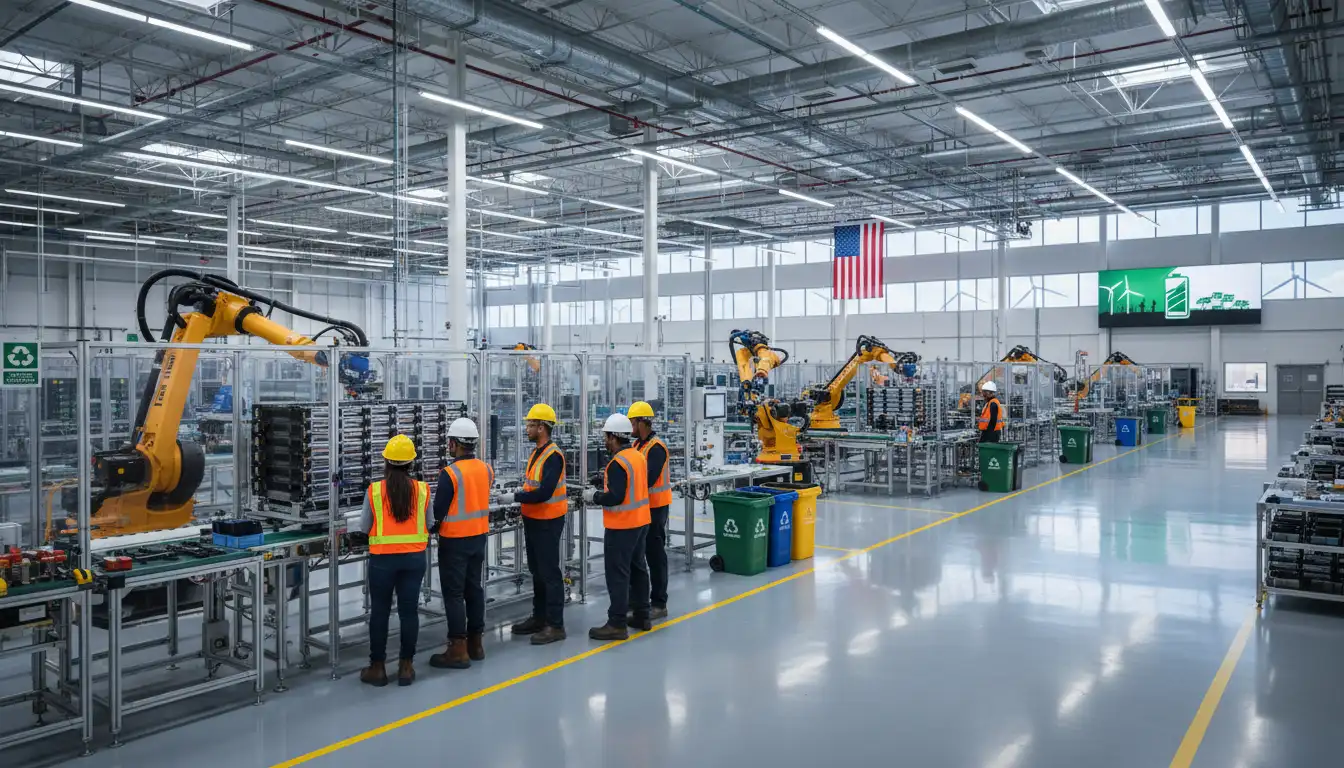

How the Inflation Reduction Act Is Reshaping EV Battery Manufacturing in the US
The Inflation Reduction Act (IRA) is doing far more than tweaking tax policy or nudging climate targets. It is fundamentally rewiring where and how electric vehicle (EV) batteries are made, and which companies will lead the next generation of automotive manufacturing. For the first time, the United States has combined climate ambition with long‑term industrial strategy, using powerful financial incentives to pull the entire EV battery supply chain back home.
In this article, we’ll look at how the IRA’s incentives work, how they are changing investment decisions, what this means for supply chains and jobs, and where the biggest opportunities and challenges still lie.
From Climate Bill to Industrial Policy
Before the IRA, much of the world’s EV battery production was concentrated in East Asia, especially China, South Korea, and Japan. Automakers in the US relied heavily on imported battery cells and critical minerals, leaving them exposed to geopolitical risks, shipping bottlenecks, and price volatility. The IRA tackles this problem head‑on by linking generous tax credits to strict “made in North America” and “friend‑shored” requirements.



The law shifts the narrative from simply subsidizing EV purchases to building an entire domestic ecosystem. Instead of only making EVs cheaper at the dealership, the IRA rewards the companies that mine, process, assemble, and recycle battery materials in the US and its allied countries. That approach marks a clear turn toward industrial policy: using public money to shape where private capital flows.
How EV Tax Credits Drive Battery Location Decisions
The most visible part of the IRA for consumers is the clean vehicle tax credit, worth up to \$7,500 per qualifying EV. But behind that single number is a complex set of rules that directly affect EV battery manufacturing.
To qualify for the full credit:
- A growing share of battery components must be manufactured or assembled in North America.
- An increasing share of critical minerals (like lithium, nickel, and cobalt) must be extracted or processed in the US or in countries that have free‑trade agreements with the US.
- None of the key materials or components can come from “foreign entities of concern,” a category that effectively excludes certain Chinese suppliers.
These conditions force automakers and battery producers to ask a new question: not simply “Where is it cheapest to produce?” but “Where can we produce and still unlock the IRA incentives?” As a result, manufacturing projects that might once have gone to other regions are now being planned and built in the US, Canada, and Mexico.
A Surge in US Battery Plant Announcements
Since the IRA’s passage, there has been a wave of announcements for new gigafactories and EV battery facilities across the United States. Automakers and battery specialists are:
- Building joint‑venture plants near major vehicle assembly hubs.
- Expanding existing facilities to increase cell and pack production.
- Planning new lines dedicated to lithium‑ion and next‑generation chemistries such as LFP (lithium iron phosphate).
States in the Midwest and the South are competing aggressively for these investments, offering their own incentives on top of the IRA’s federal benefits. This clustering effect creates regional EV “hubs” where component suppliers, recyclers, and research centers grow around anchor factories, further reinforcing the domestic manufacturing ecosystem.
Strengthening and Shortening the EV Supply Chain
One of the biggest vulnerabilities in the pre‑IRA EV landscape was the long, fragile, globally stretched supply chain. Batteries often traveled thousands of miles from mineral extraction sites to refiners to cell plants and finally to vehicle assembly lines. The IRA aims to shorten and secure this chain in several ways:
- Encouraging upstream investment
By tying tax credits to the origin of critical minerals, the IRA makes it more attractive to:- Open or expand lithium and nickel mines in the US.
- Develop refining and processing capacity that previously existed mainly abroad.
- Deepen partnerships with allied countries rich in battery minerals.
- Localizing midstream processing and cell production
Companies that invest in US cathode, anode, electrolyte and separator production gain a strategic advantage. Automakers want to meet IRA requirements, and relying on local suppliers simplifies compliance, logistics, and risk management. - Supporting recycling and circularity
The act indirectly encourages battery recycling, because recovered materials can count toward domestic content thresholds. This creates a strong business case for recycling companies and reduces long‑term dependence on virgin mining.
Overall, the EV battery supply chain becomes not only greener, but also more resilient and less exposed to disruptions.
Job Creation and Workforce Transformation
The IRA is also reshaping the labor landscape in US manufacturing. Large‑scale EV battery plants and related facilities are projected to create tens of thousands of jobs in:
- Advanced manufacturing and automation
- Engineering, quality control, and R&D
- Construction and facility maintenance
- Logistics and supply chain management
However, the transition is not just about the number of jobs, but their quality and required skill sets. Battery manufacturing is capital‑intensive and highly technical, demanding new training programs, apprenticeships, and partnerships between industry, unions, and educational institutions. Regions with a strong history in traditional auto manufacturing now have an opportunity to modernize and retain their industrial identity by shifting from engines and transmissions to cells, packs, and power electronics.
Technological Innovation and Next‑Generation Batteries
Because the IRA incentives are long‑term, they give companies confidence to invest in new battery technologies, not just replicate today’s designs. This can accelerate innovation in:
- Solid‑state batteries, which promise higher energy density and improved safety.
- LFP chemistries, which reduce reliance on expensive and geopolitically sensitive materials like cobalt and nickel.
- Manufacturing efficiency, including automation, high‑throughput coating, and advanced quality control systems.
As a large and stable domestic market rapidly takes shape around EVs and clean energy, universities, national labs, and startups are actively turning research into commercial deployment.
Challenges and Unresolved Questions
Despite its transformative potential, the IRA does not remove every obstacle. Companies still face:
- Permitting and regulatory delays for new mines and industrial facilities.
- Community concerns about land use, environmental impacts, and local infrastructure.
- Global trade tensions, as other regions respond with their own industrial policies and may challenge IRA provisions at international forums.
Policymakers and industry leaders are actively debating how fast the workforce can retrain and whether smaller suppliers can keep pace with the rapid shift in technology and policy. Regenerate using: Nonetheless, the overall direction is clear: the IRA has tilted the playing field decisively toward domestic, low‑carbon production.
What the IRA Means for the Future of EV Batteries in the US
Taken together, the Inflation Reduction Act is reshaping EV battery manufacturing in the US along three key dimensions:
- Location – More of the value chain, from raw materials to final packs, is being anchored in North America.
- Resilience – Shorter, more diversified supply chains reduce dependency on a single country or region.
- Innovation – Stable, long‑term incentives encourage companies to invest in new chemistries, recycling, and advanced manufacturing methods.
For automakers, battery producers, and suppliers, the IRA is no longer just a piece of legislation to comply with. It is a strategic framework that determines where they invest, whom they partner with, and how competitive they will be in a rapidly electrifying global market.
As EV adoption accelerates, countries that control battery technology and production capacity will shape the future of transportation and clean energy. By combining climate goals with industrial strategy, the Inflation Reduction Act is positioning the United States to be one of those leaders.